Please wait a minute...
科技与出版  2025, Vol. 44 Issue (5): 89-97    
出版育英
深度融合发展背景下的出版人才协同培养研究——基于四螺旋理论的分析
韩韶君1,2,张馨元1,陈瑞瑶1,王美玲1
1. 北京印刷学院新闻传播学院,102600,北京
2. 北京文化产业与出版传媒研究基地,102600,北京
Research on Collaborative Cultivation of Publishing Talents in the Context of Deep Integration and Development: An Analysis Based on the Quadruple Helix Theory
HAN Shaojun1,2,ZHANG Xinyuan1,CHEN Ruiyao1,WANG Meiling1
1. School of Journalism and Communication, Beijing Institute of Graphic Communication, 102600, Beijing, China
2. Beijing Cultural Industry and Publishing Media Research Base, 102600, Beijing, China
全文: HTML    PDF(10409 KB)  
输出: BibTeX | EndNote (RIS)      
摘要: 

深度融合发展背景下的传统出版人才培养在出版学学科建设、人才质量提升、主体协同合作等方面存在困境,亟需以坚定思想观念,确保融合发展方向正确;提升技能素养,融入数字出版全新业态;具备前瞻思维,主动把握市场需求变动为目标,培养高质量出版人才服务社会主义文化强国和出版强国建设。本文基于四螺旋理论提出融通政产学研用的出版人才协同培养路径,认为政府作为主导者应发挥治理作用,完善政策与资源配置;高校作为培育者应担当教研责任,创新校内校外资源改革;企业作为孵化者要加强实践培育,促进就业对接与创新培养、用户作为反馈者可强化体验评价,深化反馈效能与生态维护。

关键词 出版深度融合人才协同培养四螺旋理论    
Abstract

Under the context of deep integration development, challenges in cultivating traditional publishing talents emerge in three aspects: fristly, ambiguous disciplinary boundaries and weak academic impetus in discipline systems; secondly, deficiencies in professional expertise, digital literacy, and occupational competencies; thirdiy, insufficient strategic coordination among training entities and constraints from conventional mechanisms.To address these challenges, three strategic approaches are imperative. First, ideological reinforcement through upholding correct political values ensures appropriate development orientation. Second, skills enhancement should focus on cultivating professional excellence, digital proficiency, and ethical standards to adapt to digital publishing ecosystems. Third, fostering forward-thinking capabilities—including market sensitivity and global vision—enables proactive responses to industrial transformations.These measures collectively contribute to building China's cultural and publishing leadership. The cultivation framework must integrate political awareness with technological competencies, traditional expertise with digital innovation, and local practices with international perspectives. Establishing collaborative mechanisms among educational institutions, industries, and regulators will optimize talent supply-demand alignment,synchronize knowledge updates with technological advancements, and bridge academic training with market needs. Ultimately, this systematic approach supports the development of sustainable talent pipelines, crucial for achieving national strategic goals in cultural and publishing sector advancement. Based on the four-helix theory, this study proposes a collaborative cultivation path for publishing talents that integrates government, industry, academia, research and utilization, and in the interaction, we have formed the role position of “government-led, university cultivation, enterprise incubation and user feedback”, and established the cultivation chain of “governance-teaching-research-practice-experience”. Within the framework of the four-helix innovation model, the cultivation of publishing talents is structured around four core stakeholders—government, publishing universities, publishing enterprises, and users—forming interconnected cultivation chain and collaborative space through complementary cooperation. This stakeholder synergy establishes intersecting collaborative relationships where each actor assumes distinct yet interdependent roles: The government, as the macro-level coordinator, allocates resources within the holistic talent cultivation ecosystem, fostering strategic partnerships between publishing universities and enterprises to drive technological innovation and educational reform. Publishing universities serve as the theoretical foundation, delivering disciplinary knowledge and research-oriented training, while enterprises act as practical incubators, translating academic outputs into industry-ready solutions through applied R&D and professional internships. Meanwhile, end-users of publishing products—readers, digital content consumers, and market stakeholders—provide critical feedback by engaging with products, generating experiential data that informs curriculum design, skill requirements, and industry standards. This user-driven feedback loop enriches training practices, ensuring alignment between educational objectives and real-world market demands.

Key wordsKeyword deep integration of publishing    collaborative cultivation of publishing talents    quadruple helix theory
出版日期: 2025-06-05
基金资助:2025年度北京印刷学院本科教育教学改革专项教改创新重点项目“基于AI内容风控平台的出版交叉学科实践教学体系建设研究”;北京文化产业与出版传媒研究基地建设项目(KYCPT202501);2025年度北京印刷学院学科建设与研究生教育专项“基于AI内容风控平台的出版交叉学科研究生培养研究”;北京印刷学院平台建设项目(KYCPT202514)

引用本文:

韩韶君,张馨元,陈瑞瑶,王美玲. 深度融合发展背景下的出版人才协同培养研究——基于四螺旋理论的分析[J]. 科技与出版, 2025, 44(5): 89-97.
HAN Shaojun,ZHANG Xinyuan,CHEN Ruiyao,WANG Meiling. Research on Collaborative Cultivation of Publishing Talents in the Context of Deep Integration and Development: An Analysis Based on the Quadruple Helix Theory. Science-Technology & Publication, 2025, 44(5): 89-97.

链接本文:

http://kjycb.tsinghuajournals.com/CN/      或      http://kjycb.tsinghuajournals.com/CN/Y2025/V44/I5/89

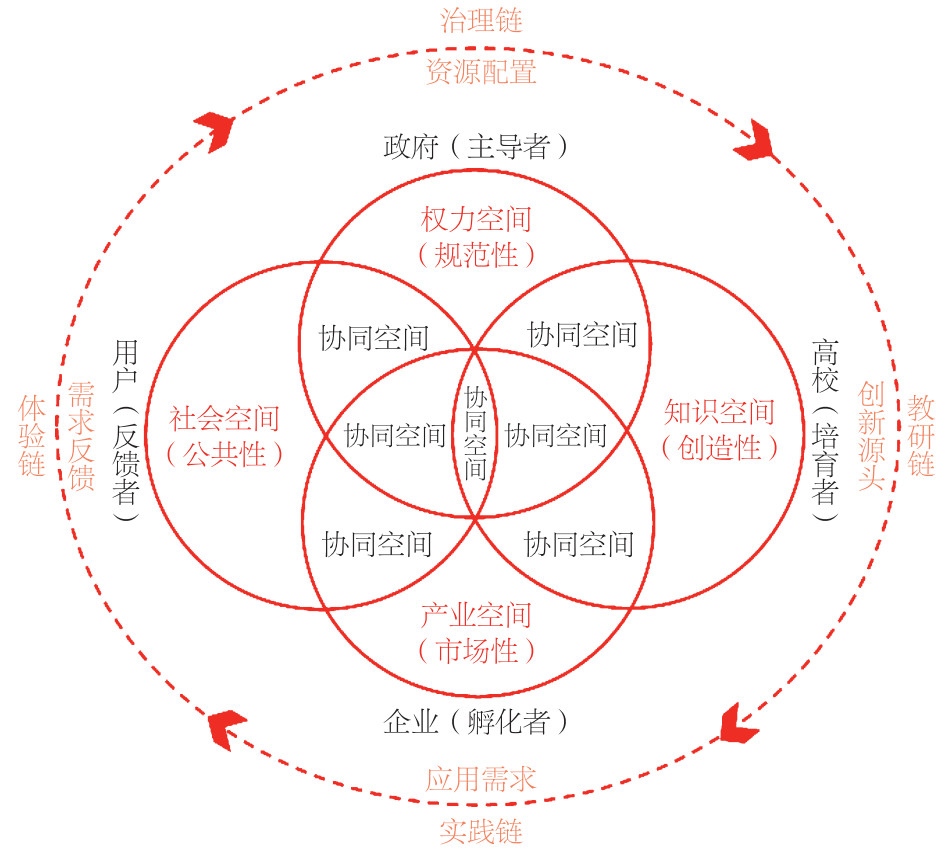
图 1  出版人才协同培养四螺旋运作机理图
1 中共中央宣传部. 关于推动出版深度融合发展的实施意见[J]. 中国出版, 2022 (9): 13- 15.
doi: 10.3969/j.issn.1002-4166.2022.09.005
2 罗志丹, 陈文雄. 深度融合视域下出版人才培养的行动框架研究[J]. 辽宁师范大学学报(自然科学版), 2024, 47 (4): 569- 576.
3 黄先蓉, 李若男. 我国出版学科建制化:历程、困境与进路[J]. 出版广角, 2021 (18): 30- 34.
4 崔海教, 王平, 徐升国, 等. 出版人才队伍建设的现状、问题及建议[J]. 中国出版, 2025 (4): 10- 14.
doi: 10.3969/j.issn.1002-4166.2025.04.003
5 黄先蓉, 严贝贝. 学科共建背景下出版人才协同培养的路径研究[J]. 出版广角, 2023 (4): 10- 15.
6 中共中央宣传部印发《关于推动出版深度融合发展的实施意见》的通知.(2022-04-24)[2025-03-15]. https://www.nppa.gov.cn/nppa/contents/279/103878.shtml.
7 李文娟. “十四五”时期我国出版人才队伍建设回顾与“十五五”展望[J]. 科技与出版, 2025 (1): 39- 47.
8 CARAYANNIS E G , CAMPBELL D F J . “Mode3”and “Quadruple Helix”:toward a 21st century fractal innovation ecosystem[J]. International Journal of Technology Management, 2009, 46 (3/4): 201- 234.
doi: 10.1504/IJTM.2009.023374
9 黄瑶, 马永红, 王铭. 知识生产模式Ⅲ促进超学科快速发展的特征研究[J]. 清华大学教育研究, 2016, 37 (6): 37- 45.
10 陈涛, 韩茜. 四螺旋创新集群:研究型大学人工智能发展生态重构与路向探究:以加拿大多伦多大学为例[J]. 重庆高教研究, 2020, 8 (2): 48- 61.
11 田凤权, 李虹. 基于四螺旋模式下创新创业教育与专业教育融合机理研究[J]. 沈阳工程学院学报(社会科学版), 2022, 18 (4): 103- 107.
12 郑志亮, 田胜立, 李忆箫. 融合发展守正创新:新时代出版行业与人才培养[J]. 出版广角, 2022 (2): 6- 10.
13 CARAYANNIS G E , CAMPBELL F D . Triple Helix,Quadruple Helix and Quintuple Helix and How Do Knowledge,Innovation and the Environment Relate To Each Other?:A Proposed Framework for a Trans-disciplinary Analysis of Sustainable Development and Social Ecology[J]. International Journal of Social Ecology and Sustainable Development(IJSESD), 2010, 1 (1): 41- 69.
doi: 10.4018/jsesd.2010010105
14 出版业“十四五”时期发展规划[EB/OL].(2021-12-30)[2025-03-15]. https://www.nppa.gov.cn/xxfb/tzgs/202112/P020221129376042550150.pdf.
15 李治堂. 深入贯彻二十届三中全会精神推进出版业高质量发展[J]. 北京印刷学院学报, 2024, 32 (8): 1- 5.
16 李文娟. “十四五”时期我国出版人才队伍建设回顾与“十五五”展望[J]. 科技与出版, 2025 (1): 39- 47.
17 戚德祥, 王壮. 新文科背景下出版学科专业共建探讨[J]. 出版广角, 2024 (16): 47- 54.
18 李永强. 新时代出版人才培养体系构建的策略研究[J]. 出版发行研究, 2024 (7): 35- 43.
19 万安伦, 黄一玫. 学科交叉融合背景下的出版人才培养:历史、困境、路径[J]. 科技与出版, 2023 (1): 22- 30.
20 李雅筝, 刘洪权. AIGC技术赋能高校编辑出版人才培养:转型机遇、能力重构与实践策略[J]. 科技与出版, 2024 (2): 52- 57.
21 余来辉. 新业态下出版硕士专业学位人才培养现状与对策研究:基于26所高校培养方案的内容分析[J]. 出版发行研究, 2022 (3): 13- 19.
doi: 10.3969/j.issn.1001-9316.2022.03.004
22 张霞. 数字智能时代出版社知识生产创新与服务升级研究[J]. 出版广角, 2023 (14): 43- 47.
23 李婷, 韩建民. 基于双三螺旋理论的主题出版人才培养模式探究[J]. 科技与出版, 2024 (6): 121- 129.
24 方宁, 崔波. 出版人才培养体系重构研究:基于融合出版2.0时代的技术驱动与业态变革[J]. 出版广角, 2025 (2): 75- 81.
25 长江出版传媒联合武汉大学举办2019编辑营销骨干培训班[EB/OL].(2019-07-02)[2025-03-15]. https://www.600757.com.cn/contents/198/18254.html.
26 张窈, 张慧敏. 深度融合发展背景下面向行业实践的出版人才培养[J]. 出版与印刷, 2024 (4): 93- 102.
27 国家新闻出版署,人力资源社会保障部. 出版专业技术人员继续教育规定[EB/OL].(2020-09-29)[2025-04-20]. https://www.nppa.gov.cn/xxfb/zcfg/gfxwj/201012/t20101206_4448.html.
28 杨凡, 申骅. 能力匹配视角下的出版人才持续培养路径探析:从员工培训入手[J]. 传媒论坛, 2024, 7 (17): 107- 110.
29 王壮. 深化出版业体制机制改革,推动构建更有效力的国际传播体系[J]. 出版发行研究, 2025 (2): 21- 28.
doi: 10.3969/j.issn.1001-9316.2025.02.004
30 锦传银. 发展新质生产力背景下的新型出版人才培养[J]. 出版广角, 2024 (21): 65- 69.
31 姚小玲, 杨帅. 出版服务视角下出版人才的培养思考[J]. 科技与出版, 2022 (1): 128- 132.
[1] 王勇安,王昭. 范式演进、底层逻辑与建构原则*[J]. 科技与出版, 2024, 43(7): 132-140.
[2] 李子星,张新新,李佰珏. 数字出版十大学术热点分析*[J]. 科技与出版, 2024, 43(4): 99-111.
[3] 陈伊高,黄楚新. 人工智能技术与出版深度融合的焦点透视与趋势展望*[J]. 科技与出版, 2024, 43(4): 112-120.
[4] 张新新,周静虹,陈少志,王健. 全媒体传播体系视角的出版深度融合发展指数研究*[J]. 科技与出版, 2024, 43(3): 75-89.
[5] 王勇安,李都. 出版深度融合的文化意蕴与实践逻辑*[J]. 科技与出版, 2024, 43(2): 63-70.
[6] 刘骐荣,张新新. 全媒体出版传播体系视域的融合出版新模式研究*[J]. 科技与出版, 2024, 43(10): 69-79.
[7] 张新新,丁靖佳. 数字出版自主知识体系建构的探索与努力*——2022年我国数字出版研究盘点[J]. 科技与出版, 2023, 42(4): 96-106.
[8] 张新新,张璐颖. 全媒体传播体系视域的出版深度融合发展指标体系建构与分析*[J]. 科技与出版, 2023, 42(11): 144-157.
[9] 孙寿山. 以建强人才队伍为突破口推动出版深度融合发展[J]. 科技与出版, 2022, 41(9): 6-11.
[10] 李文娟. 浅议出版深度融合背景下数字出版人才的激励保障措施[J]. 科技与出版, 2022, 41(9): 38-42.
[11] 谭文芳. 高校新形态教材建设浅谈[J]. 科技与出版, 2022, 41(9): 86-92.