Please wait a minute...
科技与出版  2025, Vol. 44 Issue (6): 95-102    
编辑实务
DeepSeek技术赋能医学期刊中文摘要的编辑加工
官鑫1,林琳2,赵阳3,李欣欣1,韩宏志1,陈思含1,李昕蔚1,邢翔宇4,丁昳玲5,*,张海洋3,*
1. 吉林大学学报(医学版)编辑部,130021,长春
2. 国际老年医学杂志编辑部,130021,长春
3. 长春中医药大学学术期刊社,130117,长春
4. 临床肝胆病杂志编辑部,130021,长春
5. 哈尔滨师范大学,150025,哈尔滨
6 Academic Journal Office, Changchun University of Chinese Medicine, 130117, Changchun, China
Editing and Processing of Chinese Abstract in Medical Journals Empowered by DeepSeek Technology
GUAN Xin1,DING Yiling2,LIN Lin3,ZHANG Shiyue1,CHEN Sihan1,LI Xinwei1,HAN Hongzhi1,LI Xinxin4,XING Xiangyu5,*,ZHANG Haiyang3,*
1. Editorial Department of Journal of Jilin University (Medicine Edition), Changchun, 130021, China
2. Harbin Normal University, 150025, Harbin China
3. Editorial Office of International Journal of Geriatrics, 130021, Changchun, China
4. Jilin University Library, 130000, Changchun, China
5. Editorial Department of Journal of Clinical Hepatology, 130021, Changchun, China
全文: HTML    PDF(2063 KB)  
输出: BibTeX | EndNote (RIS)      
摘要: 

探讨DeepSeek大型语言模型在医学期刊中文摘要编辑中的应用效果。通过对医学论文摘要的分析,发现该模型在基础语言处理方面表现突出:能够快速完成文本处理,对句子进行了语法修正、语言简化和连贯性优化,但在专业领域应用时存在明显局限,仅能正确处理部分学术规范用语,对专业术语的识别和修正能力不足。虽然DeepSeek能显著提升编辑工作效率,特别适用于基础性语言加工,但在涉及专业内容的编辑工作中仍需依赖人工审核和干预。这一发现为医学期刊编辑工作的智能化转型提供了实践参考,提示当前阶段最适合采用人机协作的编辑模式。

关键词 DeepSeek人工智能医学期刊编辑加工中文摘要    
Abstract

This study presents a systematic evaluation of DeepSeek, a cutting-edge Chinese-developed large language model (LLM), focusing on its application in editing and refining Chinese-language abstracts for medical journals. It employed a comprehensive methodology, analyzing 60 medical research abstracts from the Journal of Jilin University (Medical Edition). These texts were processed using DeepSeek-R1, the latest version of the model released in January 2025, which was specifically integrated into Microsoft Word to simulate practical editorial workflows. To ensure methodological rigor, this study implemented a dual evaluation framework combining quantitative metrics with qualitative expert assessments conducted by three senior medical editors with extensive publishing experience. In terms of basic language refinement, the model demonstrated remarkable proficiency, accurately identifying and correcting grammatical errors in 95% of cases compared to benchmarks set by human editors. It performed particularly well in handling complex Chinese sentence structures, including resolving issues with subject-verb agreement, proper comma usage, and logical coherence. Moreover, the model exhibited strong performance in language simplification, reducing wordiness by 44.7% across the test corpus while preserving essential meaning, a capability that could substantially improve the clarity and accessibility of medical research reporting. However, the evaluation also revealed critical limitations that currently restrict DeepSeek's utility for comprehensive medical editing. Notably, the model struggled with domain-specific challenges, achieving only 22.4% accuracy in standardizing domain-specific medical terminology. Several technical factors underlying these limitations were identified. First, the model's training data appears insufficient to comprehensively cover the full spectrum of medical sub-specialties and their evolving terminologies. Second, DeepSeek exhibits constrained ability to contextualize information within the rigorous framework of medical research reporting, occasionally prioritizing linguistic fluency over scientific precision. Third, the analysis suggests that the model has difficulty keeping pace with rapid advancements in medical science, occasionally providing outdated terminology or conceptual frameworks. Despite these limitations, the model's processing speed, approximately 20 times faster than human editors, positions it as a transformative tool for revolutionizing manuscript turnaround times, particularly during periods of high submission volume. Its consistent performance in fundamental language polishing suggests valuable applications for initial manuscript screening and formatting standardization. A tiered editorial workflow is recommended, where DeepSeek handles initial language refinement and formatting, followed by specialized human editors focusing on content validation and scientific accuracy. To maximize future potential of the model, three key development directions are proposed: (1) expanding medical domain-specific training data, particularly for emerging specialties and technologies; (2) developing hybrid models that integrate linguistic analysis with medical knowledge graphs; and (3) creating customizable modules that journals can adapt to their specific stylistic and terminological requirements. These findings.

Key wordsDeepSeek    artificial intelligence (AI)    medical journals    editing and processing    Chinese abstract
出版日期: 2025-07-09
基金资助:中国高校科技期刊研究会“单锋软件基金”项目(CUJS-TJ-2025-028);中国高校科技期刊研究会“单锋软件基金”项目(CUJS-TJ-2025-027)
通讯作者: 丁昳玲,张海洋   
Corresponding author: Xiangyu XING,Haiyang ZHANG   

引用本文:

官鑫,林琳,赵阳,李欣欣,韩宏志,陈思含,李昕蔚,邢翔宇,丁昳玲,张海洋. DeepSeek技术赋能医学期刊中文摘要的编辑加工[J]. 科技与出版, 2025, 44(6): 95-102.
GUAN Xin,DING Yiling,LIN Lin,ZHANG Shiyue,CHEN Sihan,LI Xinwei,HAN Hongzhi,LI Xinxin,XING Xiangyu,ZHANG Haiyang. Editing and Processing of Chinese Abstract in Medical Journals Empowered by DeepSeek Technology. Science-Technology & Publication, 2025, 44(6): 95-102.

链接本文:

http://kjycb.tsinghuajournals.com/CN/      或      http://kjycb.tsinghuajournals.com/CN/Y2025/V44/I6/95

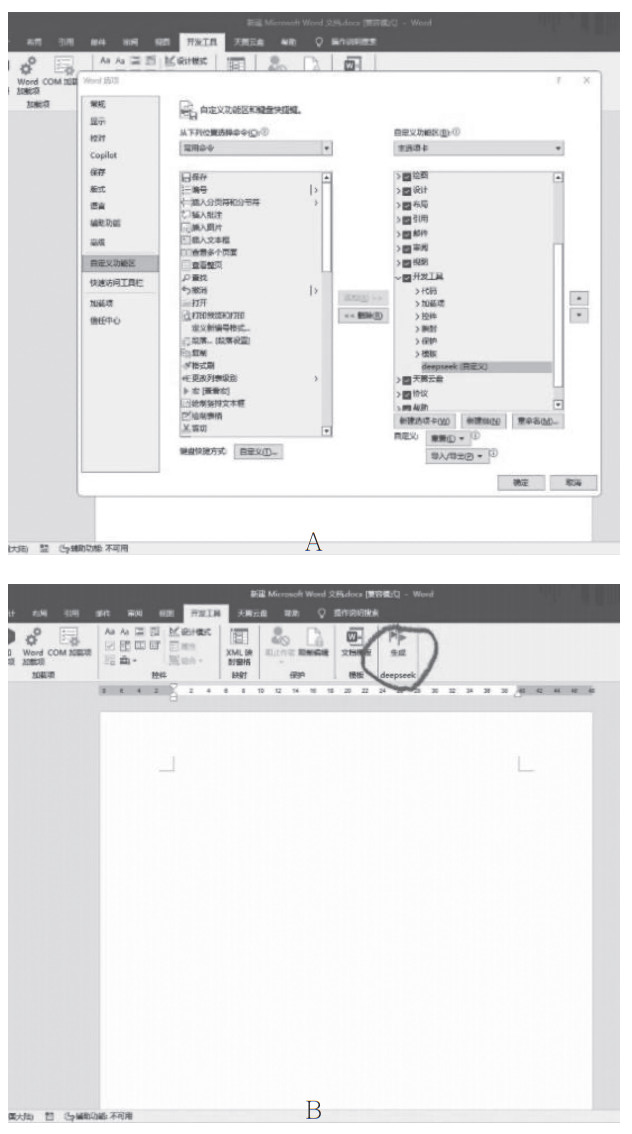
图 1  DeepSeek接入word命令中的开发模块
A:接入DeepSeek模型图;B:运行DeepSeek模型图。
1 仲文明, 王迪, 田莎. 生成式人工智能与神经网络机器翻译人工译后编辑效率对比研究[J]. 翻译研究与教学, 2024 (2): 96- 105.
2 李侗桐, 高瑞婧, 田佳. ChatGPT在中文科技期刊摘要文字编辑中的实用性测试与分析[J]. 中国科技期刊研究, 2023, 34 (8): 1014- 1019.
3 宋爽. DeepSeek:很多惊叹,更多惊喜[N]. 人民日报海外版,2025-02-06(2).
4 张明华, 李静怡. 人工智能在科技期刊编辑中的应用前景[J]. 中国科技期刊研究, 2022, 33 (5): 567- 573.
5 黄晓明, 郑雅文. 人工智能辅助编辑系统在科技期刊中的应用研究[J]. 编辑学报, 2023, 35 (4): 412- 418.
6 夏玲, 向晓莉, 李宜蔓, 等. 机器翻译医学论文摘要的现状分析及作者与编辑协同路径研究[J]. 中国科技期刊研究, 2024, 35 (12): 1757- 1766.
doi: 10.11946/cjstp.202406100640
7 陈小明. 生成式人工智能技术对医学科技期刊学术生产与出版的影响[J]. 编辑学报, 2023, 35 (S1): 132- 136.
8 庞丽, 王利鹏, 高森, 等. 中文医学科技期刊摘要标准化现状调研与分析[J]. 中国科技期刊研究, 2022, 33 (4): 458- 464.
9 闾海荣, 江瑞, 张学工, 等. DeepSeek与医学大语言模型:技术创新与医疗服务模式重构[J]. 医学信息学杂志, 2025, 46 (2): 1- 7.
doi: 10.3969/j.issn.1673-6036.2025.02.001
10 刘益东. AI科教革命, 从精准考核、主题PI制与教学系统重构开始[J]. 深圳社会科学, 2025, 8 (2): 104- 114.
[1] 王鹏飞,毛志慧. 2024年出版学研究的十大热点话题[J]. 科技与出版, 2025, 44(6): 5-17.
[2] 王钧,王飚,李苏航. 出版行业构建高质量数据集的优势分析与方法研究[J]. 科技与出版, 2025, 44(6): 64-72.
[3] 罗启元,焦霖. 数智化时代馆社共建与创新路径思考[J]. 科技与出版, 2025, 44(6): 44-51.
[4] 王亮. 检索增强生成(RAG)驱动的知识服务:原理、范式及评估[J]. 科技与出版, 2025, 44(4): 37-46.
[5] 陈矩弘,封采龄. 生成式人工智能赋能出版营销的技术逻辑与实践进路[J]. 科技与出版, 2025, 44(4): 76-84.
[6] 汤雪梅,杨春兰,杨玥涵. “十四五”时期中国出版业的回顾与思考[J]. 科技与出版, 2025, 44(1): 6-16.
[7] 谢寿光,王誉梓. 生成式人工智能应用场景下的学术出版和学术编辑:挑战与机遇[J]. 科技与出版, 2025, 44(1): 77-88.
[8] 郭壬癸. 使用生成式人工智能对学术出版伦理的冲击与法律治理*[J]. 科技与出版, 2024, 43(9): 25-33.
[9] 刘倩,王京山,詹洪春. 关于生成式人工智能的应用规范研究与启示[J]. 科技与出版, 2024, 43(8): 27-33.
[10] 杨洋,江雨莲,刘爽. 专科医学期刊集群化发展探索*[J]. 科技与出版, 2024, 43(8): 44-50.
[11] 郭欣,张焱丽,徐云峰. 医学期刊新媒体传播效果的比较分析与提升策略*[J]. 科技与出版, 2024, 43(8): 92-98.
[12] 孙山,张雯雯. 生成式人工智能预训练中权利限制制度的选择与建构*[J]. 科技与出版, 2024, 43(7): 6-15.
[13] 袁真富,夏子轩. 机器学习中作品利用的著作权补偿金制度研究*[J]. 科技与出版, 2024, 43(7): 28-36.
[14] 徐小奔,薛少雄. 生成式人工智能服务提供者版权注意义务的法律构造*[J]. 科技与出版, 2024, 43(7): 48-58.
[15] 王杰. 生成式人工智能服务输出侵犯版权内容的救济研究*[J]. 科技与出版, 2024, 43(7): 59-69.