Please wait a minute...
科技与出版  2025, Vol. 44 Issue (9): 107-116    
学术探索
高校学术期刊介导的学术不端四维协同治理机制研究——基于扎根理论的研究
侯波1,2,高虹3
1. 东南大学人文学院,211108,南京
2. 江苏经贸职业技术学院期刊社,211168,南京
3. 河海大学期刊部,210098,南京
Four-Dimensional Collaborative Governance Mechanism for Academic Misconduct Mediated by University Academic Journals: Evidence from Large-Scale Qualitative Interviews
HOU Bo1,2,GAO Hong3
1. School of Humanities, Southeast University, 211108, Nanjing, China
2. Journal Department, Jiangsu Vocational Institute of Commerce, 211168, Nanjing, China
3. Journal Department, Hohai University, 210098, Nanjing, China
全文: HTML    PDF(1801 KB)  
输出: BibTeX | EndNote (RIS)      
摘要: 

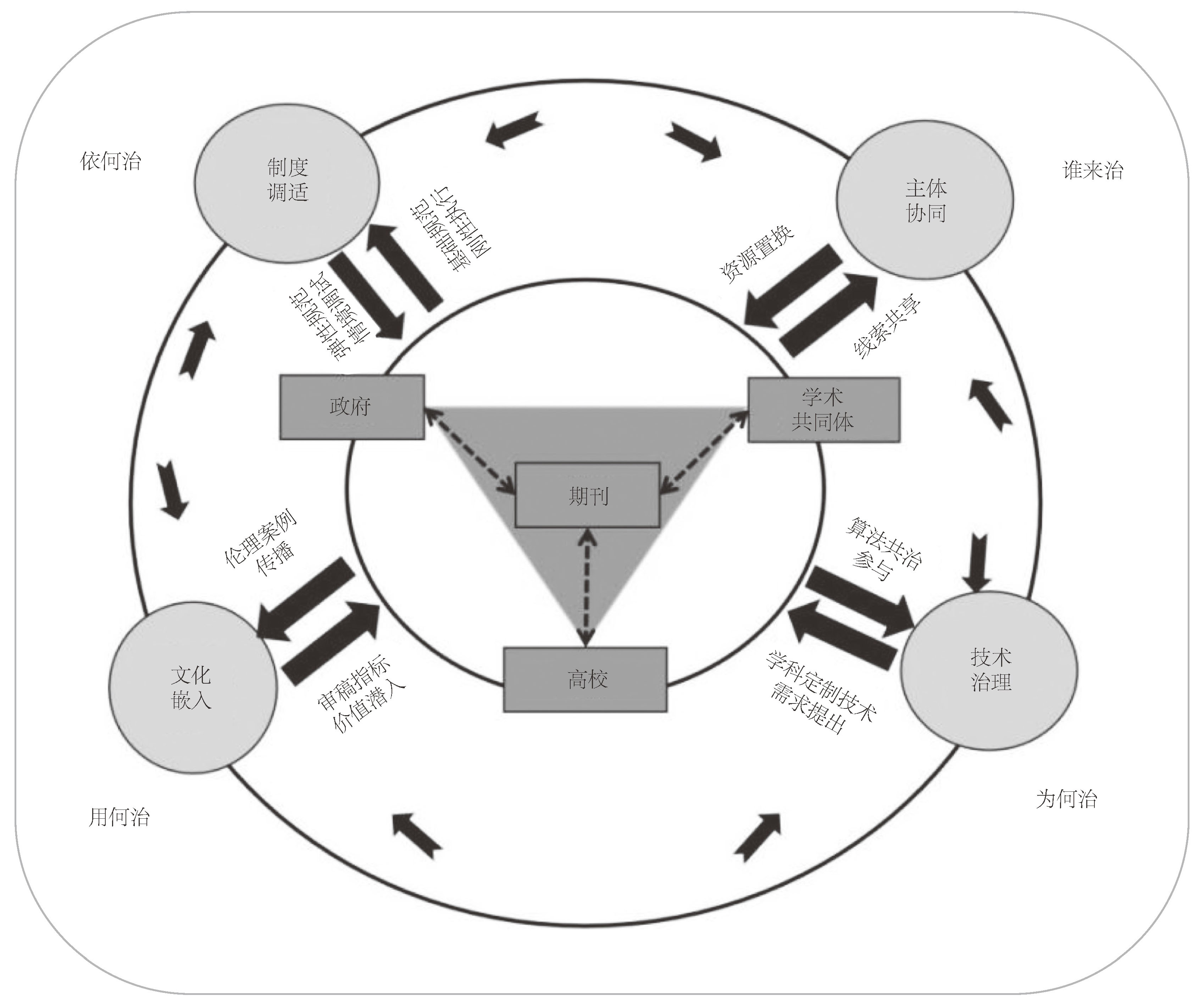
学术不端行为的频发与治理碎片化,已成为制约我国学术生态健康发展与世界一流科技期刊建设的关键瓶颈,而高校学术期刊作为学术成果传播的“首道防线”,在协同治理中的功能价值尚未被系统厘清。以协同治理理论为框架,基于对国内30家高校学术期刊的大规模深度质性访谈,运用扎根理论提炼编码,构建高校学术期刊介导的学术不端四维协同治理模型,从主体协同、制度调适、技术治理和文化嵌入四个维度系统剖析高校学术期刊在学术不端协同治理中的功能定位与作用机制。研究发现,这四个维度相互耦合、共同作用,其中高校学术期刊扮演着枢纽角色,需承担推动多元主体责任共担、制度规范价值重构、技术工具理性平衡及文化价值内化演进等功能,进而提出高校学术期刊精准发挥治理功能、完善中国特色学术治理体系的可操作实践路径。

关键词 学术不端高校学术期刊协同治理质性研究四维机制    
Abstract

The construction of China’s academic ecosystem currently faces unprecedented severe challenges. Academic misconduct and fragmented governance systems are intertwined, seriously hindering the healthy development of the academic community and becoming a key obstacle to achieving the strategic goal of building world-class scientific journals in China. However, university academic journals, as the primary gateway and important gatekeepers for publishing and disseminating academic achievements, require clearer recognition and systematic explanation of their unique functional role and potential value in the collaborative governance system addressing academic misconduct. On one hand, the concealment and complexity of academic misconduct impose higher requirements on the identification and handling capabilities of journals; on the other hand, the rights and responsibilities boundaries of journals as governance subjects are not clearly defined, making it difficult to fully leverage their hub role in the collaborative governance system. Additionally, rapid technological advancement and dynamic balance of ethical values present additional governance challenges, urgently requiring more systematic solutions from both theoretical and practical perspectives. This study, based on the theory of collaborative governance as its theoretical foundation and analytical framework, adopts in-depth qualitative research methods to conduct systematic interviews and surveys with 30 representative university academic journals across China. Through multi-dimensional and multi-level empirical data collection the study provides a solid empirical foundation. By using the three-level coding technique of grounded theory to deeply analyze the interview data, this paper develops an innovative four-dimensional collaborative governance theoretical model mediated by university academic journals for addressing academic misconduct. The model comprehensively and systematically reveals the functional positioning, action mechanisms, and intrinsic logic of university academic journals within the collaborative governance network of academic misconduct from four key dimensions: subject collaboration, institutional adjustment, technological governance, and cultural embedding, offering novel theoretical insights into academic governance complexity. The findings demonstrate that these four governance dimensions form an interconnected network of mutual support and dynamic coupling, creating a cohesive governance system. University academic journals, as key nodes connecting various stakeholders in the academic community, need to fully leverage their hub role by: fostering the formation of a responsibility community with multi-stakeholder collaborating in the subject collaboration dimension, establishing cross-departmental and cross-sectoral collaboration mechanisms; promoting the value reconstruction and dynamic adjustment of academic norms in the institutional adjustment dimension, thereby achieving the timeliness of the rules system; achieving the organic balance of tool rationality and value rationality in the technological governance dimension, while ensuring the unity of technology application and ethical values; and guiding the internalization and evolution of academic integrity values in the cultural embedding dimension, thus cultivating a healthy and upward academic cultural atmosphere.

Key wordsacademic misconduct    university academic journals    collaborative governance    qualitative research    four-dimensional mechanism
出版日期: 2025-10-15
基金资助:江苏高校哲学社会科学研究一般项目“高校学术期刊赋能学术治理研究”(2024SSJYB0529);2025年度江苏省科技智库计划项目立项项目“我省科技期刊‘十五五’战略规划前瞻研究:历程回溯、发展特征及建设策略”(JSKX0125002)

引用本文:

侯波,高虹. 高校学术期刊介导的学术不端四维协同治理机制研究——基于扎根理论的研究[J]. 科技与出版, 2025, 44(9): 107-116.
HOU Bo,GAO Hong. Four-Dimensional Collaborative Governance Mechanism for Academic Misconduct Mediated by University Academic Journals: Evidence from Large-Scale Qualitative Interviews. Science-Technology & Publication, 2025, 44(9): 107-116.

链接本文:

http://kjycb.tsinghuajournals.com/CN/      或      http://kjycb.tsinghuajournals.com/CN/Y2025/V44/I9/107

表 1  深度访谈样本结构矩阵(N=30)
表 2  开放性编码及范畴提炼
表 3  主轴编码提炼
图 1  高校学术期刊介导的学术不端四维协同治理模型
1 培育世界一流科技期刊四部门联合发文推动科技期刊改革发展[EB/OL].(2019-08-16)[2025-03-05]. https://www.gov.cn/xinwen/2019-08/16/content_5421699.htm.
2 郝凯冰, 郭菊娥, 张聪, 等. 高校学术不端行为治理嵌套逻辑建模及作用路径与影响效应研究[J]. 科技进步与对策, 2021, 38 (19): 110- 118.
3 刘言. 为学术不端拉响警报[N]. 中国青年报,2023-02-22(6).
4 康锋, 徐石勇, 张会巍, 等. 学术论文查重乱象的表现、成因及治理[J]. 编辑学报, 2023, 35 (6): 640- 645.
5 李静, 亢小玉. 学术期刊出版全流程中隐性学术不端行为的挖掘与防范[J]. 编辑学报, 2024, 36 (3): 260- 264.
6 王少. 生成式人工智能对学术不端治理的妨碍及对策[J]. 科学学研究, 2024, 42 (7): 1361- 1368.
7 张瑞, 刘生鹏. 国内外科技期刊编辑出版中的学术不端防治研究与实践[J]. 编辑学报, 2023, 35 (3): 268- 272.
8 张英丽, 戎华刚. 2006—2020年国内学术不端研究进展与文献述评[J]. 中国科技期刊研究, 2021, 32 (7): 917- 926.
9 许洁, 肖谦. 学术出版中的人工智能应用伦理治理框架与措施:基于49项国际出版政策的扎根研究[J]. 编辑之友, 2024 (8): 37- 46.
10 张俊彦, 富群华. 中文科技期刊应对学术不端来稿的案例分析及单刊实践初探[J]. 中国科技期刊研究, 2022, 33 (2): 159- 166.
11 胡裕岭, 姚浩亮. 我国GAI数据治理的多元协同模式研究:新加坡治理经验的启示[J]. 河海大学学报(哲学社会科学版), 2024, 26 (5): 86- 98.
[1] 蒋霞,黄崇亚. 不同语种发表重复内容的出版伦理问题探讨[J]. 科技与出版, 2025, 44(3): 157-166.
[2] 黄先蓉,李永政. 学术不端行为治理研究[J]. 科技与出版, 2024, 43(9): 6-12.
[3] 王景周,范晴. 学术期刊同行评议代笔行为的表现、原因及对策*[J]. 科技与出版, 2024, 43(9): 19-25.
[4] 郭壬癸. 使用生成式人工智能对学术出版伦理的冲击与法律治理*[J]. 科技与出版, 2024, 43(9): 25-33.
[5] 戴丽,胡永国,黄文杰,吴宗辉. 高校学术期刊编辑参与研究生学术诚信体系建设的路径研究*[J]. 科技与出版, 2024, 43(9): 34-39.
[6] 王子娴. 欧洲学科学会的学术出版道德准则现状及启示*[J]. 科技与出版, 2024, 43(9): 100-110.
[7] 李宁,吴坚. 我国英文科技期刊国际话语权影响因素与建构策略*[J]. 科技与出版, 2024, 43(5): 68-75.
[8] 陈铭. 开放科学背景下的数据出版:功能、困境与治理进路*[J]. 科技与出版, 2024, 43(10): 80-88.
[9] 袁源,谢文亮. ChatGPT在学术出版应用场景中的伦理困境及其纾解之道*[J]. 科技与出版, 2023, 42(8): 89-96.
[10] 沈锡宾,王立磊. 人工智能生成学术期刊文本的检测研究*[J]. 科技与出版, 2023, 42(8): 56-62.
[11] 鲁烨,王丽恩. 基于扎根理论的科技期刊编辑力评价模型构建*[J]. 科技与出版, 2023, 42(12): 119-125.
[12] 张海燕,张和,戴毅,鲁翠涛. 学术期刊查重工作面临的问题及应对策略分析*[J]. 科技与出版, 2023, 42(1): 90-95.
[13] 蔡雯雯,徐伟娟. 国家卫生健康委员会医学科研诚信专栏通报的科研失信论文分析[J]. 科技与出版, 2022, 41(7): 148-155.
[14] 熊皓男. 学术不端与版权侵权比较论考*[J]. 科技与出版, 2022, 41(2): 72-79.
[15] 唐晓莲,邹小勇,张元媛,胡晓霖,冷怀明. 中文期刊撤稿声明撤回论文情况分析及思考*[J]. 科技与出版, 2022, 41(12): 74-78.