Please wait a minute...
科技与出版  2025, Vol. 44 Issue (12): 36-46    
融媒之光
AIGC赋能视阈下数字出版产业链韧性的评价模型研究
马文欢1,王梓薇2,*,陈磊2,王纪坤2,曹凯2
1. 冶金工业出版社有限公司,100009,北京
2. 北京印刷学院,102600,北京
An Evaluation Model for the Resilience of Digital Publishing Industry Chain from the Perspective of AIGC Empowerment
MA Wenhuan1,WANG Ziwei2,*,CHEN Lei2,WANG Jikun2,CAO Kai2
1. Metallurgical Industry Press Co., Ltd., 100009, Beijing, China
2. Beijing Institute of Graphic Communication, 102600, Beijing, China
全文: HTML    PDF(11554 KB)  
输出: BibTeX | EndNote (RIS)      
摘要: 

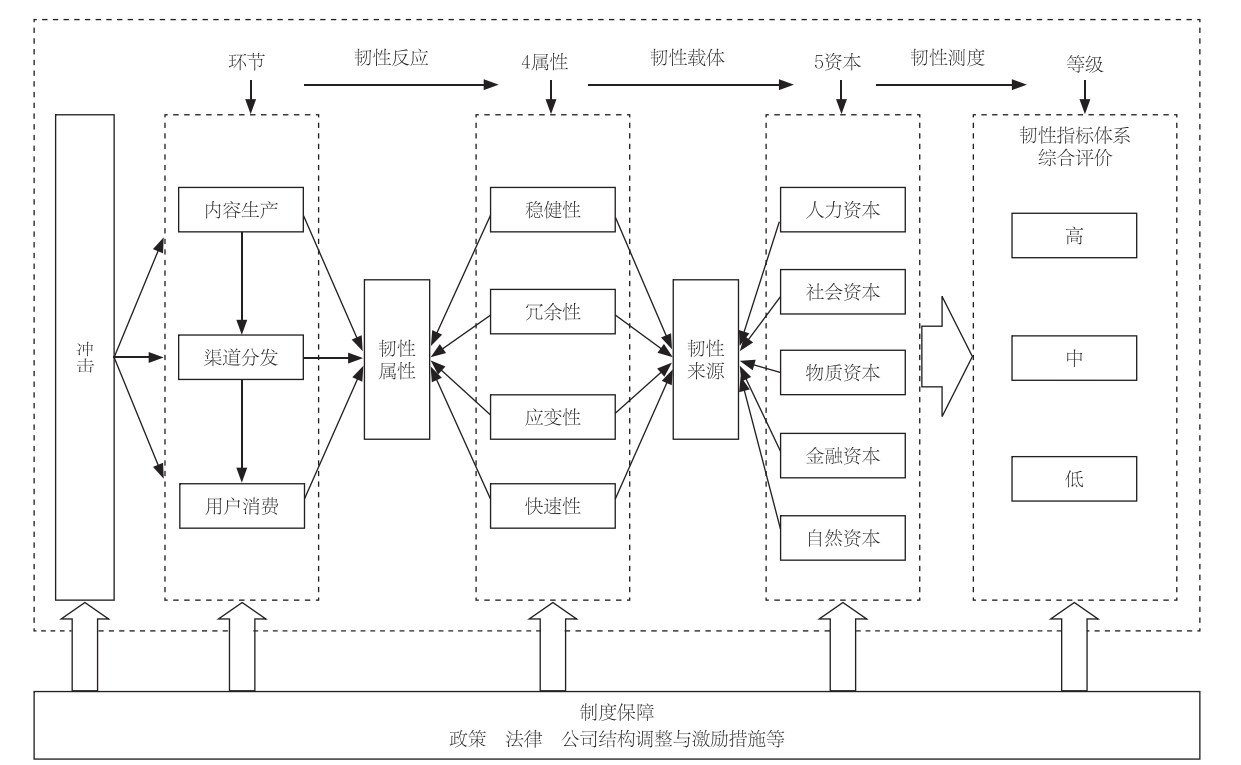
文章通过对产业链韧性评价模型的梳理和分析,提炼出AIGC赋能视阈下数字出版产业链韧性的核心评价要素:四个韧性属性(4R)、韧性来源的五类资本(5C)、支撑韧性落地的制度保障(G),并整合该产业链三个关键环节(3L)与三层韧性评价级别(3L),创新性地构建了数字出版产业链韧性评价的“3L+4R+5C+G+3L”系统性结构模型与综合测度模型,旨在为AIGC赋能视阈下数字出版产业链韧性测度及提升路径提供理论依据。

关键词 AIGC数字出版产业链韧性评价模型    
Abstract

Based on the practical progress and internal logic of artificial intelligence generated content (AIGC) empowering digital publishing, this study constructs a digital publishing industry chain resilience evaluation model encompassing five key elements: structural links, resilience attributes, resilience sources, institutional guarantees, and resilience levels. The model aims to provide theoretical support and analytical tools for the scientific identification, precise assessment, and systematic enhancement of industry chain resilience in the context of deep AIGC integration and accelerated industry restructuring. It emphasizes the dynamic collaborative evolution among these elements, addressing limitations of current resilience research that often rely excessively on physical boundaries, focuses on a single capital-driven approach, and neglects institutional factors. As such, the model provides a more integrated explanatory perspective for current industry chain resilience research. AIGC is profoundly reshaping the links in the digital publishing chain by overcoming temporal and multi-party constraints, enabling individual entities to complete publishing process anytime and anywhere. This promotes efficient coordination and integration across different links, thereby enhancing the resilience of the industry chain. AIGC also introduces cross-link risks such as copyright disputes, information silos, and user data breaches—that, if accumulated and propagated, may disrupt the operational rhythm of the chain and weaken its resilience. Therefore, a dedicated evaluation model is urgently needed to assess AIGC's dual impact on industrial chain resilience. Existing resilience models are primarily based on either the ecological dynamics-inspired four attributes (4R: robustness, redundancy, adaptability, and rapidity) framework or the sustainable livelihoods-oriented five capitals (5C: human, social, natural, physical, and financial capitals) system, both of which are better suited to traditional industrial chains with clear physical boundaries. Even studies that attempt to integrate 4R and 5C commonly overlook the critical role of legal and policy-related institutional factors. In contrast, digital publishing centers on virtual information space while relying on physical infrastructure for support, resulting in highly blurred boundaries between dynamic and static elements. Moreover, as a key vehicle for ideological dissemination, it carries distinct political attributes and cultural security responsibilities. Consequently, legal and policy-based institutional safeguards are not merely external environmental variables but have become structural elements embedded within the operation of the digital publishing industry chain as well as endogenous variables directly shaping its resilience. To address these gaps, this study proposes a "3L+4R+5C+G+3Le" resilience evaluation model for the digital publishing industry chain. It defines three links (3L): content production, channel distribution, and user consumption, and analyzes the influence of the 5C on resilience. Legal, policy, and other institutional safeguards (G) serve as an endogenous foundation spanning the entire chain. Resilience performance is characterized through 4R. Finally, through weighting and comprehensive measurement, resilience is classified into three levels (3Le: high, medium, and low). This model represents a conceptual shift from "structural analysis" to "state identification, " transforming industrial chain resilience from an abstract notion into an assessable and manageable strategic capability. Future research should focus on developing resilience indicators and exploring pathways to enhance resilience in the digital publishing industry chain.

Key wordsartificial intelligence generated content (AIGC)    resilience of the digital publishing industry chain    evaluation model
出版日期: 2026-01-09
基金资助:国家社会科学基金项目“ChatGPT赋能视阈下数字出版产业链韧性提升机制研究”(23BJY215)
通讯作者: 王梓薇   
Corresponding author: Ziwei WANG   

引用本文:

马文欢,王梓薇,陈磊,王纪坤,曹凯. AIGC赋能视阈下数字出版产业链韧性的评价模型研究[J]. 科技与出版, 2025, 44(12): 36-46.
MA Wenhuan,WANG Ziwei,CHEN Lei,WANG Jikun,CAO Kai. An Evaluation Model for the Resilience of Digital Publishing Industry Chain from the Perspective of AIGC Empowerment. Science-Technology & Publication, 2025, 44(12): 36-46.

链接本文:

http://kjycb.tsinghuajournals.com/CN/      或      http://kjycb.tsinghuajournals.com/CN/Y2025/V44/I12/36

图 1  数字出版产业链韧性评价的系统性结构模型
1 报告课题组. 出版融合发展报告(2025)[M]. 北京: 中信出版集团, 人民卫生出版社, 2025: 90.
2 李少林, 卫昭君, 马里. 产业链韧性的理论研究新进展与提升路径[J]. 东北财经大学学报, 2025 (3): 69- 82.
3 MARTIN R, SUNLEY P. Regional economic resilience: Evolution and evaluation[M]// BRISTOW G, HEALY A. Handbook on regional economic resilience. London: Edward Elgar Publishing, 2020: 10-35.
4 BAHADUR A , WILKINSON E , TANNER T . Measuring resilience: An analytical review[J]. Climate and Development, 2015 (8): 1- 19.
5 SCHIPPER E L F , LANGSTON L . A comparative overview of resilience measurement frameworks: Analyzing indicators and approaches[J]. Overseas Development Institute, 2015 (7): 1- 29.
6 BRUNEAU M , CHANG S E , EGUCHI R T , et al. A framework to quantitatively assess and enhance the seismic resilience of communities[J]. Earthquake Spectra, 2003 (4): 733- 752.
7 郝爱民, 解梦菡, 刘育廷. 农业产业链韧性水平测度与时空演变[J]. 统计与决策, 2024 (16): 95- 100.
8 张伟, 李航宇, 张婷. 中国制造业产业链韧性测度及其时空分异特征[J]. 经济地理, 2023 (4): 134- 143.
9 YANG C , TIAN K , GAO X . Supply chain resilience: Measure, risk assessment and strategies[J]. Fundamental Research, 2025 (2): 433- 436.
10 CHAMBERS R , CONWAY G R . Sustainable rural livelihoods: Practical concepts for the 21st century[J]. IDS Discussion Paper, 1992 (29): 5.
11 Department for International Development. Sustainable livelihoods guidance sheets[EB/OL]. [2025-12-02]. https://www.livelihoodscentre.org/documents/114097690/114438878/Sustainable+livelihoods+guidance+sheets.pdf/.
12 MACOPIYO L . Community based resilience analysis(CoBRA)assessment report for Zomba, Ntcheu and Nkhata Bay Districts in Malawi[J]. UNDP, 2018 (7): 46.
13 Zurich Flood Resilience Alliance. Flood resilience measurement for communities(FRMC)[EB/OL]. [2025-12-02]. https://www.ifrc.org/sites/default/files/2021-07/Flood-resilience-measurement-communities-brochure.pdf.
14 桑晶, 郭燕萍. 饲料业产业链韧性水平测度及影响因素[J]. 饲料研究, 2024 (2): 183- 188.
15 IRFANULLAH H . So, what does resilience mean for scholarly publishing?[J]. Learned Publishing, 2021 (1): 57- 63.
16 曾元祥, 余世英, 方卿. 论数字出版产业链主体及其功能定位[J]. 出版科学, 2013 (3): 85- 89.
17 裴永刚. 中国数字出版产业链整合研究[M]. 北京: 中国传媒大学出版社, 2021: 46.
18 CUTTER S L , BARNES L , BERRY M , et al. A place-based model for understanding community resilience to natural disasters[J]. Global environmental change, 2008 (4): 598- 606.
19 SERFILIPPI E , RAMNATH G . Resilience measurement and conceptual frameworks: A review of the literature[J]. Annals of Public and Cooperative Economics, 2018 (4): 645- 664.
20 ROOSTAIE S , NAWARI N , KIBERT C J . Sustainability and resilience: A review of definitions, relationships, and their integration into a combined building assessment framework[J]. Building and Environment, 2019, 154, 132- 144.
doi: 10.1016/j.buildenv.2019.02.042
21 WEBER M M . The relationship between resilience and sustainability in the organizational context: A systematic review[J]. Sustainability, 2023 (22): 15970.
22 李鸿飞, 熊祎斐. 人工智能生成内容的版权风险治理比较研究[J]. 科技与出版, 2025 (8): 102- 112.
23 陈大明, 马征远, 杨露. 大变局下的产业链供应链韧性维护及提升[M]. 上海: 上海人民出版社, 2023: 125.
24 马文欢, 王梓薇, 黄超兰. AIGC影响数字出版产业链韧性机制模型研究[J]. 科技与出版, 2024 (9): 54- 62.
[1] 本刊编辑部. 从工具到伙伴:AI如何赋能期刊未来发展[J]. 科技与出版, 2025, 44(9): 47-51.
[2] 本刊编辑部. AI驱动下的学术创作范式重构——基于七位跨学科专家观点类编与深度述要[J]. 科技与出版, 2025, 44(8): 5-15.
[3] 郑恩. 数字版权价值评估的多维动态路径研究[J]. 科技与出版, 2025, 44(8): 16-27.
[4] 吕晓峰,孟祥晴,詹洪春. 人工智能时代出版业知识服务的伦理挑战、价值重构与实践进路[J]. 科技与出版, 2025, 44(8): 47-55.
[5] 董慧娟,余非. AIGC可版权的必要非充分要件:“有限控制论”的证成与适用展开*[J]. 科技与出版, 2025, 44(8): 113-127.
[6] 陈强,张钢花. 适老化数字出版的现实与未来:基于数字可供性视角[J]. 科技与出版, 2025, 44(6): 73-79.
[7] 孙保营,董琎. AIGC融入学术出版:变革、问题与对策[J]. 科技与出版, 2025, 44(4): 31-36.
[8] 范文婷. 平台生态系统视角下多边数字阅读平台价值共创与多元主体协同创新路径优化[J]. 科技与出版, 2025, 44(4): 94-102.
[9] 毛文思,王飚. 2024年中国数字出版发展态势盘点与2025年趋势展望[J]. 科技与出版, 2025, 44(3): 14-26.
[10] 韩璐,杨军. 数据要素赋能出版企业价值创造的作用机理、现实困境与纾困路径[J]. 科技与出版, 2025, 44(12): 58-65.
[11] 邱蕾,郑汀兰. AIGC背景下学术期刊出版伦理建设的思考[J]. 科技与出版, 2025, 44(12): 85-91.
[12] 邱乾,张森. 超越“融合之困”:数智技术赋能儿童出版的现实困境、生发逻辑及其矫治之道[J]. 科技与出版, 2025, 44(1): 89-100.
[13] 张新新,陈少志. 加快建设数字出版三大体系,切实推动数字出版理论创新——数字出版“十四五”学术热点分析与“十五五”重要议题展望[J]. 科技与出版, 2025, 44(1): 61-76.
[14] 马文欢,王梓薇,黄超兰. AIGC影响数字出版产业链韧性机制模型研究*[J]. 科技与出版, 2024, 43(9): 54-62.
[15] 傅爱雯,王跃,邵波. 数字出版融合生态:体系构建与业务组织[J]. 科技与出版, 2024, 43(9): 63-70.