Please wait a minute...
科技与出版  2026, Vol. 45 Issue (2): 96-107    
编辑实务
中国科技期刊使用人工智能政策的研究及对策建议——基于40份科技核心期刊政策文本的Nvivo分析
李慧1,2,苏莉娜1,*,周会霞1,黎霜霜1,王梦婷2,谢邦彦1,刘广宇2
1. 《科技与金融》编辑部,510033,广州
2. 广东省科技合作研究促进中心,510033,广州
Research and Strategic Recommendations on Use of AI Technologies in Chinese STM Journals: Nvivo Analysis Based on the Policy Texts of 40 Core STM Journals
LI Hui1,2,SU Lina1,*,ZHOU Huixia1,LI Shuangshuang1,WANG Mengting2,XIE Bangyan1,LIU Guangyu2
1. Editorial Office of Sci-Tech Finance Monthly, 510033, Guangzhou, China
2. Guangdong Science & Technology Cooperation Center, 510033, Guangzhou, China
全文: HTML    PDF(898 KB)  
输出: BibTeX | EndNote (RIS)      
摘要: 

人工智能(AI)出现并迅速广泛应用于学术出版,在推动科研发展、提升出版效率的同时也带来了新的挑战,这迫切需要业内达成共识,规范作者、审稿人、编辑和出版单位等利益主体合理、负责任地使用AI。本文选取2024年中国科技期刊引证报告(核心版)综合评分前100的自然科学类与社会科学类期刊共200本作为研究对象,运用质性分析工具Nvivo 12 Plus对其AI使用政策文本进行分析,发现当前我国科技期刊在AI使用边界、披露要求及违规处理机制方面存在标准不统一、表述模糊等问题。基于发现的问题,本文系统梳理国内外科技期刊出版机构和学术组织规范使用AI的做法并提出针对性建议,以期为中国科技期刊制定符合我国学术出版实际并与国际规则接轨的AI使用政策框架提供参考。

关键词 科技期刊人工智能政策文本质性研究    
Abstract

Recently, artificial intelligence (AI) has developed rapidly. In the academic research field, AI has driven comprehensive innovation in research paradigms, theoretical modeling, and methodologies. In the academic publishing field, AI has reshaped the entire academic publication process, from manuscript writing, review, editing, and proofreading to dissemination. Moreover, AI has created a series of challenges for scientific research and academic publishing, such as the industrialization of "paper mills" and the fabrication of references. This urgently requires the academic publishing industry to reach a consensus; formulate clear norms and policies for the use of AI in academic publishing; and guide authors, reviewers, editors, and publishing units and other stakeholders to use AI reasonably and responsibly. This study selected 200 journals, including the top 100 natural science and social science journals in the 2024 Chinese Scientific and Technology Journal Citation Reports (Core Edition), as research objects and used the qualitative analysis tool Nvivo 12 Plus to analyze their AI-usage policy texts, aiming to provide references for Chinese scientific, technical, and medical (STM) journals in formulating AI usage policies and promoting their high-quality development. The number of reference points for author policies was the highest, totaling 531, followed by that for reviewer policies and editor policies, at 138 and 49 reference points, respectively. The number of reference points for publisher policies was the lowest, with only 29. Further analysis showed that regarding author policies, although Chinese STM journals have established tiered and categorized penalty mechanisms, there is a lack of consensus on requirements such as disclosure content, location, and statement templates. Regarding reviewer policies, Chinese STM journals clearly define the boundaries of using AI for review, but further clarification is needed on the responsibilities of reviewers and the disclosure requirements for AI usage. In terms of editor policies, Chinese STM journals have focused on regulating the scope of editors' prohibition of using AI but lack clear guidelines on the reasonable use of AI. In terms of publisher policies, Chinese STM journals lack comprehensive AI review and assessment mechanisms and a disclosure mechanism for AI usage. To this end, drawing on the practical experience of domestic and foreign STM journal publishing units and academic publishing organizations, four specific measures are proposed from the perspectives of authors, reviewers, editors, and publishing units as stakeholders. First, a disclosure mechanism for authors' use of AI is established from three dimensions: disclosure requirements, disclosure location, and content. Second, the principles of accountability and transparency should be adhered to, and the responsibility attribution and disclosure requirements for reviewers' use of AI should be clarified. Third, "human–machine collaborative" editing and publishing mechanism should be constructed by clarifying the boundaries of rights and responsibilities for AI use, establishing an infrastructure for AI-assisted editing and proofreading, and strengthening team development. Fourth, publishing units should establish AI usage policies covering the entire academic publishing process, forming a closed loop of "usage norms–review mechanisms–accountability mechanisms".

Key wordsscientific, technical, and medical (STM) journals    artificial intelligence (AI)    policy texts    qualitative research
出版日期: 2026-04-07
基金资助:2025年度韬奋基金会规划课题“科技期刊构建AI政策框架的研究”(TF2025107)
通讯作者: 苏莉娜   
Corresponding author: Lina SU   

引用本文:

李慧,苏莉娜,周会霞,黎霜霜,王梦婷,谢邦彦,刘广宇. 中国科技期刊使用人工智能政策的研究及对策建议——基于40份科技核心期刊政策文本的Nvivo分析[J]. 科技与出版, 2026, 45(2): 96-107.
LI Hui,SU Lina,ZHOU Huixia,LI Shuangshuang,WANG Mengting,XIE Bangyan,LIU Guangyu. Research and Strategic Recommendations on Use of AI Technologies in Chinese STM Journals: Nvivo Analysis Based on the Policy Texts of 40 Core STM Journals. Science-Technology & Publication, 2026, 45(2): 96-107.

链接本文:

http://kjycb.tsinghuajournals.com/CN/      或      http://kjycb.tsinghuajournals.com/CN/Y2026/V45/I2/96

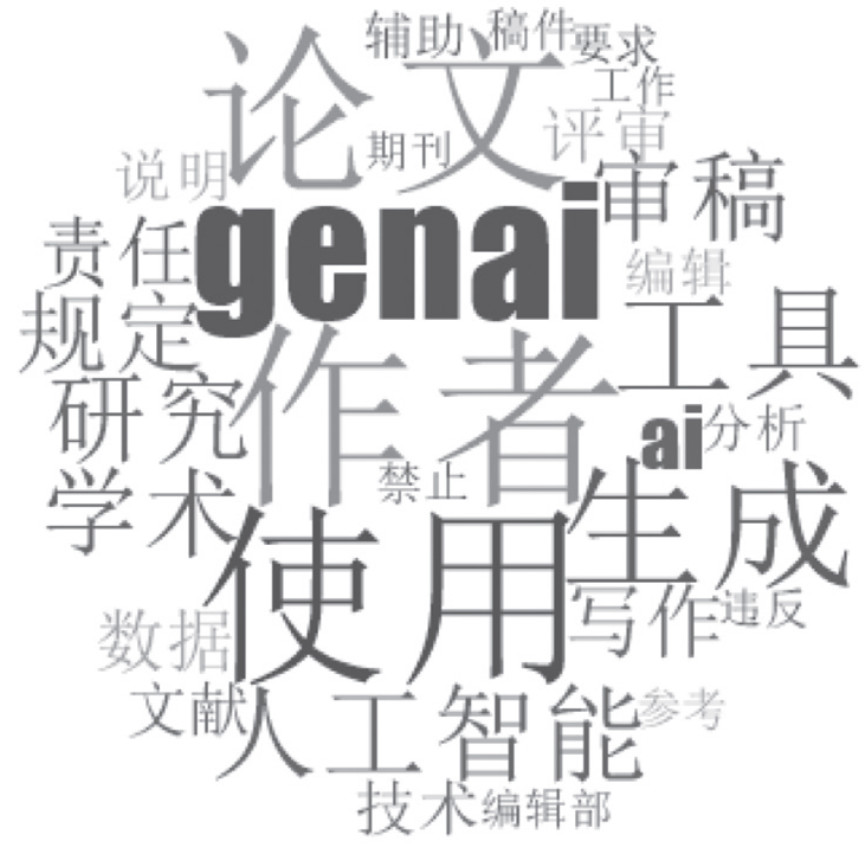
图 1  科技核心期刊AI政策词云图
表 1  科技核心期刊AI政策高频词
表 2  40份科技核心期刊作者使用AI的政策文本内容节点分析
表 3  40份科技核心期刊审稿人使用AI的政策文本内容节点分析
表 4  40份科技核心期刊编辑使用AI的政策文本内容节点分析
表 5  40份科技核心期刊出版单位使用AI的政策文本内容节点分析
1 Zhang P S, Hu X, Huang G W, et al. aiXiv: A next-generation open access ecosystem for scientific discovery generated by AI scientists[PP/OL]. aiXiv(2025-12-17)[2026-02-09]. https://doi.org/10.48550/arXiv.2508.15126.
2 Naddaf M . More than half of researchers now use AI for peer review: Often against guidance[J]. Nature, 2026, 649 (8096): 273- 274.
doi: 10.1038/d41586-025-04066-5
3 ICML 2026 Policy for LLM use in reviewing[EB/OL]. [2026-01-30]. https://icml.cc/Conferences/2026/LLM-Policy.
4 Kusumegi K , Yang X , Ginsparg P , et al. Scientific production in the era of large language models[J]. Science, 2025, 390 (6779): 1240- 1243.
doi: 10.1126/science.adw3000
5 吴明娟, 邹晨妍. 学界业界共探学术出版痛点[N]. 中国新闻出版广电报, 2025-11-05(2).
6 Sabel B , Larhammar D . Reformation of science publishing: The Stockholm declaration[J]. Royal Society Open Science, 2025, 12 (11): 251805.
doi: 10.1098/rsos.251805
7 邱蕾, 郑汀兰. AIGC背景下学术期刊出版伦理建设的思考[J]. 科技与出版, 2025 (12): 85- 91.
8 吴赟, 叶芃. 生成式人工智能环境下学术出版伦理规范体系的建构与治理[J]. 编辑之友, 2025 (7): 50- 58.
9 谭春林, 王建平. AIGC在学术研究和出版中的使用边界、透明度与伦理[J]. 编辑学报, 2024, 36 (6): 661- 666.
10 许洁, 肖谦. 学术出版中的人工智能应用伦理治理框架与措施: 基于49项国际出版政策的扎根研究[J]. 编辑之友, 2024 (8): 37- 46.
11 张艳丽, 管玉燕, 宛雪, 等. 学术研究中使用AIGC工具的风险审视与应对策略研究[J]. 知识管理论坛, 2024, 9 (4): 341- 352.
12 王琛, 赵燕清, 崔梦, 等. 生成式人工智能在国际图书情报学期刊中使用的政策审视[J]. 中国科技期刊研究, 2025, 36 (10): 1426- 1434.
13 易耀森. 人工智能生成内容应用出版伦理政策现状分析与完善建议: 以我国160种医学期刊为例[J]. 科技与出版, 2025 (10): 82- 93.
14 杨陈, 王丽芳, 胡志勇, 等. 国内外农业英文期刊科技伦理政策对比分析与启示[J]. 中国科技期刊研究, 2024, 35 (12): 1715- 1722.
15 刘普, 孙婉婷. 社科学术期刊的AI使用政策图谱与治理进阶: 基于50家社科学术期刊生成式人工智能使用政策文本的分析[J]. 科技与出版, 2025 (9): 52- 62.
16 Coucil of Science Editors. Recommendations for promoting integrity in scientific journal publications [EB/OL]. (2023-12-14) [2026-01-26]. https://www.councilscienceeditors.org/recommendations-for-promoting-integrity-in-scientific-journal-publications.
17 中国科学技术信息研究所, 爱思唯尔, 施普林格·自然, 等. 学术出版中AIGC使用边界指南3.0[Z]. 2025-12-07.
18 STM. Generative AI in scholarly communications[EB/OL]. (2023-12-14) [2025-08-14]. http://stm-assoc.org/wp-content/uploads/STM-GENERATIVE-AI-PAPER-2023.pdf.
19 Positive review only Researchers hide AI prompts in paper[EB/OL]. (2025-07-01) [2025-07-10]. https://asia.nikkei.com/Business/Technology/Artificial-intelligence/Positive-review-only-Researchers-hide-AI-prompts-in-papersl.
20 官鑫, 林琳, 赵阳, 等. DeepSeek技术赋能医学期刊中文摘要的编辑加工[J]. 科技与出版, 2025 (6): 95- 102.
21 甘海燕. 人工智能赋能下高校期刊编辑工作效率的提升策略[J]. 记者观察, 2024 (5): 26- 28.
22 李伟伟. AI赋能媒体融合趋势下高校英文科技期刊编辑职业素养提升策略探析[J]. 昭通学院学报, 2024, 46 (6): 49- 53.
23 COPE. Handling an article produced by AI[EB/OL]. [2025-08-10]. https://publicationethics.org/guidance/case/handling-article-produced-ail.
24 Suchak T , Aliu A E , Harrison C , et al. Explosion of formulaic research articles, including inappropriate study designs and false discoveries, based on the NHANES US national health database[J]. PLoS Biology, 2025, 23 (5): e3003152.
doi: 10.1371/journal.pbio.3003152
25 方引超, 邬加佳, 林佳美. 人工智能在期刊出版中的应用及思考[J]. 传播与版权, 2023 (1): 49- 52.
26 郭壬癸. 生成式人工智能对学术出版伦理的挑战与融贯性治理[J]. 编辑之友, 2025 (7): 59- 67.
27 孙裕彤, 任艳青, 袁军鹏. 学术期刊出版领域使用AIGC的政策、挑战与对策[J]. 中国科技期刊研究, 2025, 36 (2): 144- 152.
[1] 钱聪,杨晓新,杨海平. 出版业竞争力重塑:GenAI赋能下的出版业情境化转型路径研究[J]. 科技与出版, 2026, 45(2): 59-65.
[2] 宋俊锋,刘万. 可解构的“畅销经验”:AIGC赋能出版营销的价值趋向与实践落点[J]. 科技与出版, 2026, 45(1): 70-84.
[3] 秦明阳,牛晓娜,杨保华,范泓洋. 培育世界一流科技期刊背景下高校角色重塑与实践路径[J]. 科技与出版, 2026, 45(1): 85-92.
[4] 郁林羲,郑羽彤. 全球钻石开放获取可持续发展路径比较与启示[J]. 科技与出版, 2026, 45(1): 93-102.
[5] 刘超. 人工智能时代的教育出版:挑战、机遇与转型路径探索[J]. 科技与出版, 2025, 44(9): 21-28.
[6] 刘普,孙婉婷. 社科学术期刊的AI使用政策图谱与治理进阶——基于50家社科学术期刊生成式人工智能使用政策文本的分析[J]. 科技与出版, 2025, 44(9): 52-62.
[7] 张秦. AI时代科技期刊科研诚信治理的国际经验与中国路径[J]. 科技与出版, 2025, 44(9): 63-69.
[8] 郭璐琪,骆瑾,王昕. 中文科技期刊视频摘要传播效果及提升策略——以卓越计划二期项目中文单刊为例[J]. 科技与出版, 2025, 44(9): 79-86.
[9] 吴晓丽,陈广仁. 面向高质量发展的科技期刊编辑工匠精神实践路径——基于社会认知理论的研究[J]. 科技与出版, 2025, 44(9): 95-100.
[10] 吕鹏,王越,刘冰,魏均民. 医学期刊有效推动科技成果转化的路径思考[J]. 科技与出版, 2025, 44(9): 101-106.
[11] 侯波,高虹. 高校学术期刊介导的学术不端四维协同治理机制研究——基于扎根理论的研究[J]. 科技与出版, 2025, 44(9): 107-116.
[12] 李玖倩,李爱群. 数智赋能科技期刊编辑出版变革的应用场景与技术反思[J]. 科技与出版, 2025, 44(8): 38-46.
[13] 李鸿飞,熊祎斐. 人工智能生成内容的版权风险治理比较研究[J]. 科技与出版, 2025, 44(8): 102-112.
[14] 董慧娟,余非. AIGC可版权的必要非充分要件:“有限控制论”的证成与适用展开*[J]. 科技与出版, 2025, 44(8): 113-127.
[15] 刘玲武,胡海,刘菡. 我国出版融合政策体系研究——基于102项政策文本的“主体—路径—工具”三维框架分析[J]. 科技与出版, 2025, 44(7): 68-80.