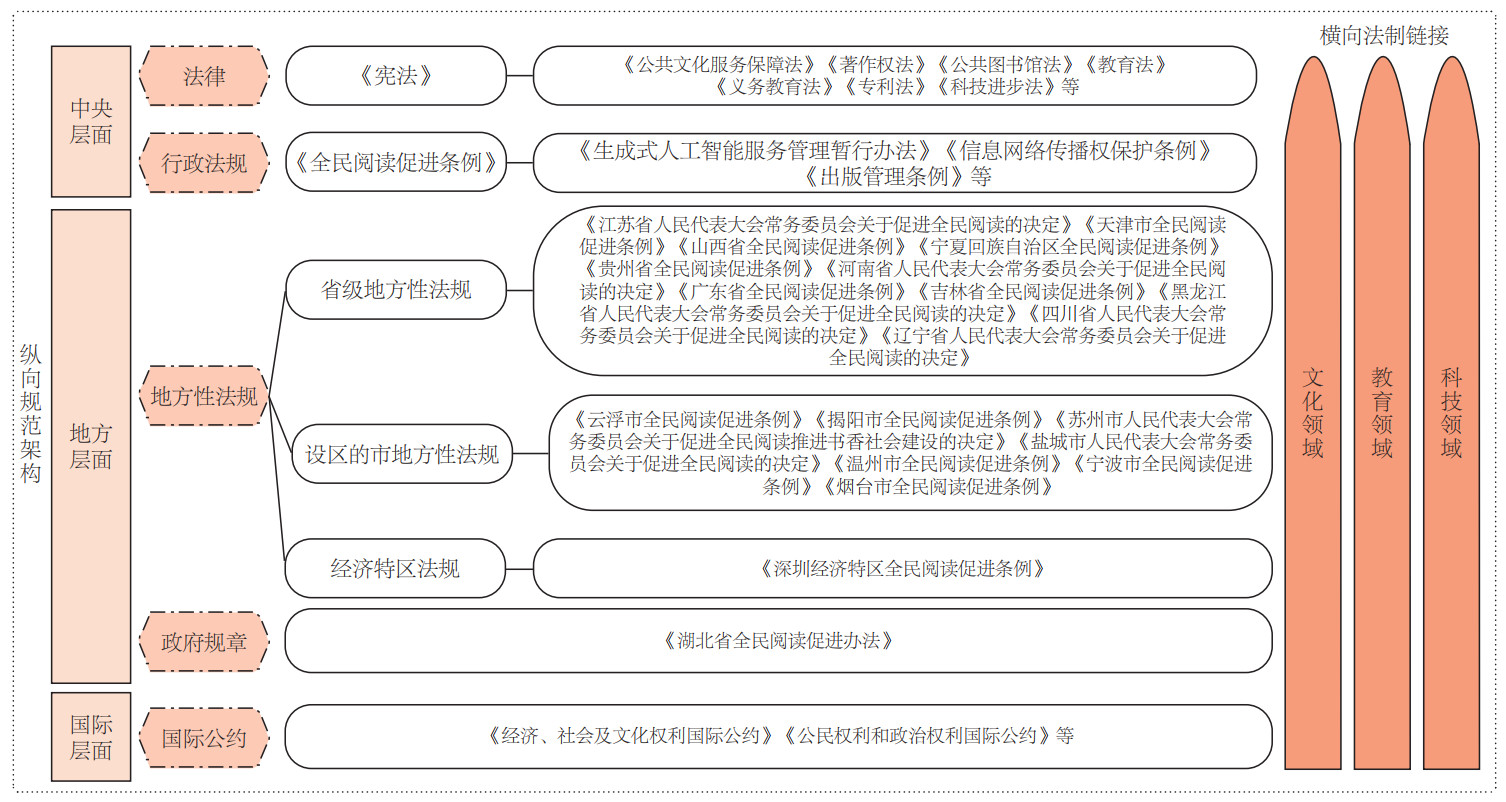
2025年《全民阅读促进条例》的颁布,标志着我国全民阅读事业迈入法治化新阶段,也意味着我国已初步建成全民阅读法制体系。该条例虽为“软法”,却设置了“法律责任”专章,发挥并扩大其实质约束力。通过对各类主体的阅读权利与义务的合理配置,在不同区域和群体之间实现分配正义。同时,为顺应阅读数字化趋势,围绕技术支撑、阅读形态和内容管理提出前瞻性制度安排。展望未来,应适时出台《中华人民共和国全民阅读促进法》并加强与《中华人民共和国著作权法》等法律的协同治理;持续完善公共图书馆、实体书店、数字阅读平台及经费、奖励、人才等软硬件阅读设施;进一步明确数字阅读服务提供者注意义务标准和范畴,为新时代社会主义文化强国建设筑牢文化法治根基。
The promulgation of the Regulations on the Promotion of National Reading in 2025 marked a historic leap in China’s national reading cause from “policy advocacy” to “national strategy” and further to “unified legislation”. It also signifies the initial establishment of a legal system for national reading underpinned by laws, with administrative regulations as the mainstay, supplemented by local regulations and government rules, and with reference to international conventions. This system is horizontally integrated with the three major fields of culture, education, and science and technology. Although the Regulations on the Promotion of National Reading are characterized as “soft law”, they include a special chapter on “legal liabilities”. Articles 42 and 43 impose hard constraints on government responsibilities, whereas Article 44 directly links relevant infringements and illegal acts to corresponding departmental laws for regulation. To effectively bridge the “reading divide”, the Regulations achieve distributive justice among different regions and groups through the rational allocation of rights and obligations. Citizens enjoy the right to freedom of reading, the right to equal reading, and the right to reading remedies. The government serves as the key obligatory subject for promoting national reading, while mass organizations, news media, publishing entities, schools, and managers of national reading facilities constitute major social forces in this endeavor. To support and regulate the application of digital technologies in reading, the Regulations encourage the use of new technologies, carriers, and facilities to expand the influence of national reading; integrate digital reading with traditional reading; and require digital reading service providers to strengthen content management. Looking ahead, the Law on the Promotion of National Reading should be enacted in due course. Its legislative structure should be further adjusted, by adding special chapters on rights and obligations, improving legal liability provisions, and optimizing legal terminology. Synergistic governance with related laws, such as the Copyright Law should be strengthened, including refining provisions on cultural poverty alleviation through networks in the Regulations on the Protection of the Right of Communication through Information Networks and provisions on fair use for persons with reading disabilities in the Copyright Law. Efforts should also be made to continuously improve various software and hardware reading facilities, promote the high-quality development of public libraries, enhance the service capacity of physical bookstores, establish a national digital platform for national reading, improve the funding guarantee mechanism for reading, implement reading incentives and reincentive models, and cultivate professional and interdisciplinary reading talent. In addition, if a digital reading service provider provides only technical services, it should be regarded as a technical service provider, and the rules on indirect copyright infringement should apply by analogy. Conversely, if it provides content services, it should be deemed a content service provider, and the provisions on direct infringement by network service providers in the Civil Code should apply directly.
徐小奔,付薄霖. 全民阅读法制建设的立法回眸与制度前瞻[J]. 科技与出版, 2026, 45(4): 33-42. XU Xiaoben,FU Bolin. Legislative Retrospect and Institutional Prospects of Legal Construction for National Reading. Science-Technology & Publication, 2026, 45(4): 33-42.
http://kjycb.tsinghuajournals.com/CN/ 或 http://kjycb.tsinghuajournals.com/CN/Y2026/V45/I4/33
Cited