Please wait a minute...
科技与出版  2026, Vol. 45 Issue (3): 82-92    
产业观察
人工智能赋能出版的政策导向、理论研究与产业实践——2025年出版业人工智能应用报告
周蔚华1,2,梁乾2,
1. 中国人民大学新闻与社会发展研究中心, 100872, 北京
2. 中国人民大学新闻学院, 100872, 北京
Artificial Intelligence in Publishing in 2025: Policy Orientation, Theoretical Research, and Industry Practice
ZHOU Weihua1,2,LIANG Qian2,
1. Research Center of Journalism and Social Development, Renmin University of China, 100872, Beijing, China
2. School of Journalism and Communication, Renmin University of China, 100872, Beijing, China
全文: HTML    PDF(1744 KB)  
输出: BibTeX | EndNote (RIS)      
摘要: 

2025年是人工智能与出版业深度融合的关键一年。政策导向方面,多项“人工智能+出版”政策出台,通过“顶层设计—创新支持—版权保障—规范传播”的路径引导产业转型升级。理论研究方面,研究主题集中,论文数量达到历史新高,研究深度增强,形成了常态化交流机制。产业实践方面,人工智能在管理机制、内容生产、产品创新、编辑审校、营销出海多个方面加速落地,出版业智能化转型有了新的突破。面向未来,出版业仍需要在行业协同合作、治理制度完善、商业模式探索、复合人才培养、人机协同模式等多个方向守正创新,系统推进,实现技术升级与文化坚守的统一,促进出版行业的高质量发展。

关键词 人工智能数字出版出版融合出版政策出版实践    
Abstract

This paper presents a 2025 development report on artificial intelligence application in the publishing industry and argues that 2025 constitutes a critical year of deep integration between AI and publishing. The paper organizes its argument around three linked domains—policy orientation, theoretical research, and industry practice—and uses this tripartite structure to translate a broad "AI wave" into a structured account of how governance, scholarship, and deployment co-evolve. On the policy side, the paper states that multiple "AI Plus publishing" policies were introduced and that these policies guide industrial transformation and upgrading through an explicit pathway: top-level design, innovation support, copyright protection, and standardized dissemination. The emphasis is on governance sequencing. "top-level design" is positioned as the upstream orientation that defines direction and coordination; "innovation support" functions as the enabling condition for exploration and scaling; "copyright protection" becomes the boundary mechanism that stabilizes legitimacy and protects rights allocation; and "standardized dissemination" anchors the downstream requirement for orderly communication and governance of publishing outputs. This pathway is presented as a policy logic that makes AI adoption governable rather than purely technological. On the theoretical research side, the paper claims a concentration of research themes, an increase in publication volume to a historical high, and a deepening of research depth. Instead of remaining at general statements, the paper structures "deepening" as a mechanism of topic consolidation: research is portrayed as becoming more focused, more systematic, and more oriented toward operational problems that AI introduces into publishing, thereby forming a knowledge base that can communicate with industry practice. On the industry practice side, the paper describes AI as enabling publishing deployment across multiple directions, including governance mechanisms, technological application, and operational innovation. At the level of future development, the paper argues for "upholding fundamental principles and breaking new ground" as a guiding orientation and specifies several action directions: industrial coordination mechanisms, institutional governance improvement, business model exploration, composite talent cultivation, and human–AI collaboration models. The logic is that AI-enabled upgrading must maintain a unity of technological upgrading and cultural integrity; otherwise, automation could erode the cultural commitments that publishing carries. The paper concludes by positioning high-quality development as the objective and system advancement as the method: the publishing industry should not merely "use AI, " but should systemically promote AI integration through policy guidance, research accumulation, and practice deployment while ensuring that governance, rights protection, dissemination order, and cultural responsibility remain integral to the AI-enabled transformation trajectory in 2025 and beyond.

Key wordsartificial intelligence    publishing industry    policy signals    research agendas    digital-intelligent transformation
出版日期: 2026-05-15
基金资助:中国人民大学马克思主义新闻观研究中心科研项目“北京经济宣传效能提升研究”(MXG202501)

引用本文:

周蔚华,梁乾. 人工智能赋能出版的政策导向、理论研究与产业实践——2025年出版业人工智能应用报告[J]. 科技与出版, 2026, 45(3): 82-92.
ZHOU Weihua,LIANG Qian. Artificial Intelligence in Publishing in 2025: Policy Orientation, Theoretical Research, and Industry Practice. Science-Technology & Publication, 2026, 45(3): 82-92.

链接本文:

http://kjycb.tsinghuajournals.com/CN/      或      http://kjycb.tsinghuajournals.com/CN/Y2026/V45/I3/82

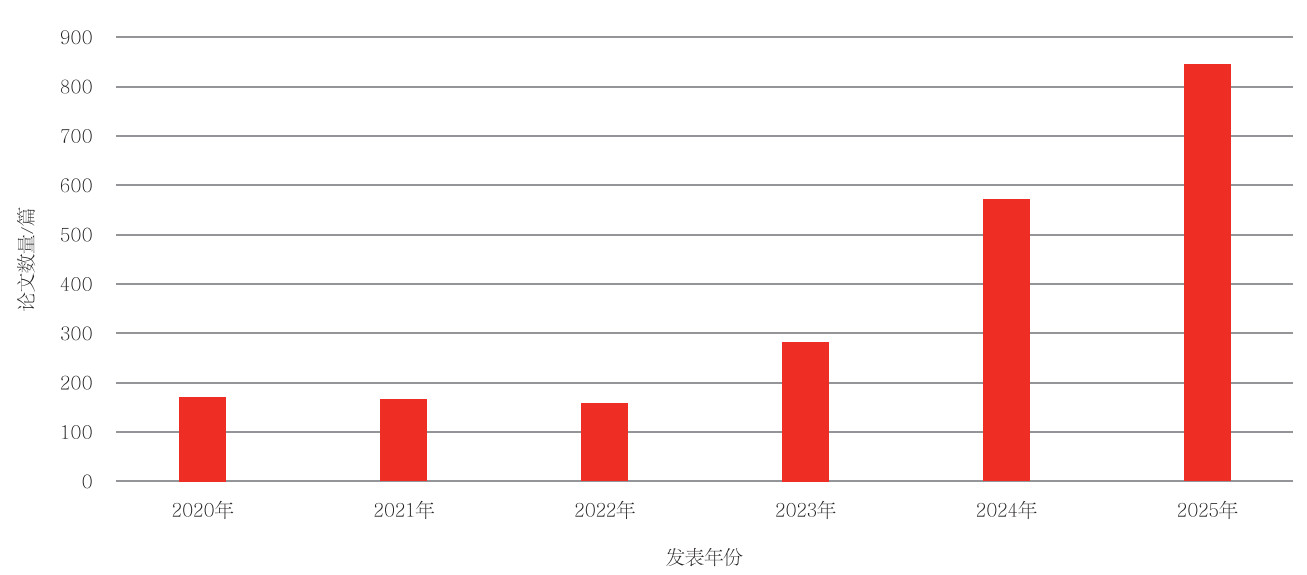
图 1  2020—2025年人工智能与出版研究论文数量统计
1 习近平. 构建高质量伙伴关系开启金砖合作新征程: 在金砖国家领导人第十四次会晤上的讲话[EB/OL]. https://www.gov.cn/gongbao/content/2022/content_5699921.htm.
2 国务院关于深入实施"人工智能+"行动的意见[EB/OL]. [2026-01-01]. https://www.gov.cn/gongbao/2025/issue_12266/202509/content_7039598.html.
3 国家新闻出版署等关于印发《网络出版科技创新引领计划》的通知[EB/OL]. [2026-01-01]. https://www.gov.cn/zhengce/zhengceku/202504/content_7019838.htm.
4 国家新闻出版署关于组织实施2026年度出版融合发展工程的通知[EB/OL]. [2026-01-01]. https://www.nppa.gov.cn/xxfb/tzgs/202512/t20251225_943952.html.
5 国家版权局印发《关于加快推进版权事业高质量发展的意见》的通知[EB/OL]. [2026-01-01]. https://www.ncac.gov.cn/xxfb/tzgg/202507/t20250723_923374.html.
6 广东省高级人民法院关于以高质量知识产权审判工作促进人工智能科技创新和产业发展的意见[EB/OL]. [2026-01-01]. https://www.gdcourts.gov.cn/gsxx/quanweifabu/guifanwenjian/content/post_1843333.html.
7 全国法院知识产权案件法律适用问题年度报告(2024)摘要[EB/OL]. [2026-01-01]. https://www.court.gov.cn/zixun/xiangqing/462901.html.
8 AI生成作品之著作权保护: 对比两个第一案[EB/OL]. [2026-01-01]. https://sfb.pkulaw.com/lawfirmarticles/601717d092554b2eb93f5f4a7b972f79bdfb.html.
9 关于印发《人工智能生成合成内容标识办法》的通知[EB/OL]. [2026-01-01]. https://www.cac.gov.cn/2025-03/14/c_1743654684782215.htm.
10 方卿, 许洁, 伍军红. 2025年编辑出版学领域十大学术热点[J]. 中国编辑, 2026 (1): 10- 23.
11 周蔚华, 程丽. 人工智能知识传播下的新阅读及其对社会的影响[J]. 编辑之友, 2025 (3): 5- 13.
12 郑泉, 白惠仁. 学术出版中的认知非正义[J]. 出版科学, 2025, 33 (4): 14- 22.
13 邓英, 刘书亮. 精准知识服务: 数智时代中文社科学术期刊影响力提升路径[J]. 四川师范大学学报(社会科学版), 2025, 52 (6): 118-126, 200-201.
14 刘锦宏, 陈姜同, 王一雪. 智媒时代的互动叙事: 电子书的现状与未来[J]. 出版科学, 2025, 33 (6): 63- 71.
15 徐立萍, 冯淼华. 具身智能赋能出版实践的可能与可为[J]. 中国出版, 2025 (21): 14- 19.
16 肖谦, 丁毅, 郑汉. 出版行业应用生成式人工智能的现实困境与实践思路: 基于对43家出版机构的访谈调查[J]. 编辑之友, 2025 (6): 49- 56.
17 宋宁远, 杨文蝶, 胡冬梅. 数智赋能出版物定制化营销路径研究[J]. 出版广角, 2025 (1): 122- 127.
18 邓肯, 常帅武. 生成式人工智能背景下我国古籍出版的发展现状、问题与策略[J]. 图书馆, 2025 (4): 13- 18.
19 卢先和. 高等教育教材版权保护: 技术革命下的挑战与对策[J]. 科技与出版, 2025 (10): 5- 12.
20 张馨月, 张立. 从GPT到Deep Seek: 技术演进赋能出版业态重构[J]. 出版广角, 2025 (5): 3- 9.
21 黎姣欣, 李玮. AI大模型辅助网文数字出版的伦理争议与治理框架[J]. 出版广角, 2025 (5): 72- 79.
22 张俊发. 著作权法上GAI生成内容的定性[J]. 新媒体与社会, 2025 (2): 184-202, 466-467.
23 吴赟, 叶芃. 生成式人工智能环境下学术出版伦理规范体系的建构与治理[J]. 编辑之友, 2025 (7): 50- 58.
24 李林容, 田园. "编辑进化": 生成式人工智能驱动下的内容生产与角色转变[J]. 编辑之友, 2025 (5): 48- 57.
25 李丁一, 胡正荣. 出版智能化的结构性瓶颈与协同路径: 基于AI赋能的系统性观察[J]. 出版广角, 2025 (5): 50- 56.
26 王卫东. 赋能而非替代: 关于AI时代图书编辑主体性重塑的思考[J]. 出版广角, 2025 (9): 61-66, 115.
27 肖延兵, 刘光金, 李军, 等. 转型与重塑: 人工智能时代图书编辑角色转变与核心能力构建研究[J]. 中国编辑, 2025 (9): 41- 47.
28 李林容, 田园. "编辑进化": 生成式人工智能驱动下的内容生产与角色转变[J]. 编辑之友, 2025 (5): 48- 57.
29 刘扬, 曹晨. 人工智能时代数字出版人才培养的机遇、挑战与对策[J]. 中国出版, 2025 (19): 53- 57.
30 周蔚华, 刘松岩. 人工智能知识重构下的出版人才"八芒星培养模式"[J]. 出版科学, 2025, 33 (2): 22- 31.
31 雷启立, 肖敖夏. 坐言起行: 以融合创新重构卓越出版人才培养[J]. 现代出版, 2025 (11): 35- 43.
32 张聪聪. 少儿出版加快推进数智发展行业共识[N]. 中国出版传媒商报, 2025-06-13(39).
33 范燕莹. 用好AI, 赋予文学出版更多可能[N]. 中国新闻出版广电报, 2025-05-30(1).
34 李美霖, 蒲添. 人工智能重新定义出版全产业链[N]. 中国新闻出版广电报, 2025-04-07(8).
35 商小舟, 李婧璇. 鼓励技术创新建立容错机制[N]. 中国新闻出版广电报, 2025-04-28(6).
36 朱子钰. 从"技术焦虑"转向"价值共识"[N]. 中国新闻出版广电报, 2025-11-17(5).
37 中国新闻出版研究院. 出版融合发展报告(2025)[M]. 北京: 中信出版集团, 2025.
38 中国数字出版产业年度报告课题组, 崔海教, 王飚, 等. 2024—2025年中国数字出版产业年度报告[J]. 出版发行研究, 2025 (10): 22- 28.
39 效率提升300%!文心一言与辞海强强结合, 推出智能知识审校系统"辞文"[EB/OL]. [2026-01-01]. https://baijiahao.baidu.com/s?id=1819841854302459217&wfr=spider&for=pc.
[1] 孙冠豪. 生成式人工智能赋能学术期刊出版的挑战与应对策略[J]. 科技与出版, 2026, 45(4): 59-68.
[2] 刘玥,黄楚新,李一凡. 人工智能赋能数智出版的平台化实践[J]. 科技与出版, 2026, 45(4): 77-85.
[3] 冯立君,鲍柳康. AI赋能科普图书内容“二次创作”及多模态转化的路径探析[J]. 科技与出版, 2026, 45(4): 94-103.
[4] 毛文思,王飚. 2025年中国数字出版发展态势盘点与2026年发展展望[J]. 科技与出版, 2026, 45(3): 14-27.
[5] 徐丽芳,田峥峥,张蒂,曹天天,王一雪. 公正导向下的开放与治理重构:2025海外科技期刊出版观察[J]. 科技与出版, 2026, 45(3): 38-55.
[6] 王鹏飞,高智晖. 人工智能驱动与情绪价值引领:2025年出版营销与运营[J]. 科技与出版, 2026, 45(3): 28-37.
[7] 曾伟明,余佳佳. 构建“全球南方”学术数字出版平台  推动全球自主知识体系公平化[J]. 科技与出版, 2026, 45(2): 51-58.
[8] 钱聪,杨晓新,杨海平. 出版业竞争力重塑:GenAI赋能下的出版业情境化转型路径研究[J]. 科技与出版, 2026, 45(2): 59-65.
[9] 谢冰滨. PMC指数模型视角下政策赋能出版人才队伍建设的机制研究[J]. 科技与出版, 2026, 45(2): 66-81.
[10] 李慧,苏莉娜,周会霞,黎霜霜,王梦婷,谢邦彦,刘广宇. 中国科技期刊使用人工智能政策的研究及对策建议——基于40份科技核心期刊政策文本的Nvivo分析[J]. 科技与出版, 2026, 45(2): 96-107.
[11] 王芷若,刘睿. 人工智能时代大型工具书编纂出版的著作权挑战与应对[J]. 科技与出版, 2026, 45(2): 108-118.
[12] 吴赟,牛蓉. 我国出版融合研究的现有格局、深层挑战与创新路径[J]. 科技与出版, 2026, 45(2): 22-32.
[13] 宋俊锋,刘万. 可解构的“畅销经验”:AIGC赋能出版营销的价值趋向与实践落点[J]. 科技与出版, 2026, 45(1): 70-84.
[14] 刘超. 人工智能时代的教育出版:挑战、机遇与转型路径探索[J]. 科技与出版, 2025, 44(9): 21-28.
[15] 刘普,孙婉婷. 社科学术期刊的AI使用政策图谱与治理进阶——基于50家社科学术期刊生成式人工智能使用政策文本的分析[J]. 科技与出版, 2025, 44(9): 52-62.