Please wait a minute...
科技与出版  2026, Vol. 45 Issue (3): 105-112    
产业观察
前沿科技企业与科技期刊的共生发展路径探索
王海燕1,张莉1,严美娟1,吴年华2,刘明寿3,*
1. 南通大学学报(医学版. 编辑部, 226019, 江苏南通
2. 扬州职业技术大学, 225009, 江苏扬州
3. 扬州大学, 225009, 江苏扬州
Co-evolving Frontier Tech Enterprise and Science Journals: Symbiotic Pathways for Cultivating New Quality Productive Forces
WANG Haiyan1,ZHANG Li1,YAN Meijuan1,WU Nianhua2,LIU Mingshou3,*
1. Editorial Department of Journal of Nantong University(Medical Sciences), 226019, Nantong, China
2. Yangzhou Polytechnic University, 225009, Yangzhou, China
3. Yangzhou University, 225009, Yangzhou, China
全文: HTML    PDF(1710 KB)  
输出: BibTeX | EndNote (RIS)      
摘要: 

前沿科技企业是新质生产力发展的核心引擎,科技期刊是学术交流与知识扩散的关键设施,二者共生构成创新生态系统的关键主体。研究表明,前沿科技企业重塑期刊内容与评价体系,科技期刊则为企业提供战略导航、产学研协同平台,并提升企业国际声誉。二者在与政府、资本、人才等要素互动中形成协同演化系统,但仍面临技术转化鸿沟、伦理挑战、期刊适配性不足、激励错位及协作平台缺失等制约。为此,研究提出构建产学研长效协同机制、建立“学术—产业”双轨评价、创新知识产权管理、设计激励相容政策及打造智能协同平台等普适性策略,为优化创新生态系统提供参考。

关键词 前沿科技企业科技期刊新质生产力共生发展创新生态系统    
Abstract

This article explores a symbiotic development pathway between frontier technology enterprises and sci-tech journals from the perspective of cultivating new quality productive forces. The paper positions frontier technology enterprises as a core engine of the development of new quality productive forces, and sci-tech journals as key infrastructure for academic exchange and knowledge diffusion; together, their symbiosis is described as constituting a pivotal set of actors within the innovation ecosystem. The analysis thereby shifts attention from treating enterprises and journals as separate systems to treating them as mutually shaping nodes embedded in a broader ecology of policy, capital, and talent. The article makes three core role claims and then builds its problem–solution logic around them. First, it argues that frontier technology enterprises actively reshape journals' content systems and evaluation systems. The mechanism implied is agenda-setting and standard-shifting: technological breakthroughs and industrial practice generate frontier questions, press for interdisciplinary integration, and thereby remodel what journals prioritize, how they curate content, and which evaluative dimensions gain legitimacy. Second, sci-tech journals are portrayed as providing multidimensional strategic empowerment for enterprises. They function as strategic navigation platforms (supporting knowledge orientation), as channels for international reputation and authority formation, and as platforms that facilitate industry–academia–research coordination. In this framing, journals do not merely "publish" research; they enable visibility, coordination, and the circulation of innovation factors. Third, the paper argues that these roles are not formed in isolation but emerge through interaction with government, capital, and talent factors, producing a synergistic co-evolution system in which institutional guidance, resource allocation, and capability mobility become boundary conditions for symbiosis. The article then identifies constraints that prevent symbiosis from automatically producing high-quality outcomes. It lists five interrelated bottlenecks: a technology-translation gap, ethical challenges, insufficient journal adaptability, incentive misalignment, and the absence of dedicated collaboration platforms. Importantly, the paper treats these as systemic constraints rather than isolated problems; they operate across the innovation chain and the industrial chain, across norms and incentives, and across organizational infrastructures. In response, the study proposes five "universal strategies" for optimizing symbiotic development. These include building long-term industry–academia–research coordination mechanisms; establishing an academic–industrial dual-track evaluation system; innovating intellectual property management; designing incentive-compatible policy tools; and constructing intelligent collaboration platforms. The strategic emphasis is not on adding more actors but on reconstructing coupling mechanisms—evaluation, governance, rights allocation, incentives, and platformization—so that knowledge chains and innovation chains can be more tightly integrated. The article concludes that clarifying this internal logic and these practical dilemmas provides a usable reference for policy formulation, journal development, and enterprise innovation management aimed at the high-quality cultivation of new quality productive forces.

Key wordsfrontier technology enterprise    science and technology journals    new quality productive forces    symbiotic development    innovation ecosystem
出版日期: 2026-05-15
基金资助:江苏省社科基金重点项目(25DJA001)
通讯作者: 刘明寿   
Corresponding author: Mingshou LIU   

引用本文:

王海燕,张莉,严美娟,吴年华,刘明寿. 前沿科技企业与科技期刊的共生发展路径探索[J]. 科技与出版, 2026, 45(3): 105-112.
WANG Haiyan,ZHANG Li,YAN Meijuan,WU Nianhua,LIU Mingshou. Co-evolving Frontier Tech Enterprise and Science Journals: Symbiotic Pathways for Cultivating New Quality Productive Forces. Science-Technology & Publication, 2026, 45(3): 105-112.

链接本文:

http://kjycb.tsinghuajournals.com/CN/      或      http://kjycb.tsinghuajournals.com/CN/Y2026/V45/I3/105

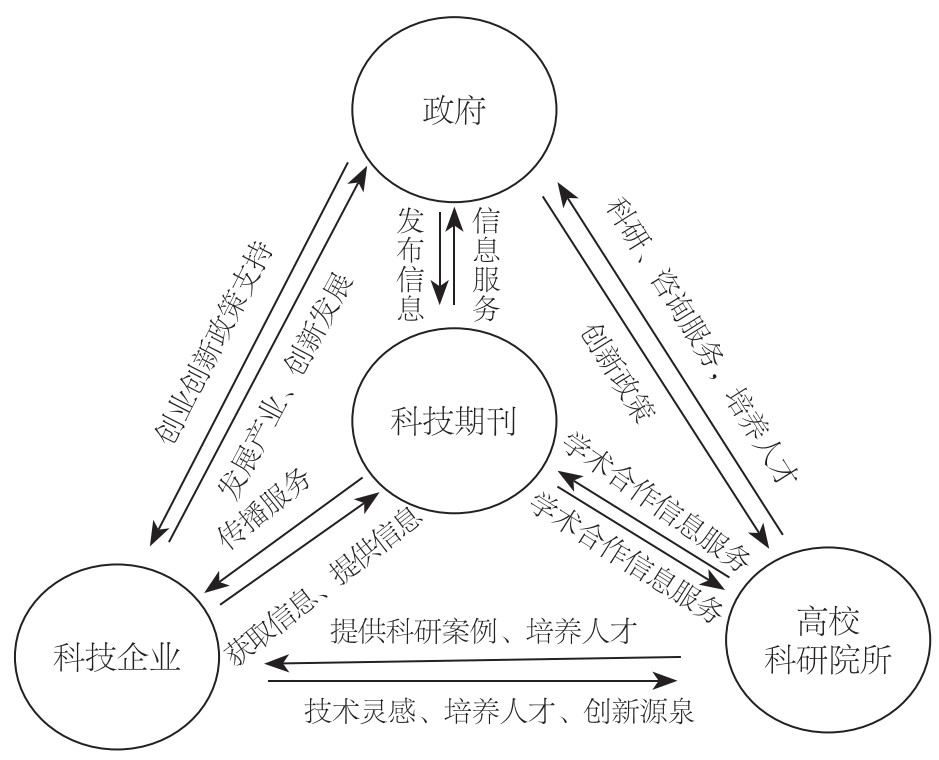
图 1  科技期刊驱动的产学研协同创新生态系统
表 1  “学术—产业”双轨评价体系
1 金会平, 吴治平. 科技期刊在推动新质生产力发展中的评价体系创新[J]. 科技与出版, 2024 (12): 76- 82.
2 Etzkowitz H , Leydesdorff L . The dynamics of innovation: From National Systems and "Mode 2" to a Triple Helix of university–industry–government relations[J]. Research Policy, 2000, 29 (2): 109- 123.
3 尹西明, 陈劲, 武沛琦, 等. 新质生产力培育视角下杭州"六小龙"创新崛起密码与启示[J]. 创新科技, 2025, 25 (3): 1- 15.
4 Hu W T, Zheng J, Zhang Z X, et al. PlankAssembly: Robust 3D reconstruction from three orthographic views with learnt shape programs[C]//Proceedings of the IEEE/CVF Conference on Computer Vision(ICCV), 2023: 18495-18505.
5 Ming Y H , Ma D , Dai W C , et al. SLC2-SLAM: Semantic-guided loop closure using shared latent code for NeRF SLAM[J]. IEEE Robotics and Automation Letters, 2025, 10 (5): 4978- 4985.
6 OpenAI, Achiam J, Adler S, et al. GPT-4 Technical Report [PP/OL]. V6. arXiv(2024-03-04). [2026-02-03]. https://arxiv.org/abs/2303.08774.
7 闫润, 黄立波, 郭辉, 等. 实时光线追踪相关研究综述[J]. 计算机科学与探索, 2023, 17 (2): 263- 278.
8 Liu S , Wang Z , Liu S , et al. Quantifying the interfacial reactions at anode of lithium metal batteries[J]. Nature Nanotechnology, 2024, 19 (4): 528- 534.
9 施志晖, 陆岷峰. 大模型驱动金融智能化转型: 本地化优化与风险管理[J]. 区域金融研究, 2025 (2): 1- 9.
10 Engineering编辑部. Engineering征稿启事: 人工智能赋能工程科技[EB/OL]. (2025-03-31) [2025-11-14]. https://paper.sciencenet.cn/htmlpaper/2025/3/2025331113350858130841.shtml.
11 国产软件加速攻坚群核科技牵头工业级云端CAD研发项目通过验收[EB/OL]. (2024-07-25) [2025-11-14]. https://caijing.chinadaily.com.cn/a/202407/25/WS66a205bba3107cd55d26c950.html.
12 百济神州有限公司. 百济神州有限公司2024年年度报告[R/OL]. (2025-04-29) [2025-11-14]. http://vip.stock.finance.sina.com.cn/corp/view/vCB_AllBulletinDetail.php?stockid=688235&id=11040880.
13 HarmonyOS: Technical innovation and international standardization[J]. IEEE Transactions on Mobile Computing, 2024, 23(7): 6892-6905.
14 杨博宇. 国资赋能机器人产业: 宇树科技融资案例分析[EB/OL]. (2024-09-29)[2025-11-14]. https://www.chinaventure.com.cn/news/80-20240929-383206.html.
15 吴光东, 袁明杰, 谢智敏. 创新生态系统驱动区域创新绩效路径识别[J]. 中国科技论坛, 2024 (9): 11-20, 56.
16 侯春梅, 贺郝钰, 孙力炜, 等. 基于智库功能视角下科技期刊"三维桥梁"构建与实践[J]. 中国科技期刊研究, 2025, 36 (12): 1669- 1674.
17 浙江省财政厅浙江省科学技术协会关于印发浙江省科学普及和学术智力专项扶持资金管理办法的通知[EB/OL]. [2025-11-14]. https://czt.zj.gov.cn/art/2023/12/20/art_1229135599_2502441.html.
18 长三角科技创新共同体建设办公室. 长三角科技企业集群与期刊协同发展报告[R]. 上海: 长三角科技创新共同体建设办公室, 2024.
19 刘渊, 王琳珂. 基于创新生态系统视域的教育科技人才一体化发展实现路径研究[J]. 河北青年管理干部学院学报, 2025, 37 (2): 86- 93.
20 王舒磊, 么鹏飞, 张义鑫, 等. 我国产业链供应链生态体系构建路径研究[J]. 机器人产业, 2025 (2): 6- 17.
21 李玉洋. 杭州为何崛起"六小龙"?长期优化创新环境开花结果[EB/OL]. (2025-02-15) [2025-11-14]. http://www.cb.com.cn/index/show/bzyc/cv/cv135243801640.
22 任红梅, 张恬, 刘晶晶, 等. 我国科技期刊产业服务能力建设的调查与思考[J]. 中国科技期刊研究, 2024, 35 (5): 586- 592.
23 区域科技成果转化"死亡之谷"破解路径[EB/OL]. (2025-07-18) [2025-11-14]. https://www.1633.com/article/315748.html.
24 李梅芳, 章子豪. 人工智能技术伦理治理与合规框架研究[J]. 技术经济与管理研究, 2025 (1): 140- 145.
25 张牟婷, 卢璐璐. 人工智能"黑箱"问题的伦理困境与破解[J]. 艺术管理(中英文), 2025 (1): 104- 111.
26 崔宇红, 于文娟. 开放科学背景下科研伦理审查优化路径[J]. 图书情报工作, 2025, 69 (4): 4- 11.
27 王晓刚. 科技期刊快速发表模式创新与实践[EB/OL]. (2021-07-09) [2025-11-14]. https://news.sciencenet.cn/htmlnews/2021/7/461009.shtm.
28 杨立赟. 我国科技期刊国际化发展短板与突破路径[EB/OL]. (2025-05-30) [2025-11-14]. http://yuanchuang.caijing.com.cn/2025/0530/5093291.shtml.
29 姚伟峰, 鲁桐. 文化冲突对企业商业模式创新影响的研究[J]. 企业经济, 2011, 30 (4): 10- 13.
30 破局传统转化模式, 区域科技成果转化服务赋能高校科研创新[EB/OL]. (2025-07-18) [2025-11-14]. https://www.1633.com/article/315748.html.
31 杭州市人民政府办公厅. 杭州市专利转化运用专项行动实施方案[EB/OL]. (2024-11-04) [2025-11-14]. https://www.hangzhou.gov.cn/art/2024/11/19/art_1229063387_1847104.html.
32 段弘. 士不可以不弘毅: 记2019年度国家自然科学奖二等奖项目"神经网络的若干关键基础理论研究"主研专家章毅教授[J]. 中国科技奖励, 2020 (5): 49- 52.
33 德国Factory Berlin柏林创意工场(众创空间) [EB/OL]. (2020-07-31) [2025-11-14]. https://www.ciste.org.cn/gjjsmy/gjjsjylm/art/2023/art_9b6475929d194101af4b2c718e98fb9f.html.
34 杭州市市场监督管理局. 《人民日报》高度点赞"专利快速预审服务"等杭州经验[EB/OL]. (2025-01-20) [2025-11-14]. https://scjg.hangzhou.gov.cn/art/2025/2/20/art_1693482_58926966.html.
35 鲍悦华. 德国弗劳恩霍夫学会科技服务的最新举措与启示[EB/OL]. (2024-06-11) [2025-11-14]. http://howxidea.com/archives/939.
36 李景煜. 德国科研成果概念验证体系建设经验[EB/OL]. (2023-07-20) [2025-11-14]. https://cice.shnu.edu.cn/0f/6c/c26051a790380/page.htm.
[1] 贺思,陈红兵,王景周,贺嫁姿. 高APC限制:政策动因剖析与协同治理路径探索[J]. 科技与出版, 2026, 45(4): 43-51.
[2] 秦福强,贺斌,胡玉景. 从评价驱动到价值驱动:地方科技期刊深度服务区域创新生态的路径探索[J]. 科技与出版, 2026, 45(4): 52-58.
[3] 徐卓仕. 强化科技期刊在有组织科研创新体系中的核心作用[J]. 科技与出版, 2026, 45(4): 69-76.
[4] 徐丽芳,田峥峥,张蒂,曹天天,王一雪. 公正导向下的开放与治理重构:2025海外科技期刊出版观察[J]. 科技与出版, 2026, 45(3): 38-55.
[5] 任胜利,俞征鹿,宁笔,陈哲. 2025年我国英文科技期刊发展回顾[J]. 科技与出版, 2026, 45(3): 56-67.
[6] 王婧,张芳英,吴领叶,刘志强,张铁明,张昕. 收官“十四五”:从“卓越计划”到“卓越生态”——2025年我国中文科技期刊发展盘点[J]. 科技与出版, 2026, 45(3): 68-81.
[7] 沈锡宾,李鹏,黄丽洋,刘红霞,赵巍,吕相征,魏均民. 中国科技期刊集群加盟期刊协同发展与生态治理机制研究[J]. 科技与出版, 2026, 45(3): 93-104.
[8] 李慧,苏莉娜,周会霞,黎霜霜,王梦婷,谢邦彦,刘广宇. 中国科技期刊使用人工智能政策的研究及对策建议——基于40份科技核心期刊政策文本的Nvivo分析[J]. 科技与出版, 2026, 45(2): 96-107.
[9] 秦明阳,牛晓娜,杨保华,范泓洋. 培育世界一流科技期刊背景下高校角色重塑与实践路径[J]. 科技与出版, 2026, 45(1): 85-92.
[10] 郁林羲,郑羽彤. 全球钻石开放获取可持续发展路径比较与启示[J]. 科技与出版, 2026, 45(1): 93-102.
[11] 张秦. AI时代科技期刊科研诚信治理的国际经验与中国路径[J]. 科技与出版, 2025, 44(9): 63-69.
[12] 郭璐琪,骆瑾,王昕. 中文科技期刊视频摘要传播效果及提升策略——以卓越计划二期项目中文单刊为例[J]. 科技与出版, 2025, 44(9): 79-86.
[13] 吴晓丽,陈广仁. 面向高质量发展的科技期刊编辑工匠精神实践路径——基于社会认知理论的研究[J]. 科技与出版, 2025, 44(9): 95-100.
[14] 吕鹏,王越,刘冰,魏均民. 医学期刊有效推动科技成果转化的路径思考[J]. 科技与出版, 2025, 44(9): 101-106.
[15] 李玖倩,李爱群. 数智赋能科技期刊编辑出版变革的应用场景与技术反思[J]. 科技与出版, 2025, 44(8): 38-46.