Please wait a minute...
科技与出版  2026, Vol. 45 Issue (6): 43-57    
产业观察
沉淀与涌现:数智时代出版业知识库建设的现实样态、困局机理及未来进路
李嘉宁1,2,李梦竹3
1. 中国传媒大学信息传播学院,100024,北京
2. 中国新闻出版研究院,100073,北京
3. 北京师范大学新闻传播学院,100875,北京
Sedimentation and Emergence: Current Landscape, Structural Constraints, and Future Pathways of Knowledge Base Construction in the Publishing Industry in the Digital-Intelligent Era
LI Jianing1,2,LI Mengzhu3
1. School of Information and Communication, Communication University of China, 100024, Beijing, China
2. Chinese Academy of Press and Publication, 100073, Beijing, China
3. School of Journalism and Communication, Beijing Normal University, 100875, Beijing, China
全文: HTML    PDF(1873 KB)  
输出: BibTeX | EndNote (RIS)      
摘要: 

出版业知识库建设正由资源沉淀走向服务涌现。本文基于68家知识服务模式试点单位的访谈式问卷数据,运用“魔川—死谷—达尔文海”创新理论模型,考察出版业知识库建设的现实样态、困局机理与未来进路。研究发现,出版业在资源积累、技术应用、模式创新和组织调适等方面取得了积极进展,但资源优势与需求规则仍存在错配,用户导向尚未充分内化为平台建构的前置约束,形成认知“魔川”;平台功能和运营兑现衔接尚不足,构成市场“死谷”。用户连接不足、协作网络偏弱与生态适应滞后相互叠加,致使知识库建设面临“达尔文海”式筛选压力。基于此,研究提出应以战略校准、能力贯通和生态共建为主线的跨越路径,通过优化需求规则、贯通绩效链条、健全协作机制,提升知识库持续供给能力和价值释放效能,旨在为出版业知识资源开发与知识服务转型提供理论参照和实践启示。

关键词 出版知识库知识服务数智转型生态共建创新理论模型    
Abstract

Knowledge base construction in the publishing industry is gradually shifting from resource accumulation toward service emergence. Based on interview-based questionnaire data from 68 pilot units engaged in knowledge service models, this study applies the "Magic Canyon–Valley of Death–Darwinian Sea" innovation framework to examine its evolutionary logic across three dimensions of empirical patterns, structural constraints, and future pathways. The findings indicate that the industry has made staged progress in resource accumulation, technological application, business model innovation, and organizational adaptation, while structural tensions remain evident. Although user orientation has formed a general consensus, it has not yet been internalized as an ex-ante constraint in platform design, and the mismatch between resource advantages and demand rules generates a cognitive "Magic Canyon." Weak coupling between functional construction and operational realization limits the stable conversion of resource capacity into service capability and market returns, producing a "Valley of Death" in value transformation. Insufficient user connectivity, weak collaborative networks, and lagging ecosystem adaptation jointly intensify sustained pressure on knowledge base construction within open competitive environments, constituting a "Darwinian Sea" condition of selection and competition. Technological adoption varies significantly across institutions, with some platforms remaining at a foundational digitization stage, while others explore intelligent transformation, indicating an overall transitional phase from a data-centric stage toward a semanticized and model-based architecture. In terms of service models, a diversified structure has emerged, anchored in database services and extended through customized products and interactive services, yet customer structures remain fragmented, and business models lack stability, resulting in persistent uncertainty in value realization. Organizationally, editorial teams and technology development constitute a dual-core driving force, while capabilities in market operations and user growth remain relatively weak; closed loops between demand transformation and revenue generation remain incomplete, and many institutions still operate under conditions where investment exceeds returns. Based on the above analysis, this study proposes an optimization pathway centered on strategic alignment, capability integration, and ecosystem co-construction. Strategic alignment emphasizes embedding user demand into platform rule-setting mechanisms to enable a structural shift from resource orientation toward demand orientation. Capability integration focuses on reconstructing operational systems around user task performance to improve continuity of value transformation across the service chain. Ecosystem co-construction highlights multi-actor collaborative networks that enhance the adaptability and iterative resilience of knowledge service systems. The study argues that the essence of knowledge base construction in the publishing industry lies in a systemic restructuring of knowledge production logic and service paradigms. Its core rests in achieving a structural transition from resource accumulation to service emergence, alongside the establishment of stable coupling mechanisms across cognitive rules, value transformation, and ecosystem coordination, thereby providing both empirical grounding and a theoretical interpretive framework for the continued evolution of knowledge infrastructure in the digital-intelligent era.

Key wordspublishing knowledge base    knowledge services    digital-intelligent transformation    ecosystem co-construction    innovation theoretical framework
出版日期: 2026-07-14

引用本文:

李嘉宁,李梦竹. 沉淀与涌现:数智时代出版业知识库建设的现实样态、困局机理及未来进路[J]. 科技与出版, 2026, 45(6): 43-57.
LI Jianing,LI Mengzhu. Sedimentation and Emergence: Current Landscape, Structural Constraints, and Future Pathways of Knowledge Base Construction in the Publishing Industry in the Digital-Intelligent Era. Science-Technology & Publication, 2026, 45(6): 43-57.

链接本文:

http://kjycb.tsinghuajournals.com/CN/      或      http://kjycb.tsinghuajournals.com/CN/Y2026/V45/I6/43

表 1  问卷模块设置及功能分布
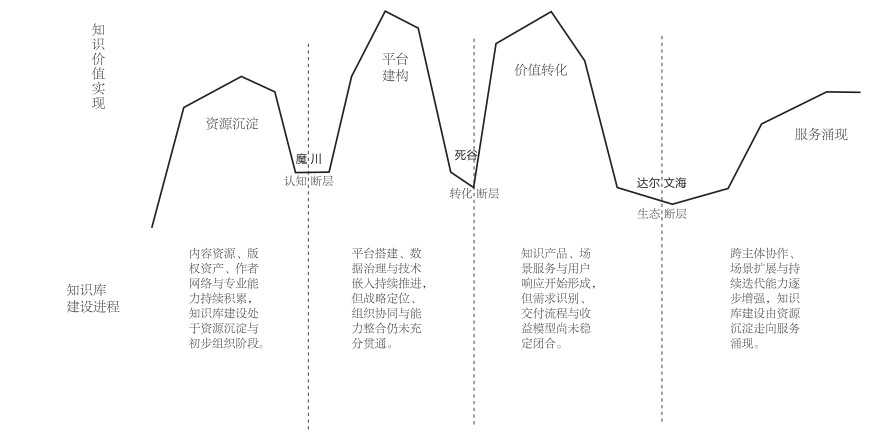
图 1  出版业知识库建设“魔川—死谷—达尔文海”模型
1 中共中央办公厅?国务院办公厅印发《关于推进实施国家文化数字化战略的意见》[EB/OL]. (2022-05-22)[2026-01-19]. https://www.gov.cn/zhengce/2022-05/22/content_5691759.htm.
2 中共中央办公厅?国务院办公厅印发《"十四五"文化发展规划》[EB/OL]. (2022-08-16)[2026-01-19]. https://www.gov.cn/zhengce/202212/content_6688296.htm.
3 国家新闻出版署. 出版业"十四五"时期发展规划[EB/OL]. [2026-01-19]. https://www.nppa.gov.cn/xxfb/tzgs/202112/P020221129376042550150.pdf.
4 周青. 知识服务视角下融合出版企业商业模式创新研究[J]. 科技与出版, 2025 (09): 13- 20.
5 何朝辉, 肖宏. 数智时代期刊出版深度融合的3大创新路径[J]. 中国科技期刊研究, 2025, 36 (12): 1695- 1702.
6 张娜, 许洁. 四螺旋视域下专业出版知识服务平台发展现状及策略[J]. 出版发行研究, 2023 (3): 18- 24.
7 陈铭, 孙梦婷. 面向数据要素价值化的出版知识服务创新路径研究[J]. 编辑之友, 2026 (5): 44- 52.
8 杨石华. 作为知识服务的数据库出版: 驱动力、服务机制与优化[J]. 编辑之友, 2022 (9): 17-22, 29.
9 吴赟, 牛蓉. 我国出版融合研究的现有格局、深层挑战与创新路径[J]. 科技与出版, 2026 (2): 22- 32.
10 吴丹, 郭清玥, 杨馨梅, 等. 智慧图书馆场景下数据与知识双驱动方法创新研究[J]. 中国图书馆学报, 2025, 51 (5): 37- 53.
11 李丽萍. AIGC嵌入出版生态系统演化进程、机理变革及风险化解[J]. 中国出版, 2024 (4): 35- 40.
12 任培民, 袁旗, 赵树然. 知识资产价值视角下的中国企业专利组合价值测度研究[J]. 情报杂志, 2023, 42 (7): 193- 200.
13 黄玉烨, 李凡. 出版数据资产化的演进逻辑、现实困境及法治进路[J]. 编辑之友, 2025 (10): 20- 29.
14 李嘉宁, 李梦竹. 生成式人工智能赋能传统出版: 逻辑、案例与进路[J]. 出版发行研究, 2024 (8): 32- 38.
15 吴寿仁. 创新知识基础(第四版)[M]. 上海: 上海社会科学院出版社, 2016: 18- 20.
16 吴寿仁. 科技成果转化若干热点问题解析(十一): 关于科技成果成熟度的思考[J]. 科技中国, 2018 (4): 28- 35.
17 傅慧芳, 游深铖. 新型举国体制促进新质生产力发展的独特优势与实践路向[J]. 东南学术, 2024 (5): 27- 37.
18 解佳龙, 王梦兰, 张璐. 突破创新价值链锁定: 国家自主创新示范区三重转化壁垒的效能解构与动态追踪[J]. 技术经济, 2025, 44 (10): 18- 33.
19 刘华军, 史淑翌. 推动科技创新和产业创新深度融合的内在逻辑与实践进路[J]. 数量经济技术经济研究, 2026, 43 (2): 5- 29.
20 揭其涛, 王奕诺. 玫瑰荆棘: 生成式AI赋能数字出版内容生产的逻辑、机遇与隐忧[J]. 科技与出版, 2024 (4): 64- 70.
21 Tuli K R , Kohli A K , Bharadwaj S G . Rethinking customer solutions: From product bundles to relational processes[J]. Journal of Marketing, 2007, 71 (3): 1- 17.
22 Macdonald E K , Kleinaltenkamp M , Wilson H N . How business customers judge solutions: Solution quality and value in use[J]. Journal of Marketing, 2016, 80 (3): 96- 120.
doi: 10.1509/jm.15.0109
23 Xu Y , Shieh C H , Van Esch P , et al. AI customer service: Task complexity, problem-solving ability, and usage intention[J]. Australasian Marketing Journal, 2020, 28 (4): 189- 199.
doi: 10.1016/j.ausmj.2020.03.005
24 王鹏涛. 构建可信的知识生态: AIGC出版中的知识核验机制研究[J]. 中国编辑, 2025 (2): 42- 48.
25 贾晓巍. 智能时代场景下知识服务与出版转型思考[J]. 中国编辑, 2021 (2): 62- 65.
26 侯丽, 康宏宇, 钱庆. 医学图书馆公众健康知识服务平台的构建与应用实践[J]. 图书情报知识, 2018 (2): 40-49, 76.
27 陆朦朦. 协同创新理念下出版知识服务价值共创机理研究[J]. 科技与出版, 2020 (12): 35- 42.
28 纳西姆·尼古拉斯·塔勒布. 反脆弱: 从不确定性中获益[M]. 雨珂, 译. 北京: 中信出版社, 2020.
[1] 张窈,吴媛媛. 算法逻辑下的场景重构:教育出版人工智能应用的三重层级与实现框架[J]. 科技与出版, 2026, 45(6): 68-75.
[2] 冯立君,鲍柳康. AI赋能科普图书内容“二次创作”及多模态转化的路径探析[J]. 科技与出版, 2026, 45(4): 94-103.
[3] 周青. 知识服务视角下融合出版企业商业模式创新研究[J]. 科技与出版, 2025, 44(9): 13-20.
[4] 吕晓峰,孟祥晴,詹洪春. 人工智能时代出版业知识服务的伦理挑战、价值重构与实践进路[J]. 科技与出版, 2025, 44(8): 47-55.
[5] 王亮. 检索增强生成(RAG)驱动的知识服务:原理、范式及评估[J]. 科技与出版, 2025, 44(4): 37-46.
[6] 谢寿光,王誉梓. 生成式人工智能应用场景下的学术出版和学术编辑:挑战与机遇[J]. 科技与出版, 2025, 44(1): 77-88.
[7] 傅爱雯,王跃,邵波. 数字出版融合生态:体系构建与业务组织[J]. 科技与出版, 2024, 43(9): 63-70.
[8] 王真真,李乾丙,王雪莲,王相飞. AI背景下智慧体育教育出版的知识服务转型路径研究*[J]. 科技与出版, 2024, 43(3): 109-116.
[9] 卢晓熙,陈奎莲. 创新驱动可持续增长:专业出版社深度融合的方向和路径分析*[J]. 科技与出版, 2024, 43(2): 58-63.
[10] 宋奇,蒋雪颖. 专业书店是否要“破圈”:基于人文考古书店反常个案的研究*[J]. 科技与出版, 2024, 43(12): 51-59.
[11] 王小艳. 专题类学术资源库建设:社科类出版单位数字化实践的重要面向[J]. 科技与出版, 2024, 43(1): 96-102.
[12] 戚德祥,马瑞洁. 数字内容资源开发与管理:出版知识服务转型的关键*[J]. 科技与出版, 2023, 42(9): 20-28.
[13] 姬建敏,王琪. 困境与突围:人工智能赋能学术期刊知识服务的技术架构*[J]. 科技与出版, 2023, 42(8): 49-55.
[14] 陈璐,刘谦,白小晶. 建设全国科技期刊出版统一大市场的思考与建议*[J]. 科技与出版, 2023, 42(5): 58-65.
[15] 马瑞洁,戚德祥. 产业生态视阈下出版知识服务版权保护机制探究*[J]. 科技与出版, 2023, 42(4): 50-56.