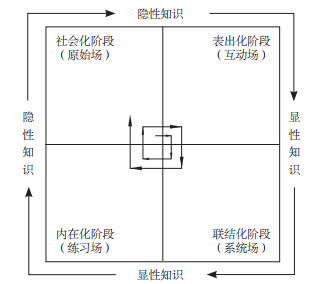
文章基于SECI知识创新模型,并结合科普实践特征进行理论调适,从“场”和“知识螺旋”两大维度对科技期刊资源科普化展开研究。研究发现,科技期刊资源科普化面临的核心困境并非内容与渠道问题,而是原始场、互动场、系统场、练习场的结构缺失或链条断裂。据此构建嵌入型、转化型、共创型分层科普路径,揭示三条路径以场域主导权渐进让渡为核心的演进逻辑,探究场域与路径之间的内在关联,形成“场—路”耦合机制。同时基于SECI模型提出科普编辑应由“语言转译者”重塑为“场域架构师”;科普化本质是其出版功能从“生产并传播内容”向“组织并运营知识转化全过程”的深层转型等全新认识。研究旨在为科技期刊突破科普化困境、释放社会服务效能提供理论参照与实践思路。
The present study takes up the SECI model of knowledge creation and applies it—modified where necessary—to the popularization of sci-tech periodical resources. It analyzes how specialized scientific or technological periodicals may help to turn complex material into usable knowledge for general audiences. Two main ideas guide the analysis: "Ba" and the knowledge spiral. With this framework,"Ba" denotes a setting for joint creation and use of knowledge, as well as for practical application, whereas the knowledge spiral charts the progression of individual learning toward communal knowledge and back again to action. Such concepts are brought together here in order to clarify how the popularization of periodical resources might escape the limits of bare transmission and develop into an orderly method of knowledge conversion. From a research standpoint it is clear that the chief difficulty in the popularization of sci-tech periodical resources is not mainly one of content availability or of efficient communication. Rather, the key issue lies in structural gaps and in disconnections between the four types of Ba: originating Ba, interacting Ba, systematizing Ba, and exercising Ba. Each of these spaces refers to an identifiable phase of knowledge production or of its use. If one or more of them are underdeveloped or loosely linked, then the popularization of periodical resources suffers from reduced effectiveness. Even with good academic material available in periodicals, failure to provide suitable interactional spaces (for all concerned) blocks full societal access to knowledge—and to progress. With a view to meeting these challenges, this paper suggests three layered pathways for the popularization of periodical resources: the embedded pathway, the transformative pathway, and the co-creative pathway. The embedded pathway advocates the integration of popularization with already established academic or social practices. The transformative pathway deals with the reinterpretation and reshaping of knowledge so as to meet the needs of non-specialist publics. The co-creative pathway promotes joint work by editors, writers, specialists, readers, and online tools—thus enabling collective development and dissemination of knowledge. None of the three pathways is necessarily an alternative to the others. Rather, they describe an evolutionary trend in which roles and responsibilities are incrementally assigned to many participants. The present study considers also the relation of Ba to the various pathways discussed, and concludes with a proposal for a "Ba-Pathway" coordination mechanism. Such a mechanism gives an account of the ways in which shared spaces foster certain popularization practices and of how those practices may themselves help create knowledge communities. On the basis of this analysis, it is claimed that editors of science popularization need not be considered simply as language mediators who rewrite complex texts in simpler form. Rather, they should now be regarded as architects of Ba, whose job is to shape—spatially or otherwise—interaction, cooperation, and social use of knowledge. The research now indicates that the essence of the popularization of periodical resources calls for a more radical transformation of academic publishing's role. Periodicals can no longer rest on the simple provision or transmission of information. They have to help shape—not merely record—the whole sequence of knowledge transformation, from technical data to lay understanding or to action. Such a shift is part of a wider change in the social mission of scientific and technological periodicals. With both theoretical and practical proposals at hand, the present study tries to assist sci-tech periodicals in meeting the demands of science popularization and in achieving greater social utility.
姜曼. 基于SECI模型的科技期刊资源科普化“场—路”耦合机制研究[J]. 科技与出版, 2026, 45(7): 110-119. JIANG Man. The "Ba–Pathway" Coordination Mechanism for the Popularization of Sci-Tech Periodical Resources: An SECI-Model Approach. Science-Technology & Publication, 2026, 45(7): 110-119.
http://kjycb.tsinghuajournals.com/CN/ 或 http://kjycb.tsinghuajournals.com/CN/Y2026/V45/I7/110
Cited