Please wait a minute...
科技与出版  2026, Vol. 45 Issue (8): 5-14    
专稿
关于“模数共振”驱动科技出版社构建行业数据集的思考与路径探索
刘鲲翔1,2,隗静秋3
1. 机械工业出版社,100037,北京
2. 国家新闻出版署语义出版与知识服务重点实验室,430072,武汉
3. 浙江传媒学院出版学院,310018,杭州
Reflections and Path Exploration on Building Industry Datasets for Sci-Tech Publishers Driven by "Model-Data Resonance"
LIU Kunxiang1,2,KUI Jingqiu3
1. China Machine Press, 100037, Beijing, China
2. Key Laboratory of Semantic Publishing and Knowledge Services, National Press and Publication Administration, 430072, Wuhan, China
3. School of Publishing, Communication University of Zhejiang, 310018, Hangzhou, China
全文: HTML    PDF(1754 KB)  
输出: BibTeX | EndNote (RIS)      
摘要: 

人工智能产业竞争正从通用智能能力比拼转向行业深度应用落地,但高质量行业数据集的供给不足已成为“人工智能+”赋能千行百业发展过程中面临的关键瓶颈。科技出版社凭借长期积累的专业知识资源和深厚的行业网络,具备成为核心供给方的独特禀赋,却也面临战略认知滞后、供需结构错位、加工技术难度大且成本高、工具与标准缺失、流通机制不健全以及复合型人才匮乏等多重挑战。本文系统梳理国家密集出台的“人工智能+”相关政策,基于“模数共振”核心理念,阐释以高质量行业数据训练更懂行业的模型,以模型应用催生新场景并产生新数据,进而反向优化模型的正向循环机制。文章厘清行业数据集的定义及其多模态、多维度数据形态,涵盖基础数据模态、专业数据形态与知识组织形态三个层次,并分析科技出版社构建数据集的驱动因素、角色定位、特有优势与现实挑战。在此基础上,从战略与执行两个层面提出九条构建路径:在战略上提升认知水平、加强政策研究、明确行业方向、构建“政产学研用”深度融合的生态体系;在执行上坚持做好传统出版主业、以“三步法”优化开发路径、共建工具与标准体系、组建复合型专业团队,并重视行业本体数据集建设。本文认为,2026年是中国人工智能从通用对话迈向行业应用落地的关键转折年,科技出版社应把握战略窗口期,以“模数共振”为指引,加快从内容生产者向数据服务商转型,将专业出版的知识积累转化为智能时代不可替代的竞争壁垒,为构建中国自主知识体系和提升国家科技竞争力提供有力支撑。

关键词 : 行业数据集,  科技出版,  模数共振,  人工智能,  知识服务    
Abstract:

Competition in the artificial intelligence industry is increasingly shifting from a contest of general-purpose capabilities to deep industry applications, yet the insufficient supply of high-quality industry datasets has become the key bottleneck constraining the "AI+" empowerment of diverse industries. Science and technology publishers (STPs), with their long-accumulated professional knowledge resources and deep-rooted industry networks, are well positioned to become core suppliers, yet they simultaneously face multiple challenges including lagging strategic awareness, structural supply-demand mismatches, high processing costs and technical difficulties, the absence of shared tools and standards, underdeveloped circulation mechanisms, and a critical shortage of interdisciplinary talent. This paper systematically reviews recent national policies on "AI+" and grounded in the core concept of "model-data resonance", elucidates its positive feedback loop: high-quality industry data train more models with stronger domain knowledge, and the application of these models in turn generates new scenarios and produces fresh data, which then feeds back to further optimize the models. The paper clarifies the definition of industry datasets, which encompass multimodal and multidimensional data forms across three hierarchical layers—basic data modalities, specialized professional data forms, and knowledge organization structures—and analyzes the driving factors, role positioning, distinctive advantages, and practical challenges that STPs face in constructing such datasets. Building on this analysis, the paper proposes nine concrete pathways at both strategic and implementation levels. Strategically, these include raising strategic awareness of the data economy, strengthening policy research to align with national directives, clearly defining priority industry directions, and fostering a deeply integrated ecosystem that brings together government, industry, academia, research, and application stakeholders. On the execution front, the pathways consist of maintaining the core traditional publishing business while leveraging it as a foundation, adopting a "three-step method" for data identification, annotation, and iterative validation to optimize the development process, co-developing shared tools and standards in collaboration with industry partners, assembling interdisciplinary professional teams that combine editorial, technical, and domain expertise, and placing special emphasis on constructing industry ontology datasets to ensure semantic interoperability and long-term reusability. The paper contends that 2026 marks a pivotal year for China's AI trajectory—the transition from general-purpose conversational AI to practical industry applications. For science and technology publishers, this represents a strategic window of opportunity. Guided by the principle of "model-data resonance", these publishers should accelerate their transformation from traditional content producers to data service providers, converting their accumulated intellectual capital from professional publishing into a distinctive competitive advantage in the intelligent age, thereby providing robust support for building China's independent knowledge system and enhancing the nation's overall scientific and technological competitiveness.

Key words: high-quality industry datasets    science and technology publishing    model-data resonance    artificial intelligence    knowledge services
出版日期: 2026-09-08
基金资助:浙江大学教育基金会出版教育基金出版理论研究课题“大学出版社学术出版智慧服务模式创新研究”(LLYJ-2025-YB001)

引用本文:

刘鲲翔,隗静秋. 关于“模数共振”驱动科技出版社构建行业数据集的思考与路径探索[J]. 科技与出版, 2026, 45(8): 5-14.
LIU Kunxiang,KUI Jingqiu. Reflections and Path Exploration on Building Industry Datasets for Sci-Tech Publishers Driven by "Model-Data Resonance". Science-Technology & Publication, 2026, 45(8): 5-14.

链接本文:

http://kjycb.tsinghuajournals.com/CN/      或      http://kjycb.tsinghuajournals.com/CN/Y2026/V45/I8/5

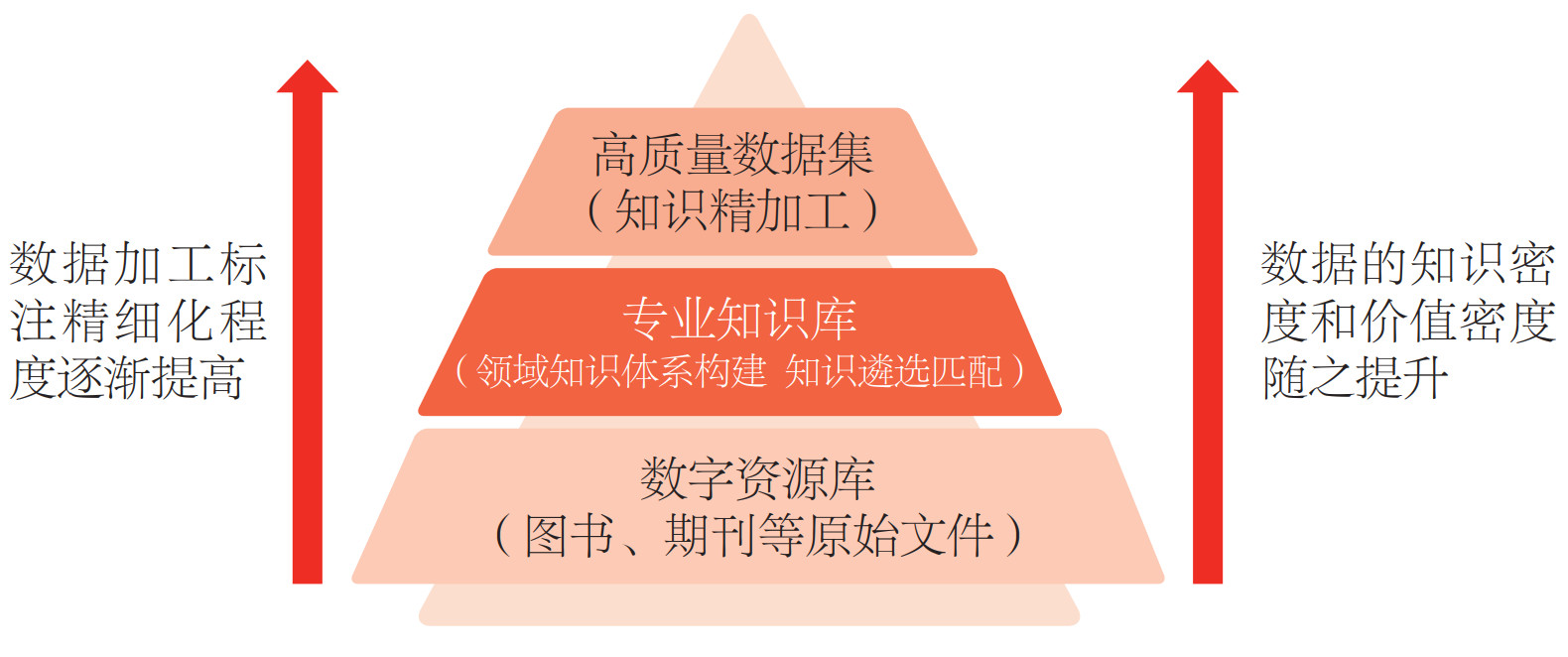
图 1  “三步法”优化数据集开发路径
1 国务院关于深入实施"人工智能+"行动的意见[EB/OL]. (2025-08-21)[2026-06-24]. https://www.gov.cn/zhengce/content/202508/content_7037861.htm.
2 中华人民共和国国民经济和社会发展第十五个五年规划纲要[EB/OL]. (2026-03-13)[2026-06-24]. https://www.gov.cn/yaowen/liebiao/202603/content_7062633.htm.
3 智能体规范应用与创新发展实施意见[EB/OL]. (2026-05-08)[2026-06-24]. https://www.cac.gov.cn/2026-05/08/c_1779979789523320.htm.
4 关于推进行业高质量数据集建设行动的实施方案[EB/OL]. (2026-06-08)[2026-06-24]. https://www.nda.gov.cn/sjj/zwgk/tzgg/0608/20260608172117399715004_pc.html.
5 工业和信息化部办公厅, 国家数据局综合司. 关于联合实施2026年"模数共振"行动的通知[EB/OL]. (2026-04-28)[2026-06-24]. https://www.nda.gov.cn/sjj/zwgk/tzgg/0428/20260428215540161552208_pc.html.
6 全国数据标准化技术委员会. 国家标准《高质量数据集??分类指南》(征求意见稿)编制说明[EB/OL]. (2026-01-30)[2026-06-09]. https://www.nda.gov.cn/sjj/ywpd/szkjyjcss/0408/ff808081-9b5e8657-019d-6bc2a8d3-0dbf.pdf.
7 刘鲲翔,王飚."数据要素×"背景下关于出版业数据资产化的思考[J].出版发行研究,2024(8):5-15.
8 中国音像与数字出版协会. 《出版业高质量数据集: 建设与应用指南》和《出版业高质量数据集: 格式与分类要求》两项团体标准工作组稿评审会在京召开[EB/OL]. (2026-04-02)[2026-06-24]. https://www.cadpa.org.cn/3282/202604/41787.html.
[1] 李金城,谭涘雨. 人工智能时代出版达人营销逻辑转向研究:基于资源行动视角[J]. 科技与出版, 2026, 45(8): 111-119.
[2] 杨阳,李建红. 教育出版智能化应用场景的功能逻辑、落地瓶颈与深化路径[J]. 科技与出版, 2026, 45(8): 64-74.
[3] 孙保营,董琎. 数智阅读的体验转向、风险机制与可持续路径[J]. 科技与出版, 2026, 45(7): 57-64.
[4] 陈华明,梁雨欣. 生成式人工智能驱动出版文创发展的逻辑、困境与出路[J]. 科技与出版, 2026, 45(7): 75-84.
[5] 刘普,蔡英辉. 学术期刊在科研诚信建设中的职责定位与实践路径——基于近年来曝光的涉刊学术不端典型案例的分析[J]. 科技与出版, 2026, 45(6): 5-15.
[6] 沈悦,赵新毅,孙露铭. 数智时代实体书店空间体验优化与场景营销探新[J]. 科技与出版, 2026, 45(6): 136-149.
[7] 申尧. AI时代影像档案出版的真实性机制与成果链[J]. 科技与出版, 2026, 45(6): 36-42.
[8] 李嘉宁,李梦竹. 沉淀与涌现:数智时代出版业知识库建设的现实样态、困局机理及未来进路[J]. 科技与出版, 2026, 45(6): 43-57.
[9] 张窈,吴媛媛. 算法逻辑下的场景重构:教育出版人工智能应用的三重层级与实现框架[J]. 科技与出版, 2026, 45(6): 68-75.
[10] 张弘杨,吴瑜,肖进,彭熙,别思瑶,唐定国. 人工智能辅助期刊审稿责任认定规则构建研究[J]. 科技与出版, 2026, 45(6): 106-114.
[11] 肖晓羽,姜钰,李佳. 人工智能视域下中小学数字教材的实践省思与进路展望[J]. 科技与出版, 2026, 45(5): 28-36.
[12] 张新新,杜欢欢,席媛媛. 具身智能视域的出版智能体:概念、构成与价值——基于《智能体规范应用与创新发展实施意见》的研究视角[J]. 科技与出版, 2026, 45(5): 37-48.
[13] 范晔. 出版内容语料库建设的逻辑前提、现状检视与实践路径[J]. 科技与出版, 2026, 45(5): 93-102.
[14] 孙冠豪. 生成式人工智能赋能学术期刊出版的挑战与应对策略[J]. 科技与出版, 2026, 45(4): 59-68.
[15] 刘玥,黄楚新,李一凡. 人工智能赋能数智出版的平台化实践[J]. 科技与出版, 2026, 45(4): 77-85.