Please wait a minute...
科技与出版  2026, Vol. 45 Issue (8): 146-156    
学术探索
科研论文基金项目标注不端行为及治理对策——基于国家自然科学基金委员会2021—2025年科研诚信不端案件通报的分析
张娟
上海大学期刊社, 200444, 上海
Misconduct in Funding Acknowledgments in Research Papers and Countermeasures: An Analysis of NSFC Research Integrity Case Notices, 2021—2025
ZHANG Juan
Periodicals Agency of Shanghai University, 200444, Shanghai, China
全文: HTML    PDF(1754 KB)  
输出: BibTeX | EndNote (RIS)      
摘要: 

科研论文中基金项目标注不端问题已成为当前科研诚信领域的一大顽疾,其普遍性与隐蔽性引起了监管部门、学术界等的高度重视。本文以国家自然科学基金委员会官网发布的2021—2025年科研诚信不端案件通报为调查对象,统计分析国家自然科学基金标注不端行为案件的具体情况,并从制度环境、主观动机、核查义务、监管技术四个层面深入分析其成因,提出遵循“源头治理—过程监管—事后严惩”的逻辑,构建多元主体协同治理的全链条防控体系。

关键词 : 基金标注,  科研论文,  学术不端,  国家自然科学基金,  科研诚信    
Abstract:

Misconduct in funding acknowledgments in research papers has become a persistent problem in the field of research integrity. Its widespread and difficult-to-detect nature have attracted great attention from regulatory authorities and the academic community. Although a funding acknowledgment may appear to be ancillary information at the end of a paper, it directly affects the attribution of research outputs, the assessment of project performance, and the fair allocation of academic resources. Misconduct in funding acknowledgments not only distorts statistics on funded research outputs but also undermines the research integrity system, harming the research ecosystem and institutional credibility. Therefore, there is an urgent need to analyze the underlying causes and explore governance pathways. This paper analyzes research integrity misconduct case notices published on the official website of the National Natural Science Foundation of China (NSFC) from 2021 to 2025 and statistically examines cases involving improper acknowledgments of NSFC support. The results show that among the 314 papers involved in 132 cases of scientific misconduct, 282 papers acknowledged funding, encompassing a total of 201 funding sources. The proportion of funded papers was 89.8%. Improper acknowledgment involving multiple funding sources is a serious problem. Of the 282 funded papers, 106 (37.6% of the funded papers) acknowledged more than two funding sources, 28 papers acknowledged six funding sources, and 6 papers acknowledged seven funding sources. Among the 201 funding sources, 18 funding sources involved expired projects; 53 funding sources were acknowledged without authorization; four funding sources were unrelated to the paper; one funding source was fictitious; and two funding sources were recorded incorrectly. The paper delves into the underlying causes from four perspectives: institutional environment, subjective motivation, verification obligations, and regulatory technology. First, poorly designed evaluation systems (including academic evaluation and journal evaluation) is the fundamental incentive for misconduct in funding acknowledgments. Second, some researchers lack a strong awareness of research integrity or fail to clearly understand relevant regulations. Third, host institutions and journal publishers have not performed their management and oversight roles effectively or fulfilled their verification obligations. Finally, funding agencies have not provided convenient tools for project verification, and relevant definitions and rules remain unclear. Therefore, comprehensive measures are needed to address misconduct in funding acknowledgments in research papers. Following the logic of "source governance–process supervision–strict ex post punishment", this paper proposes a full-chain prevention and control system based on collaboration among multiple stakeholders, including NSFC, scientific researchers, host institutions, and journal publishers, to systematically curb misconduct in funding acknowledgments.

Key words: funding acknowledgments    research papers    academic misconduct    National Natural Science Foundation of China    research integrity
出版日期: 2026-09-08

引用本文:

张娟. 科研论文基金项目标注不端行为及治理对策——基于国家自然科学基金委员会2021—2025年科研诚信不端案件通报的分析[J]. 科技与出版, 2026, 45(8): 146-156.
ZHANG Juan. Misconduct in Funding Acknowledgments in Research Papers and Countermeasures: An Analysis of NSFC Research Integrity Case Notices, 2021—2025. Science-Technology & Publication, 2026, 45(8): 146-156.

链接本文:

http://kjycb.tsinghuajournals.com/CN/      或      http://kjycb.tsinghuajournals.com/CN/Y2026/V45/I8/146

表 1  科研论文基金标注不端行为的分类
表 2  314篇论文标注基金项数情况 数量/篇
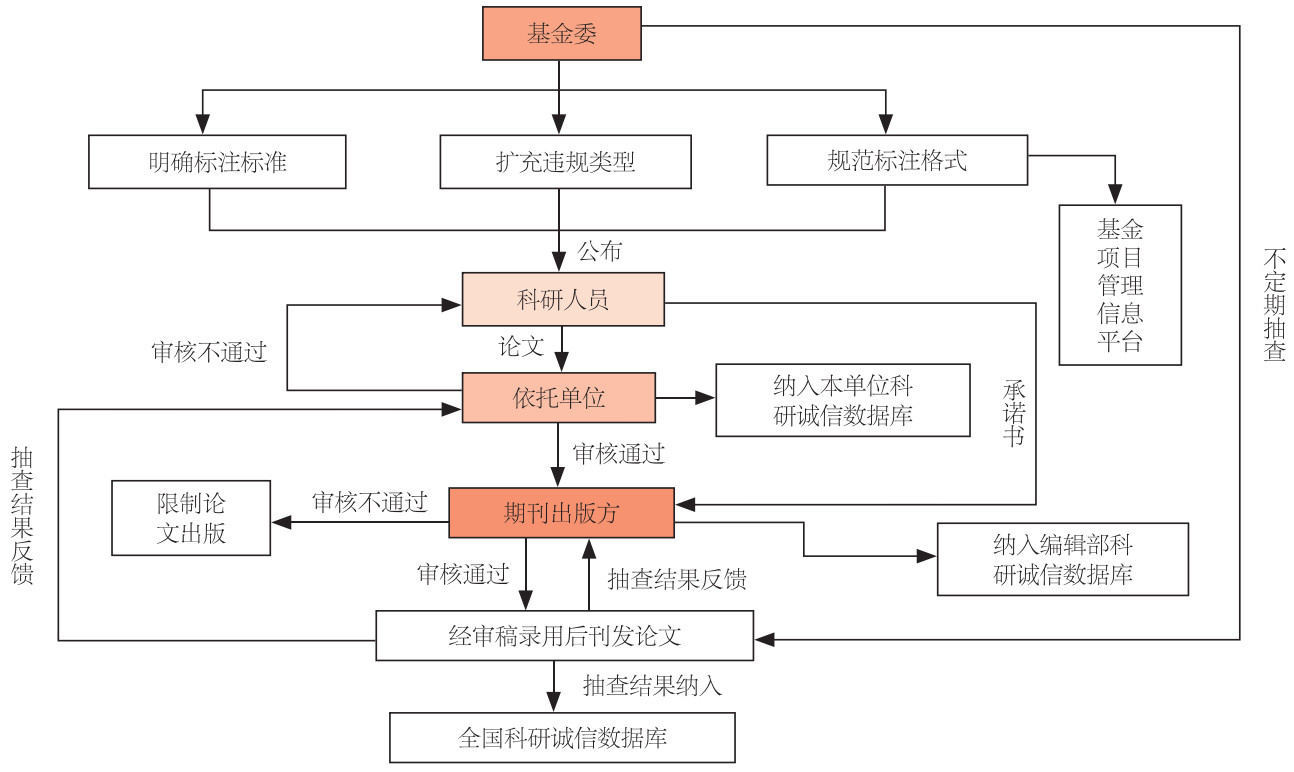
图 1  多元主体协同治理监管框架
3 国家自然科学基金委员会. 国家自然科学基金资助项目研究成果管理办法[EB/OL]. (2025-2-28)[2026-02-26]. https://www.nsfc.gov.cn/p1/2871/2874/2884/69605.html.
4 国家自然科学基金委员会. 科技部资助领域和注意事项[EB/OL]. [2026-02-26]. https://www.nsfc.gov.cn/p1/2931/3971/3975/kxbzzlyhzysx22.html.
5 金丹, 王华菊, 李洁, 等. 科技论文中基金项目标注存在的问题及常见错误分析[J]. 编辑学报, 2019 (S1): 137- 139.
6 鲁翠涛, 张和, 张海燕. 全要素标注学术论文的基金项目信息[J]. 学报编辑论丛, 2021 (1): 297- 301.
7 温晓平, 王国辉, 窦春蕊, 等. 关于科技论文基金项目标注的思考[J]. 中国科学基金, 2006, 20 (6): 353-355, 352.
8 陈留院. 人为因素对科技期刊基金论文比评价指标的影响[J]. 中国科技期刊研究, 2009, 20 (4): 634- 636.
9 舒安琴, 罗瑞, 张耀元, 等. 科技期刊中国家自然科学基金标注失范现象的调查[J]. 中国科技期刊研究, 2020, 31 (4): 413- 418.
10 白雪娜, 张辉玲, 黄修杰. 科技论文基金项目标注的不端行为及防范对策研究: 基于178篇论文标注209个国家自然科学基金项目的实证分析[J]. 编辑学报, 2017, 29 (3): 260- 264.
11 王小艳. 科技论文基金项目标注不实分析及对策[J]. 中国科技期刊研究, 2014, 25 (7): 954-957, 974.
12 国家自然科学基金委员会. 国家自然科学基金项目科研不端行为调查处理办法(国科金发诚〔2022〕53号)[EB/OL]. (2025-02-28)[2026-02-26]. https://www.nsfc.gov.cn/p1/2871/2874/2884/69604.html.
13 韩磊, 邱源. 学术期刊须警惕基金论文中基金项目不实标注现象[J]. 编辑学报, 2017, 29 (2): 151- 154.
14 国家自然科学基金委员会. 关于进一步加强依托单位国家自然科学基金项目资金管理工作的若干意见[EB/OL]. (2026-01-14)[2026-02-26]. https://www.nsfc.gov.cn/p1/3381/2822/99724.html.
15 夏朝晖. 基金论文比在科技期刊评价体系中的作用探析[J]. 中国科技期刊研究, 2008, 19 (4): 574- 577.
1 国家自然科学基金委员会. 国家自然科学基金条例(国务院令第796号修订)[EB/OL]. (2024-11-29)[2026-02-26]. https://www.nsfc.gov.cn/p1/2871/2873/69510.html.
2 国家自然科学基金委员会. 【光明日报】国家自然科学基金累计资助科研项目达88万项[EB/OL]. (2026-02-14)[2026-02-26]. https://www.nsfc.gov.cn/p1/3381/2821/120043.html.
16 国家自然科学基金委员会. 关于2026年度国家自然科学基金项目申请与结题等有关事项的通告[EB/OL]. (2026-01-14)[2026-02-26]. https://www.nsfc.gov.cn/p1/3381/2824/99667.html.
[1] 刘普,蔡英辉. 学术期刊在科研诚信建设中的职责定位与实践路径——基于近年来曝光的涉刊学术不端典型案例的分析[J]. 科技与出版, 2026, 45(6): 5-15.
[2] 张秦. AI时代科技期刊科研诚信治理的国际经验与中国路径[J]. 科技与出版, 2025, 44(9): 63-69.
[3] 侯波,高虹. 高校学术期刊介导的学术不端四维协同治理机制研究——基于扎根理论的研究[J]. 科技与出版, 2025, 44(9): 107-116.
[4] 徐丽芳,罗婷,田峥峥,张蒂. 技术驱动的开放与可信出版:2024年海外科技期刊出版动态研究[J]. 科技与出版, 2025, 44(3): 35-54.
[5] 蒋霞,黄崇亚. 不同语种发表重复内容的出版伦理问题探讨[J]. 科技与出版, 2025, 44(3): 157-166.
[6] 邱蕾,郑汀兰. AIGC背景下学术期刊出版伦理建设的思考[J]. 科技与出版, 2025, 44(12): 85-91.
[7] 黄先蓉,李永政. 学术不端行为治理研究[J]. 科技与出版, 2024, 43(9): 6-12.
[8] 王景周,范晴. 学术期刊同行评议代笔行为的表现、原因及对策*[J]. 科技与出版, 2024, 43(9): 19-25.
[9] 郭壬癸. 使用生成式人工智能对学术出版伦理的冲击与法律治理*[J]. 科技与出版, 2024, 43(9): 25-33.
[10] 戴丽,胡永国,黄文杰,吴宗辉. 高校学术期刊编辑参与研究生学术诚信体系建设的路径研究*[J]. 科技与出版, 2024, 43(9): 34-39.
[11] 张倩,曹健. 我国中医药科技期刊报告利益冲突的现状及分析*[J]. 科技与出版, 2024, 43(9): 85-90.
[12] 王子娴. 欧洲学科学会的学术出版道德准则现状及启示*[J]. 科技与出版, 2024, 43(9): 100-110.
[13] 沈锡宾,王立磊. 人工智能生成学术期刊文本的检测研究*[J]. 科技与出版, 2023, 42(8): 56-62.
[14] 黄荣丽,王大鹏. “热需求”下的科研论文科普转化情况研究——以新冠肺炎疫情相关医学类论文为例[J]. 科技与出版, 2023, 42(4): 142-152.
[15] 张海燕,张和,戴毅,鲁翠涛. 学术期刊查重工作面临的问题及应对策略分析*[J]. 科技与出版, 2023, 42(1): 90-95.