Please wait a minute...
科技与出版  2026, Vol. 45 Issue (10): 47-61    
融媒之光
AIGC赋能视阈下数字出版产业链韧性提升路径——基于扎根理论的质性研究视角
王梓薇,王纪坤,程阳雯斐,冯涵钰,杨依帆
北京印刷学院,102600,北京
An enhancement path for the resilience of the digital publishing industry chain from the perspective of AIGC empowerment: A Qualitative Study Based on Grounded Theory
WANG Ziwei,WANG Jikun,CHENG Yangwenfei,FENG Hanyu,YANG Yifan
Beijing Institute of Graphic Communication, 102600, Beijing, China
全文: HTML    PDF(1887 KB)  
输出: BibTeX | EndNote (RIS)      
摘要: 

文章凝练出AIGC视阈下数字出版产业链韧性的理论分析框架,采用扎根理论方法,提炼归纳出七大主范畴与一大核心范畴。在厘清主范畴与核心范畴内在逻辑关系的基础上,构建了数字出版产业链韧性提升路径模型,并选取网络文学、期刊出版、教育出版三类细分领域开展对照分析,揭示不同场景下韧性生成机理的差异化特征,进而将路径模型与理论分析框架进行对照分析。研究阐释了产业链从韧性触发出发,经多环节耦合演进,于产业链韧性重构与价值锚定节点完成本轮韧性提升,同时触发调适反馈回流,通过持续循环迭代实现数字出版产业链韧性螺旋跃升。

关键词 : AIGC,  数字出版,  产业链韧性,  扎根理论    
Abstract:

Rooted in the practical context of AIGC being deeply embedded in the digital publishing industry, this paper employs grounded theory to construct a resilience enhancement pathway model. This model encompasses five core components: resilience triggering, resilience anchoring, resilience carriers, dual driving forces, and dual dual guarantees. It elucidates how digital publishing industrial chain resilience is triggered by internal and external factors and how five-component coupling promotes resilience reconstruction and value anchoring within a cycle of resilience enhancement. Meanwhile, an adaptive adjustment feedback loop enables resilience leap via successive iterations. The study first proposes a theoretical framework for digital publishing industry chain resilience. This framework treats ideological security and control over value orientation as core requirements, uses the 5C model to specify the foundations of resilience, and identifies institutional provision as a guarantee for resilience. It covers application scenarios across three stages of the industry chain, uses the 4R model to define performance dimensions, and outlines the dimensions of resilience. Building on this foundation, the study employs grounded theory to construct a concrete pathway model using empirical data. The data, collected from December 2023 to May 2026, included approximately 300,000 words of interview transcripts, supplemented by secondary data such as policy documents, media reports, and meeting minutes for triangulation. The researchers used NVivo 15 to support open, axial, and selective coding to extract concepts and construct categories. This process yielded 365 initial codes and 252 initial concepts, refined into 105 primary concepts and 22 subcategories. Ultimately, seven main categories and one core category were identified, establishing the AIGC-empowered resilience enhancement pathway model. Taking "AIGC-related risks and practical dilemmas of cultural resources" as the resilience trigger, the model uses digital and AI-enabled infrastructure as resilience carriers under the guidance of resilience anchoring. It supports interactions between dual driving forces and dual guarantees, which are integrated within the core category. Two paths derive from this core category: one leads to resilience enhancement and reconstruction; the other feeds back to the trigger through an adaptive mechanism that recalibrates the risk identification threshold and feeds back into links such as material and resilience carriers, forming a spiraling closed loop of "triggering–anchoring–supporting–guaranteeing–reconstructing–enhancing". Furthermore, the study selects three subfields—mass publishing (represented by online fiction), professional publishing (represented by journal publishing), and educational publishing—to compare how resilience develops across different settings. Finally, comparing the pathway model with the theoretical framework's five-dimensional structure reveals a systematic correspondence. This correspondence suggests consistency between the theoretical framework and the pathways identified in the empirical analysis.

Key words: AIGC    the resilience of the digital publishing industry chain    grounded theory
出版日期: 2026-11-17
基金资助:国家社会科学基金项目“ChatGPT赋能视阈下数字出版产业链韧性提升机制研究”的阶段性研究成果(23BJY215)

引用本文:

王梓薇,王纪坤,程阳雯斐,冯涵钰,杨依帆. AIGC赋能视阈下数字出版产业链韧性提升路径——基于扎根理论的质性研究视角[J]. 科技与出版, 2026, 45(10): 47-61.
WANG Ziwei,WANG Jikun,CHENG Yangwenfei,FENG Hanyu,YANG Yifan. An enhancement path for the resilience of the digital publishing industry chain from the perspective of AIGC empowerment: A Qualitative Study Based on Grounded Theory. Science-Technology & Publication, 2026, 45(10): 47-61.

链接本文:

http://kjycb.tsinghuajournals.com/CN/      或      http://kjycb.tsinghuajournals.com/CN/Y2026/V45/I10/47

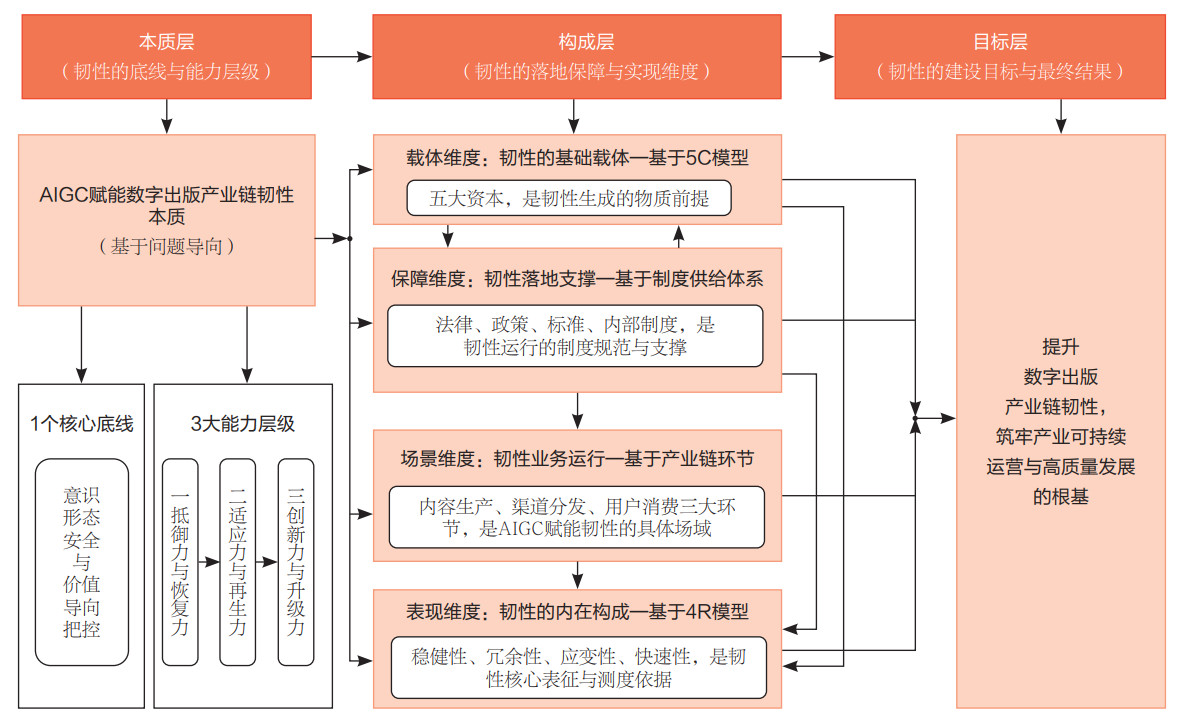
图 1  AIGC赋能数字出版产业链韧性的维度解构图
:一级顶层框架;:二级子维度解析模块;:三级基础要素单元;↓:逻辑支撑与递进关系
注:本维度结构图分为本质层、构成层、目标层三级。本质层界定数字出版产业韧性的核心底线与三大能力;构成层包含载体、保障、场景、表现四大维度,分别对接5C模型、制度供给体系、产业链环节、4R模型开展韧性解析;目标层落脚于产业可持续运营与高质量发展。三层级自上而下逻辑递进,共同构成完整的韧性分析框架。
表 1  开放式编码过程示例
表 2  主轴编码:数智基础设施与核心技术底座
表 3  主轴编码:智能生产范式重构与价值增值
表 4  主轴编码:产业生态协同与价值网络重构
表 5  主轴编码:组织适配与人力资本转型
表 6  主轴编码:AIGC衍生风险与文化资源现实困境
表 7  主轴编码:外部制度供给与产业共识协同
表 8  主轴编码:文化价值引领与“技术—产业”演进响应
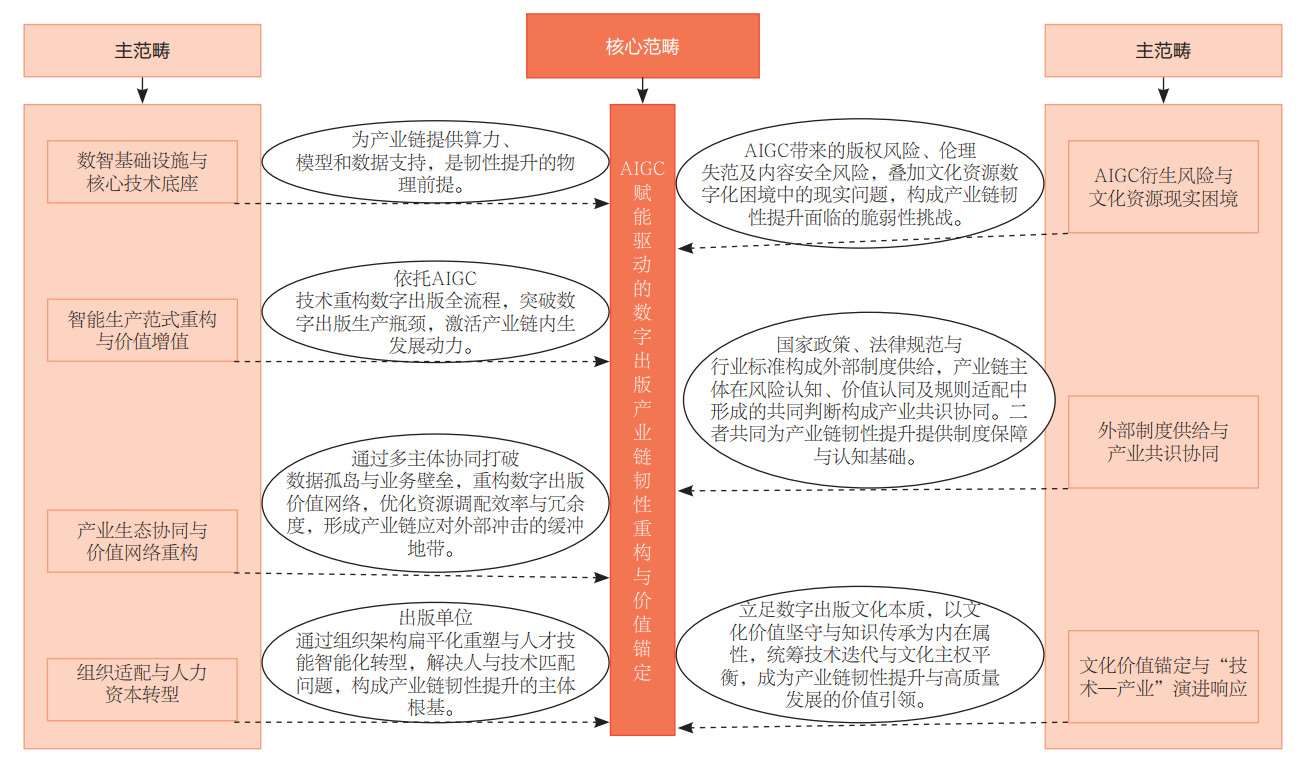
图 2  主范畴与核心范畴的典型关系结构与内涵
:核心范畴;:主范畴;:主范畴内涵解释;↓:逻辑支撑;:内涵阐释关联
注:图中椭圆形文本框阐释对应主范畴的内涵及其作用机理;左右两侧主范畴作用于核心范畴,直观呈现主范畴与核心范畴的关联结构。
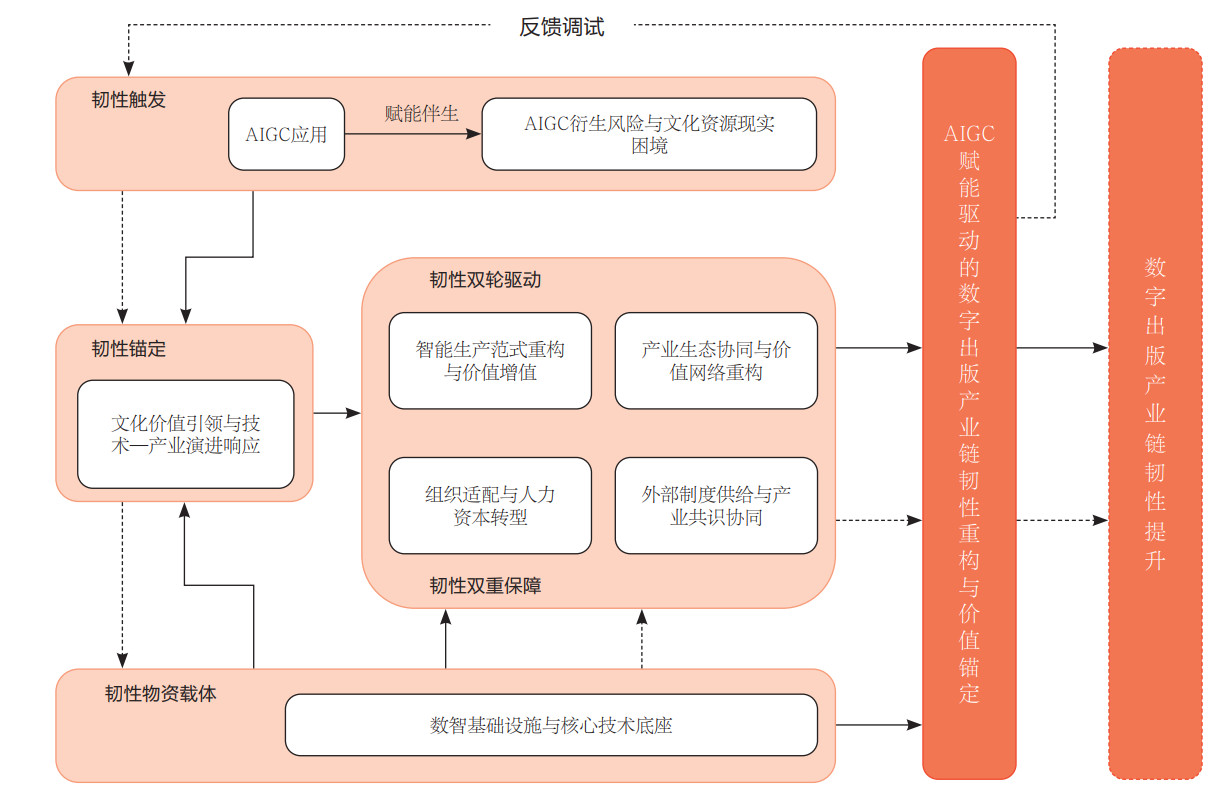
图 3  AIGC赋能视阈下数字出版产业链韧性提升路径模型
:韧性演化阶段与功能模块;:模块内部构成要素;:模型结果模块;→:演化传导过程;:反馈调试路径
注:该模型以韧性触发为起点,在韧性锚定与韧性载体共同作用的基础上,依托韧性双轮驱动与双重保障的核心机制,推动产业链实现韧性重构与价值锚定,最终达成数字出版产业链韧性提升的目标;并通过反馈机制形成逻辑闭环,开启新一轮的韧性路径演化。
1 孙裕彤, 任艳青, 袁军鹏. 学术期刊出版领域使用AIGC的政策、挑战与对策[J]. 中国科技期刊研究, 2025, 36 (2): 144- 152.
2 肖谦, 丁毅, 郑汉. 出版行业应用生成式人工智能的现实困境与实践思路: 基于对43家出版机构的访谈调查[J]. 编辑之友, 2025 (6): 49- 56.
3 段永杰, 李彤. 数字出版中AIGC生成物的应用场景及其伦理规制[J]. 出版科学, 2023, 31 (6): 84- 93.
4 谷彤彤, 田飞. 融合数字出版背景下AIGC的发展与应用研究[J]. 新闻研究导刊, 2023, 14 (7): 4- 6.
5 谢忠明. AIGC对数字出版的机遇与挑战[J]. 新闻传播, 2025 (20): 88- 90.
6 周荣庭, 尤丽娜, 周诗涵, 等. AIGC+VRM: 数字出版的创新应用策略探析[J]. 数字出版研究, 2024, 3 (2): 119- 124.
7 起海霞. AIGC风险治理中的数字出版平台内容审核责任[J]. 出版发行研究, 2024 (9): 79-86, 31.
8 Liebrenz M , Schleifer R , Buadze A , et al. Generating scholarly content with ChatGPT: Ethical challenges for medical publishing[J]. The Lancet Digital Health, 2023, 5 (3): e105- e106.
doi: 10.1016/S2589-7500(23)00019-5
9 Kaebnick G E , Magnus D C , Kao A , et al. Editors’ statement on the responsible use of generative AI technologies in scholarly journal publishing[J]. Medicine, Health Care and Philosophy, 2023, 26 (4): 499- 503.
doi: 10.1007/s11019-023-10176-6
10 姜晓乐. AIGC赋能数字出版的发展路径研究[J]. 传媒论坛, 2026 (6): 146- 148.
11 Irfanullah H M . So, what does resilience mean for scholarly publishing?[J]. Learned Publishing, 2021, 34 (1): 57- 63.
doi: 10.1002/leap.1351
12 肖婧文, 朱文佩. 变革与调适: 人工智能介入的学术期刊出版风险与韧性治理[J]. 出版与印刷, 2026 (2): 65- 76.
13 尹召凯, 王莉. 数字经济赋能数字出版产业链韧性提升的理路与进路[J]. 中国数字出版, 2024, 2 (5): 122- 130.
14 马文欢, 王梓薇, 黄超兰. AIGC影响数字出版产业链韧性机制模型研究[J]. 科技与出版, 2024 (9): 54- 62.
doi: 10.16510/j.cnki.kjycb.20240923.011
15 马文欢, 王梓薇, 陈磊, 等. AIGC赋能视阈下数字出版产业链韧性的评价模型研究[J]. 科技与出版, 2025 (12): 36- 46.
16 裴永刚. 中国数字出版产业链整合研究[M]. 北京: 中国传媒大学出版社, 2021: 46.
17 李理. 基于扎根理论的网络事件信任传递机制研究: 以罗尔事件为例[J]. 全球传媒学刊, 2018, 5 (1): 39- 52.
18 Ho H Y , Wang L W , Cheng H J . Authors, publishers, and readers in publishing supply chain: The contingency model of digital contents production, distribution, and consumption[J]. Systems Engineering Procedia, 2011 (2): 398- 405.
19 董华, 张皓越, 高爱宇. 生成式人工智能大模型赋能传统出版企业转型升级路径研究: 基于扎根理论的质性研究[J]. 出版科学, 2024, 32 (4): 37- 46.
20 付国乐, 张志强. 基于扎根理论的中国科技期刊国际出版评价体系构建与分析[J]. 中国科技期刊研究, 2025, 36 (12): 1768- 1775.
21 李凤萍, 文常莹. 基于扎根理论的中国国际传播力提升路径研究: 以中国对缅传播为例[J]. 新闻与写作, 2021 (10): 62- 68.
22 李玮. 人工智能对网络文学的冲击现状与对策[J]. 社会科学文摘, 2026 (2): 51- 53.
23 李珮, 庞丁茂. 人工智能赋能网络文学的实践新态与价值重构[J]. 编辑之友, 2026 (3): 12- 19.
24 吴明娟. 我国数字出版产业总规模10年增长4倍[N]. 中国新闻出版广电报, 2025-09-08(005).
25 金鑫. AIGC技术对出版行业影响有多大?[N]. 中国新闻出版广电报, 2025-08-19(003).
26 证券之星. 阅文集团(00772. HK)2025年度ESG报告解读[EB/OL]. (2026-06-04) [2026-06-12]. https://wap.stockstar.com/detail/RB2026060400028141.
27 李文瑶. 阅文发布“火种计划”加码AI漫剧打造AIGC视频共创生态[EB/OL]. (2025-03-28) [2026-06-12]. https://tech.huanqiu.com/article/4QxHHkgyfBq.
28 李慧, 苏莉娜, 周会霞, 等. 中国科技期刊使用人工智能政策的研究及对策建议: 基于40份科技核心期刊政策文本的Nvivo分析[J]. 科技与出版, 2026 (2): 96- 107.
29 邱蕾, 郑汀兰. AIGC背景下学术期刊出版伦理建设的思考[J]. 科技与出版, 2025 (12): 85- 91.
[1] 张新新,杜欢欢,席媛媛. 具身智能视域的出版智能体:概念、构成与价值——基于《智能体规范应用与创新发展实施意见》的研究视角[J]. 科技与出版, 2026, 45(5): 37-48.
[2] 袁萱. AIGC重塑网络文学IP:从线性写作到循环生成工作流研究[J]. 科技与出版, 2026, 45(5): 121-132.
[3] 毛文思,王飚. 2025年中国数字出版发展态势盘点与2026年发展展望[J]. 科技与出版, 2026, 45(3): 14-27.
[4] 徐丽芳,田峥峥,张蒂,曹天天,王一雪. 公正导向下的开放与治理重构:2025海外科技期刊出版观察[J]. 科技与出版, 2026, 45(3): 38-55.
[5] 周蔚华,梁乾. 人工智能赋能出版的政策导向、理论研究与产业实践——2025年出版业人工智能应用报告[J]. 科技与出版, 2026, 45(3): 82-92.
[6] 曾伟明,余佳佳. 构建“全球南方”学术数字出版平台  推动全球自主知识体系公平化[J]. 科技与出版, 2026, 45(2): 51-58.
[7] 丁靖佳,宋宁远. 生成式出版:内涵、外延与框架[J]. 科技与出版, 2026, 45(1): 112-120.
[8] 本刊编辑部. 从工具到伙伴:AI如何赋能期刊未来发展[J]. 科技与出版, 2025, 44(9): 47-51.
[9] 本刊编辑部. AI驱动下的学术创作范式重构——基于七位跨学科专家观点类编与深度述要[J]. 科技与出版, 2025, 44(8): 5-15.
[10] 郑恩. 数字版权价值评估的多维动态路径研究[J]. 科技与出版, 2025, 44(8): 16-27.
[11] 吕晓峰,孟祥晴,詹洪春. 人工智能时代出版业知识服务的伦理挑战、价值重构与实践进路[J]. 科技与出版, 2025, 44(8): 47-55.
[12] 董慧娟,余非. AIGC可版权的必要非充分要件:“有限控制论”的证成与适用展开*[J]. 科技与出版, 2025, 44(8): 113-127.
[13] 陈强,张钢花. 适老化数字出版的现实与未来:基于数字可供性视角[J]. 科技与出版, 2025, 44(6): 73-79.
[14] 孙保营,董琎. AIGC融入学术出版:变革、问题与对策[J]. 科技与出版, 2025, 44(4): 31-36.
[15] 范文婷. 平台生态系统视角下多边数字阅读平台价值共创与多元主体协同创新路径优化[J]. 科技与出版, 2025, 44(4): 94-102.