|
|
|
| Four-Dimensional Collaborative Governance Mechanism for Academic Misconduct Mediated by University Academic Journals: Evidence from Large-Scale Qualitative Interviews |
| HOU Bo1,2,GAO Hong3 |
1. School of Humanities, Southeast University, 211108, Nanjing, China
2. Journal Department, Jiangsu Vocational Institute of Commerce, 211168, Nanjing, China
3. Journal Department, Hohai University, 210098, Nanjing, China |
|
|
|
|
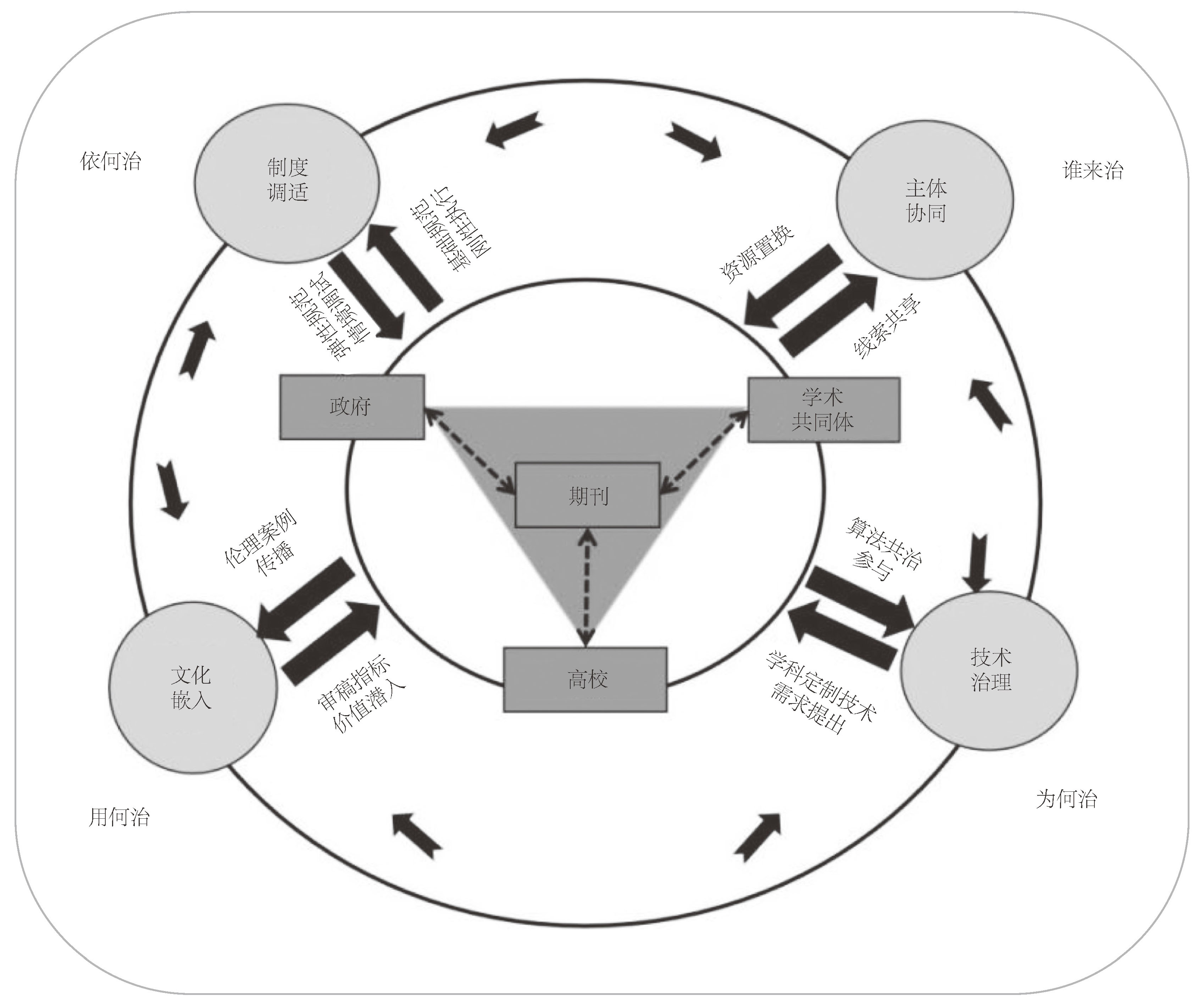
Abstract The construction of China’s academic ecosystem currently faces unprecedented severe challenges. Academic misconduct and fragmented governance systems are intertwined, seriously hindering the healthy development of the academic community and becoming a key obstacle to achieving the strategic goal of building world-class scientific journals in China. However, university academic journals, as the primary gateway and important gatekeepers for publishing and disseminating academic achievements, require clearer recognition and systematic explanation of their unique functional role and potential value in the collaborative governance system addressing academic misconduct. On one hand, the concealment and complexity of academic misconduct impose higher requirements on the identification and handling capabilities of journals; on the other hand, the rights and responsibilities boundaries of journals as governance subjects are not clearly defined, making it difficult to fully leverage their hub role in the collaborative governance system. Additionally, rapid technological advancement and dynamic balance of ethical values present additional governance challenges, urgently requiring more systematic solutions from both theoretical and practical perspectives. This study, based on the theory of collaborative governance as its theoretical foundation and analytical framework, adopts in-depth qualitative research methods to conduct systematic interviews and surveys with 30 representative university academic journals across China. Through multi-dimensional and multi-level empirical data collection the study provides a solid empirical foundation. By using the three-level coding technique of grounded theory to deeply analyze the interview data, this paper develops an innovative four-dimensional collaborative governance theoretical model mediated by university academic journals for addressing academic misconduct. The model comprehensively and systematically reveals the functional positioning, action mechanisms, and intrinsic logic of university academic journals within the collaborative governance network of academic misconduct from four key dimensions: subject collaboration, institutional adjustment, technological governance, and cultural embedding, offering novel theoretical insights into academic governance complexity. The findings demonstrate that these four governance dimensions form an interconnected network of mutual support and dynamic coupling, creating a cohesive governance system. University academic journals, as key nodes connecting various stakeholders in the academic community, need to fully leverage their hub role by: fostering the formation of a responsibility community with multi-stakeholder collaborating in the subject collaboration dimension, establishing cross-departmental and cross-sectoral collaboration mechanisms; promoting the value reconstruction and dynamic adjustment of academic norms in the institutional adjustment dimension, thereby achieving the timeliness of the rules system; achieving the organic balance of tool rationality and value rationality in the technological governance dimension, while ensuring the unity of technology application and ethical values; and guiding the internalization and evolution of academic integrity values in the cultural embedding dimension, thus cultivating a healthy and upward academic cultural atmosphere.
|
|
Published: 15 October 2025
|
|
|
|

| 结构维度 | 类目 | 样本量 | 主要理论功能 | | 角色类型 | 编辑(含主编/编审) | 24名 | 解构守门人角色的认知冲突 | | 期刊管理者 | 6名 | 透视科层制与学术自治的张力 | | 学科领域 | 人文社科 | 8种 | 映射学科评价体系的差异化影响 | | 自然科学 | 22种 | 检验数据伦理的特殊性 |
|
|
|
| 原始语句(节选) | 初始概念 | 初始范畴 | | “期刊编辑发现抄袭后联系涉事教师所在高校,但校方以‘保护人才’为由拒绝公开处理” | 高校拒绝公开处理 | 信息通报受阻(C01) | | “高校学术委员会启动独立调查程序但拒绝与期刊共享结果” | 调查结果不共享 | | “学术数据库检测系统只对期刊开放,高校科研处需额外付费查询本校教师投稿记录” | 检测系统付费壁垒 | 数据权限制约(C02) | | “某高校科研处反映,获取外文期刊论文查重报告需通过第三方中介,周期长达20个工作日” | 数据获取周期冗长 | | “期刊联盟曾制定联合惩戒制度,但因缺乏法律依据实际执行率低” | 联合惩戒制度虚置 | 联合惩戒失效(C03) | | “地方高校学报反映,跨区域期刊协作中‘黑名单’互认机制因各校学术委员会章程不同而难以落地” | 跨区域惩戒互认难 | | “科研团队拒绝向营利性数据库开放原始数据,理由是‘数据所有权归属不明确’” | 数据所有权争议 | | ... | ... | ... |
|
|
|
| 主范畴 | 副范畴 | 初始范畴 | 内涵解释 | | A01主体协同 | B01跨主体权责分割 | C01(信息通报受阻)、C03(联合惩戒失效)、C17(执行率低下) | 不同主体之间由于职责划分不明确、权力界定模糊,导致信息通报、联合惩戒等关键治理环节出现问题,进而引发执行率低下等现象 | | B02技术资源壁垒 | C02(数据权限制约)、C14(技术接口不兼容) | 不同主体之间因技术和资源方面存在限制与差异,导致在治理标准以及数据使用等关键治理环节出现问题 | | B03协同制度缺失 | C09(治理标准冲突)、C16(流程衔接断裂)、C18(协同规则不完善) | 不同主体之间由于缺乏有效的协同制度,难以形成高效的合作机制,影响治理工作的顺利开展 | | A02制度调适 | B04规范执行张力 | C04(多标评审冲突)、C19(执行偏差累积)、C30(综合评估困境) | 在制度执行过程中,由于多标评审存在冲突、技术运用可能误伤创新以及执行偏差不断累积等情况,导致制度执行面临复杂且具有挑战性的局面 | | B05跨文化制度摩擦 | C09(治理标准冲突)、C12(数据主权争议)、C28(文化认知差异) | 不同文化背景下的制度在交互过程中所产生的矛盾与冲突 | | B06路径依赖惯性 | C31(变革成本约束)、C15(历史经验束缚)、C21(流程僵化、固化) | 在制度推进与发展过程中,受变革成本约束、历史经验束缚以及流程僵化固化等因素影响,相关主体倾向于遵循以往的路径和模式开展工作 | | A03技术治理 | B07技术赋能悖论 | C05(技术赋能协同)、C10(技术误伤创新)、C24(技术依赖加剧) | 在技术治理生态中,技术本应起到积极的赋能作用,但却在实际应用过程中产生了与预期相悖的结果 | | B08算法权力失衡 | C20(算法偏见固化)、C22(算法黑箱风险)、C26(算法权力滥用) | 在技术治理生态里,算法本应作为一种中性工具发挥作用,但由于多种因素影响,算法权力出现了失衡状态 | | B09技术适配困境 | C11(本土化技术失灵)、C25(技术标准差异) | 技术在不同的地域、组织和业务场景中难以实现有效适配 | | A04文化嵌入 | B10功利主义导向 | C23(学术生态恶化)、C29(文化功利化加深) | 过度追求短期的利益和效果,将功利价值置于首位,而忽视了文化本身的内涵、价值和长远发展 | | B11伦理自觉滞后 | C06(伦理认知异化)、C07(伦理决策短视)、C08(技术伦理失范) | 在技术与文化的发展进程中,相关主体对伦理问题的感知、判断和行动反应迟缓。在面对新出现的技术应用和文化现象时,未能及时从伦理层面进行审视和反思 | | B12监督文化缺失 | C13(举报机制不完善)、C27(内部监督乏力) | 在技术与文化发展中缺乏有效的监督机制和文化氛围 |
|
|
|
|
|
|
| 1 |
培育世界一流科技期刊四部门联合发文推动科技期刊改革发展[EB/OL].(2019-08-16)[2025-03-05]. https://www.gov.cn/xinwen/2019-08/16/content_5421699.htm.
|
| 2 |
郝凯冰, 郭菊娥, 张聪, 等. 高校学术不端行为治理嵌套逻辑建模及作用路径与影响效应研究[J]. 科技进步与对策, 2021, 38 (19): 110- 118.
|
| 3 |
刘言. 为学术不端拉响警报[N]. 中国青年报,2023-02-22(6).
|
| 4 |
康锋, 徐石勇, 张会巍, 等. 学术论文查重乱象的表现、成因及治理[J]. 编辑学报, 2023, 35 (6): 640- 645.
|
| 5 |
李静, 亢小玉. 学术期刊出版全流程中隐性学术不端行为的挖掘与防范[J]. 编辑学报, 2024, 36 (3): 260- 264.
|
| 6 |
王少. 生成式人工智能对学术不端治理的妨碍及对策[J]. 科学学研究, 2024, 42 (7): 1361- 1368.
|
| 7 |
张瑞, 刘生鹏. 国内外科技期刊编辑出版中的学术不端防治研究与实践[J]. 编辑学报, 2023, 35 (3): 268- 272.
|
| 8 |
张英丽, 戎华刚. 2006—2020年国内学术不端研究进展与文献述评[J]. 中国科技期刊研究, 2021, 32 (7): 917- 926.
|
| 9 |
许洁, 肖谦. 学术出版中的人工智能应用伦理治理框架与措施:基于49项国际出版政策的扎根研究[J]. 编辑之友, 2024 (8): 37- 46.
|
| 10 |
张俊彦, 富群华. 中文科技期刊应对学术不端来稿的案例分析及单刊实践初探[J]. 中国科技期刊研究, 2022, 33 (2): 159- 166.
|
| 11 |
胡裕岭, 姚浩亮. 我国GAI数据治理的多元协同模式研究:新加坡治理经验的启示[J]. 河海大学学报(哲学社会科学版), 2024, 26 (5): 86- 98.
|
|
|
|