Please wait a minute...
科技与出版  2025, Vol. 44 Issue (1): 27-38    
特别策划·从“十四五”到“十五五”:出版业的转型与升级
主题出版“十四五”回顾与“十五五”展望
周蔚华1,2,熊小明2
1. 中国人民大学新闻与社会发展研究中心,100872,北京
2. 中国人民大学新闻学院,100872,北京
Review of Thematic Publishing During the 14th Five-Year Plan Period and Outlooks for the 15th Five-Year Plan
ZHOU Weihua1,2,XIONG Xiaoming2
1. Research Center of Journalism and Social Development, Renmin University of China, 100872, Beijing, China
2. School of Journalism and Communication, Renmin University of China, 100872, Beijing, China
全文: HTML    PDF(1711 KB)  
输出: BibTeX | EndNote (RIS)      
摘要: 

“十四五”期间,主题出版在政策层面获得了更为全面的支持,学术研究不断深入,产品类型更趋丰富,并在选题范围、运作模式、叙述手法、出版形式、功能定位和读者范围等方面形成了一定的规律和特点。但与高质量发展的要求相比,主题出版在内容生产、经营管理和知识积累等方面仍有提升空间。“十五五”期间,主题出版需要面向用户需求开展内容生产,充分运用政策工具激励创新,构建更具解释力的知识体系。

关键词 主题出版“十四五”“十五五”回顾展望    
Abstract

During the 14th Five-Year Plan period, thematic publishing has received more comprehensive support at the policy level. The 14th Five-Year Plan for National Cultural Development has outlined clear and specific requirements for major projects of thematic publishing, while the 14th Five-Year Plan for the Publishing Industry has built a comprehensive guidance system for thematic publishing, encompassing content production, organizational guidance, and guarantee measures. Thematic publishing has also further consolidated its independent position in the selection of national fund projects and awards, leading to significant growth in quantity. The continuous enrichment of research outputs represented by projects, papers and books indicates that both theoretical research and practical development of thematic publishing during the 14th Five-Year Plan period have advanced in parallel. The industrial practices of thematic publishing have achieved both external expansion and internal structural fission, resulting in the emergence of numerous product branches with unique perspectives and creative content in the fields of politics, history, governance, science and technology, traditional culture, literature and children's literature. This has enhanced the scale of thematic publishing and the quality of selected topics. Based on a comprehensive analysis of publishing practices, this paper identifies six key characteristics of thematic publishing in the "14th Five-Year Plan" period, (1) continuous development of the scope of topic selection in a more detailed and in-depth direction; (2) a growing reliance on the independent planning capabilities of publishing units in addition to administrative power; (3) a shift in narrative methods from macro to micro and from theoretical to popular; (4) a publishing form emphasis on intelligence and interactivity; (5) functional focuses on combining publicity, guidance, and education with the dissemination of knowledge, inheritance of culture, and public service; (6) an expansion of readership from a narrow demographic to a broader, more diverse audience. In addressing the challenges and proposing solutions, this paper believes that thematic publishing in the "14th Five-Year Plan" period has several problems, such as the need to improve content creativity, the lack of refinement in business management model, and insufficient systematic academic research. Therefore, during the 15th Five-Year Plan, it is recommended that the competent authorities strengthen policy support for outstanding projects in macro-management, expand the benefits of thematic publishing projects, and stimulate the enthusiasm of all involved entities. At the micromanagement level, publishing units should focus on improving the content quality standards of thematic publishing, establishing internal mechanisms for topic selection cooperation and benefit sharing, as well as encouraging authors to produce content based on in-depth grassroots research, mastering real data around social realities, thereby making specific choices of publishing formats based on user needs. The academic community should deepen the theoretical research on thematic publishing to build a more explanatory and systematic knowledge framework, making it an important component of the theoretical system of publishing in Chinese.

Key wordsthematic publishing    14th Five-Year Plan    15th Five-Year Plan    review    outlook
出版日期: 2025-03-12
基金资助:北京市主题出版高质量发展研究(23XCA004)

引用本文:

周蔚华,熊小明. 主题出版“十四五”回顾与“十五五”展望[J]. 科技与出版, 2025, 44(1): 27-38.
ZHOU Weihua,XIONG Xiaoming. Review of Thematic Publishing During the 14th Five-Year Plan Period and Outlooks for the 15th Five-Year Plan. Science-Technology & Publication, 2025, 44(1): 27-38.

链接本文:

http://kjycb.tsinghuajournals.com/CN/      或      http://kjycb.tsinghuajournals.com/CN/Y2025/V44/I1/27

表 1  《出版业“十四五”时期发展规划》中与主题出版相关的内容
表 2  “十四五”时期中宣部主题出版重点出版物选题申报重点方向
表 3  2016—2024年中宣部主题出版重点出版物选题类型分布情况 /种
表 4  2021—2023年国家出版基金年度项目中主题出版项目的数量和比例
表 5  2021—2023年“中国好书”中主题图书占比情况
表 6  “十四五”时期中国出版界三大奖项获奖作品中主题出版物占比情况
表 7  “十四五”时期国家社科基金主题出版方向课题立项情况
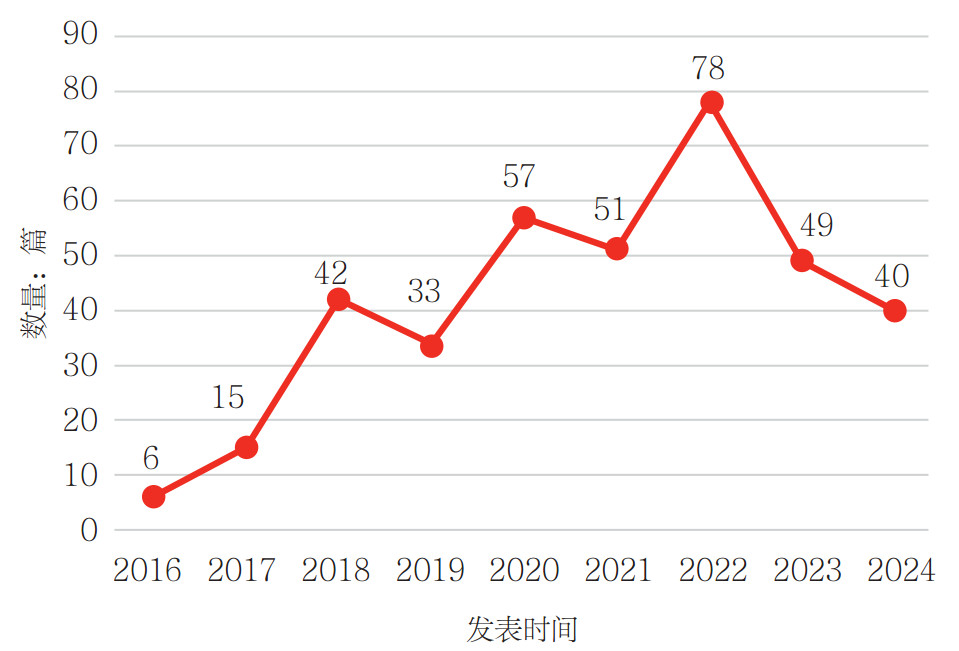
图 1  2016—2024年CSSCI来源期刊主题出版学术论文发表时间分布情况
表 8  2016—2024年CSSCI来源期刊(含扩展版)主题出版学术论文发表期刊分布情况
表 9  2016—2024年CSSCI来源期刊(含扩展版)主题出版学术论文关键词分布情况
表 10  “十四五”时期主题出版研究著作出版情况
2 周蔚华, 熊小明. 做强做优,实现主题出版高质量发展:《出版业“十四五”时期发展规划》主题出版内容解读与思考[J]. 中国出版, 2022 (7): 25- 31.
3 周兵. 新文化史:历史学的文化转向[M]. 上海: 复旦大学出版社, 2012: 2.
4 中共中央办公厅国务院办公厅印发《关于实施中华优秀传统文化传承发展工程的意见》[EB/OL].(2017-01-25)[2024-10-29]. http://www.xinhuanet.com/politics/2017-01/25/c_1120383155.htm.
5 周蔚华. 重新理解当代中国出版业[J]. 出版发行研究, 2020 (1): 5- 15.
6 范燕莹,洪玉华,隋明照. 从社科、文学、少儿三大类看2024年主题出版重点出版物选题如何做[EB/OL].(2024-10-21)[2024-10-29]. https://mp.weixin.qq.com/s/i_liatBjCAxj-xhNklzs8Q.
7 付玉, 韩建民. 主题出版评价机制优化研究[J]. 编辑之友, 2022 (11): 7- 18.
8 彭兰. 新媒体用户研究:节点化、媒介化、赛博化的人[M]. 北京: 中国人民大学出版社, 2020: 24.
1 中共中央办公厅国务院办公厅印发《“十四五”文化发展规划》[EB/OL].(2022-08-16)[2024-10-29].http://www.xinhuanet.com//politics/zywj/2022-08/16/c_1128920613.htm.
[1] 汤雪梅,杨春兰,杨玥涵. “十四五”时期中国出版业的回顾与思考[J]. 科技与出版, 2025, 44(1): 6-16.
[2] 刘坚. 主题出版赋能文化强国建设的逻辑、使命及路径*[J]. 科技与出版, 2024, 43(9): 111-120.
[3] 钟悠天. 主题出版的“中国-中亚”模式及启示[J]. 科技与出版, 2024, 43(8): 34-43.
[4] 程丽. 记忆建构与符号运用:少儿主题出版图书的价值观传播进路[J]. 科技与出版, 2024, 43(8): 112-120.
[5] 陈进才. 重构与转换:主题出版数字化的媒介逻辑分析[J]. 科技与出版, 2024, 43(6): 116-120.
[6] 李婷,韩建民. 基于双三螺旋理论的主题出版人才培养模式探究*[J]. 科技与出版, 2024, 43(6): 121-129.
[7] 吕建生,刘浩冰,赵玉山. 大学出版企业智库建设的时代价值、创新路径与未来展望[J]. 科技与出版, 2024, 43(5): 51-58.
[8] 蒋琤琤,韩建民. 数字化驱动主题出版高质量发展的实践检视与优化路径*[J]. 科技与出版, 2024, 43(3): 117-126.
[9] 刘欣,蒋雪颖,袁也. 数智时代的国家认同与主题出版融合发展路径探析*[J]. 科技与出版, 2024, 43(2): 71-76.
[10] 石磊. 中华优秀传统文化融入少儿主题出版的实践探析[J]. 科技与出版, 2024, 43(11): 95-101.
[11] 韩建民,王琳,张敬平,李万星. 主题出版在阐释与传播党的创新理论中的作用研究[J]. 科技与出版, 2024, 43(11): 23-33.
[12] 杨石华. 吸纳与嵌入:马克思主义出版观与主题出版的协同发展*[J]. 科技与出版, 2024, 43(1): 39-45.
[13] 李彭涛. 试论大学出版社主题出版学术化的三重逻辑[J]. 科技与出版, 2024, 43(1): 65-70.
[14] 杨石华. 出版在构建中国式现代化叙事体系中的作用与实践路径*[J]. 科技与出版, 2023, 42(7): 40-48.
[15] 陈卓. 中国式现代化进程中期刊主题出版的内涵、功能及未来向路*[J]. 科技与出版, 2023, 42(7): 72-79.