Please wait a minute...
科技与出版  2025, Vol. 44 Issue (7): 102-109    
编辑实务
开放科学背景下的科技期刊版权管理策略研究
郭梦征,纪方方,张小利,范晨芳*
军事科学院军事科学出版社《军事医学研究(英文)》编辑部,100036,北京
Copyright Management Strategies for STM Journals in the Context of Open Science
GUO Mengzheng,JI Fangfang,ZHANG Xiaoli,FAN Chenfang*
Editorial Office of Military Medical Research, Military Sciences Publishing House, Academy of Military Sciences, 100036, Beijing, China
全文: HTML    PDF(8804 KB)  
输出: BibTeX | EndNote (RIS)      
摘要: 

文章通过问卷调查共收集有效样本348份,并采用NVivo软件进行质性分析,深入探讨了在开放科学背景下科研人员对版权知识的认知水平、应用现状及其影响因素。尽管多数科研人员对版权有清晰的认识,但仍有约三分之一的受访者存在认知不足的问题,特别是70%的研究对象无法准确区分不同类型的CC协议,且在论文撰写、投稿及发表过程中普遍存在不同程度的理解模糊或误用现象。此外,研究揭示了科研人员对版权知识的正规化培训及期刊版权服务的强烈需求。鉴于此,文章提出创新版权知识普及模式、构建“三层级递进式”版权管理工具、搭建“三位一体”版权保护机制等策略,旨在提升科研人员的版权素养与管理能力。未来可通过建设沉浸式版权培训系统,发展区块链智能治理平台、智能版权助手、版权信用评价体系以及开放科学背景下的版权联盟等综合性措施,以更好地支撑开放科学环境下的版权管理与服务体系建设。

关键词 开放科学科技期刊版权意识影响因素策略研究    
Abstract

This study employed questionnaire surveys to collect 348 valid responses and utilized NVivo software for qualitative analysis, aiming to comprehensively investigate researchers’ understanding of copyright knowledge, its practical application, and the associated influencing factors within the context of open science. While the majority of researchers demonstrated a basic understanding of copyright principles, approximately one-third exhibited insufficient knowledge. Notably, 70% of participants struggled to accurately distinguish between different types of Creative Commons (CC) licenses. Furthermore, varying degrees of confusion or misuse were observed throughout key stages of the research lifecycle, including writing, submission, and publication. Approximately 22.55% of respondents reported experiencing copyright disputes, primarily involving unauthorized use of their work or improper reuse of figures and tables. Moreover, several key contributing factors were identified. First, academic training systems exhibit structural deficiencies by prioritizing disciplinary expertise over the systematic development of cross-cutting competencies such as copyright literacy. Second, mechanisms for updating copyright knowledge remain outdated, particularly concerning emerging tools like CC licenses. Third, systemic weaknesses exist in the copyright education ecosystem, characterized by heavy reliance on informal and fragmented sources rather than structured institutional training. Finally, there is a widespread lack of awareness regarding rights enforcement and ambiguity about responsibility, which is frequently delegated to journals or publishers. This issue is compounded by limited institutional incentives, insufficient support systems, and a prevailing cultural undervaluation of intellectual property rights within research practices. Over 80% of respondents expressed the need for enhanced formal training and dedicated journal-based support services. In response to these findings, this paper proposes a series of strategic interventions: 1) An innovative model for disseminating copyright knowledge that shifts from passive reception to active engagement through a “Conference Presentation + Interactive Feedback” approach tailored to specific knowledge gaps; 2) A “Three-Tiered Progressive” copyright management tool system comprising a discipline-specific “Basic Knowledge Map”, an “Intelligent Agreement Assistant” utilizing decision trees for CC license selection, and a “Personalized Consultation Platform” offering expert guidance; 3) A “Trinity Copyright Protection Mechanism” integrating a pre-submission “Early Warning and Prevention System”, a “Real-Time Response Platform” providing 24/7 expert consultation, and a “Tracking Protection Mechanism” ensuring traceability. Looking forward, multi-dimensional collaborative innovation is recommended to address deeper systemic challenges. Future directions include the development of immersive virtual reality (VR)-based training that simulates real-world publishing scenarios; the creation of a blockchain-powered platform for automated copyright lifecycle management; the design of an AI-driven “Intelligent Copyright Assistant” to resolve complex issues; the establishment of a Copyright Credit Evaluation System integrated into academic performance metrics; and the formation of an Open Science Copyright Alliance involving publishers, technology firms, and academic institutions to promote resource sharing and interoperability. These comprehensive measures aim to establish a robust, efficient, and supportive copyright ecosystem aligned with the evolving demands of open science.

Key wordsopen science    scientific, technical, and medical (STM) journals    copyright awareness    influencing factors    strategy research
出版日期: 2025-08-19
基金资助:2023年度中国科技期刊卓越行动计划选育高水平办刊人才子项目-青年人才支持项目(2023ZN042502)
通讯作者: 范晨芳   
Corresponding author: Chenfang FAN   

引用本文:

郭梦征,纪方方,张小利,范晨芳. 开放科学背景下的科技期刊版权管理策略研究[J]. 科技与出版, 2025, 44(7): 102-109.
GUO Mengzheng,JI Fangfang,ZHANG Xiaoli,FAN Chenfang. Copyright Management Strategies for STM Journals in the Context of Open Science. Science-Technology & Publication, 2025, 44(7): 102-109.

链接本文:

http://kjycb.tsinghuajournals.com/CN/      或      http://kjycb.tsinghuajournals.com/CN/Y2025/V44/I7/102

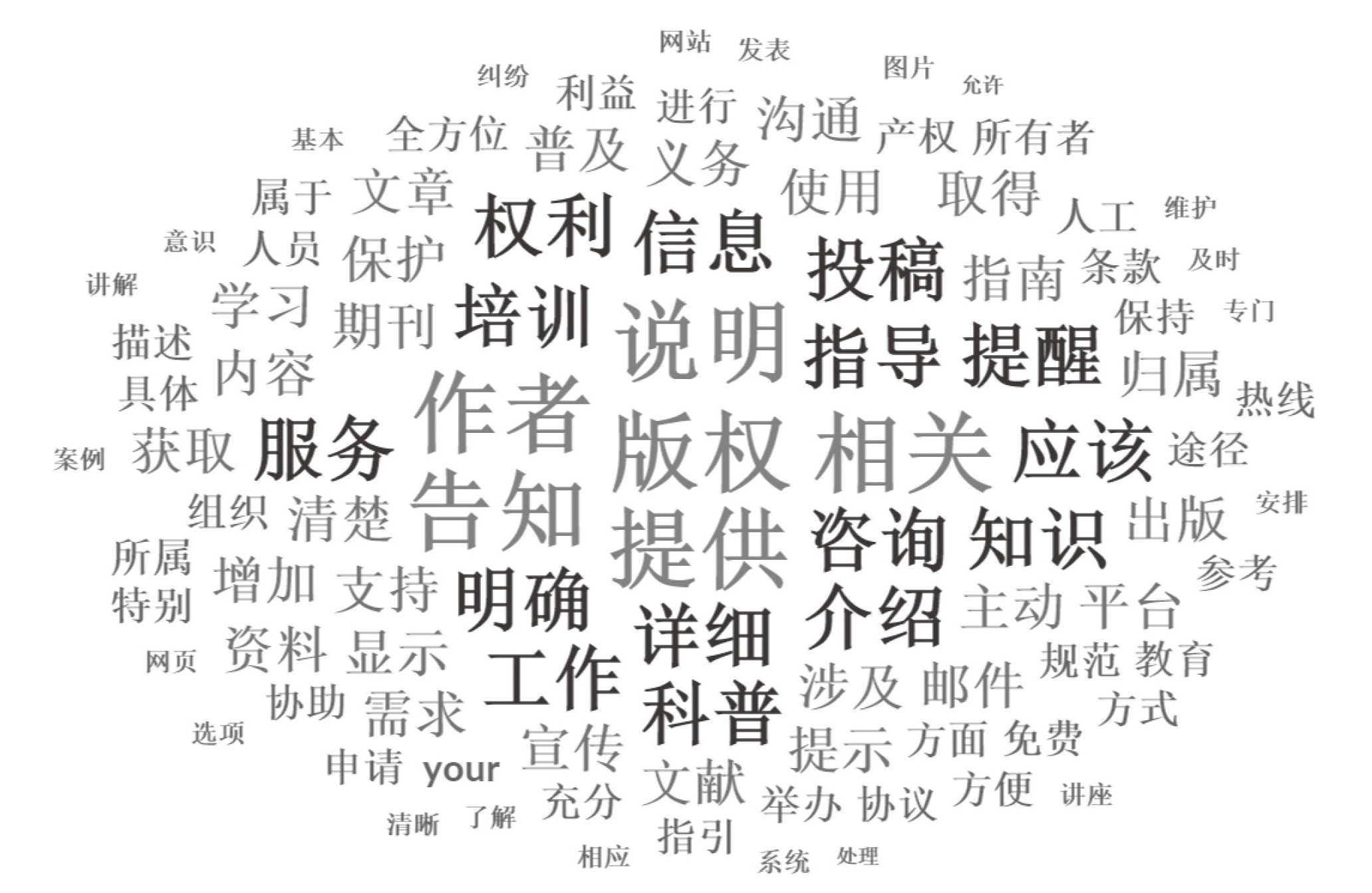
图 1  科研人员对于科技期刊版权服务工作的建议词云图
1 Budapest open access initiative[EB/OL]. [2025-07-09]. https://www.budapestopenaccessinitiative.org/read/.
2 UNESCO. Implementation of the UNESCO Recommendation on Open Science 2021[EB/OL].(2025-03-13)[2025-03-19]. https://www.unesco.org/en/natural-sciences/open-science/implementation.
3 BERTRAM M G , SUNDIN J , ROCHE D G , SáNCHEZ-TóJAR A , THORé E S J , BRODIN T . Open science[J]. Current Biology, 2023 (15): R792- R797.
4 LAWRENCE S . Free online availability substantially increases a paper’s impact[J]. Nature, 2001 (6837): 521.
5 LANGHAM-PUTROW A , BAKKER C , RIEGELMAN A . Is the open access citation advantage real? A systematic review of the citation of open access and subscription-based articles[J]. PLoS One, 2021 (6): e0253129.
6 LAAKSO M , BJ?RK B C . Anatomy of open access publishing:A study of longitudinal development and internal structure[J]. BMC Medicine, 2012 (10): 124.
7 Creative Commons. About CC Licenses[EB/OL]. [2025-03-19]. https://creativecommons.org/share-your-work/cclicenses/.
8 NEWMAN J C , FELDMAN R . Copyright and open access at the bedside[J]. New England Journal of Medicine, 2011 (26): 2447- 2449.
9 CARROLL M W . Creative Commons and the openness of open access[J]. New England Journal of Medicine, 2013 (9): 789- 791.
10 HOORN E , van der GRAAF M . Copyright issues in open access research journals[J]. D-Lib Mag, 2006, 12
doi: 10.1045/february2006-vandergraaf
11 胡正君, 曾文, 刘素琴, 等. 我国科研人员和期刊编辑对学术期刊开放科学数据的认知调查分析[J]. 中国科技期刊研究, 2020 (1): 63- 70.
12 刘静羽, 章岑, 孙雯熙, 等. 开放科学中的知识产权问题分析[J]. 农业图书情报学报, 2020 (12): 59- 69.
13 XIAO X , HE X , ZHANG Y , et al. Blockchain-based reliable image copyright protection[J]. IET Blockchain, 2023 (4): 222- 237.
14 JIANG J , GAO Y , GONG Y , et al. A blockchain copyright protection scheme based on CP-ABE scheme with policy update[J]. Sensors, 2024 (14): 4493.
[1] 程志波,岑智. 新型生产关系推进高质量科技期刊建设的目标、困境与对策[J]. 科技与出版, 2025, 44(6): 26-34.
[2] 武艳芹. 地方高校科技期刊编委会建设研究[J]. 科技与出版, 2025, 44(6): 88-94.
[3] 李艳红,邓履翔. 科技期刊实施开放同行评议面临的挑战与应对策略[J]. 科技与出版, 2025, 44(6): 80-87.
[4] 姜红贵,秦娟娟. 总体国家安全观视角下科技期刊的作用与风险管理策略[J]. 科技与出版, 2025, 44(5): 141-148.
[5] 林润华,祝叶华,刘志远,李娜. 综合性科技期刊影响力要素研究及启示[J]. 科技与出版, 2025, 44(5): 51-59.
[6] 金会平,罗斌. 科技期刊高质量发展的哲学思考:矛盾、规律与目标[J]. 科技与出版, 2025, 44(5): 60-69.
[7] 贺嫁姿,孙涛,徐志武,唐虞. 科技期刊编辑职业竞争力的差异性分析及提升策略[J]. 科技与出版, 2025, 44(5): 78-88.
[8] 秦明阳,李艳红,刘森,余海钊. 高校自主制定科技期刊清单的特点、意义与建议[J]. 科技与出版, 2025, 44(4): 103-111.
[9] 刘广东,陈丹. 科技期刊编辑人才流动的制度性困境及其治理[J]. 科技与出版, 2025, 44(4): 5-12.
[10] 徐丽芳,罗婷,田峥峥,张蒂. 技术驱动的开放与可信出版:2024年海外科技期刊出版动态研究[J]. 科技与出版, 2025, 44(3): 35-54.
[11] 任胜利,刘筱敏,宁笔,陈哲,颜帅. 2024年我国英文科技期刊发展回顾[J]. 科技与出版, 2025, 44(3): 55-65.
[12] 刘志强,王婧,张芳英,吴领叶,张铁明,张昕. 政策引领 拓新致远——2024年我国中文科技期刊盘点与展望[J]. 科技与出版, 2025, 44(3): 66-77.
[13] 丁佐奇,李亚萍,李楚威. “中国科技期刊卓越行动计划”二期项目英文单刊特征分析及发展建议[J]. 科技与出版, 2025, 44(3): 87-96.
[14] 杨燕. 我国科技期刊的投审稿系统功能优化需求分析——基于作者、编辑、审稿专家和编委的调查[J]. 科技与出版, 2025, 44(3): 106-114.
[15] 蒋霞,黄崇亚. 不同语种发表重复内容的出版伦理问题探讨[J]. 科技与出版, 2025, 44(3): 157-166.