Please wait a minute...
科技与出版  2026, Vol. 45 Issue (5): 37-48    
融媒之光
具身智能视域的出版智能体:概念、构成与价值——基于《智能体规范应用与创新发展实施意见》的研究视角
张新新1,2,杜欢欢3,席媛媛3
1. 上海理工大学数字文明研究院,200093,上海
2. 北京航空航天大学人文与社会科学高等研究院,100191
3. 上海理工大学出版学院,上海,200093
Publishing Agents from the Perspective of Embodied Intelligence: Concept, Architecture, and Value Functions
ZHANG Xinxin1,2,DU Huanhuan3,XI Yuanyuan3
1. Institute of Digital Civilization, University of Shanghai for Science and Technology, 200093, Shanghai, China
2. Institute of Advanced Studies in Humanities and Social Sciences, Beihang University, 100191, Beijing, China
3. College of Publishing, University of Shanghai for Science and Technology, 200093, Shanghai, China
全文: HTML    PDF(1979 KB)  
输出: BibTeX | EndNote (RIS)      
摘要: 

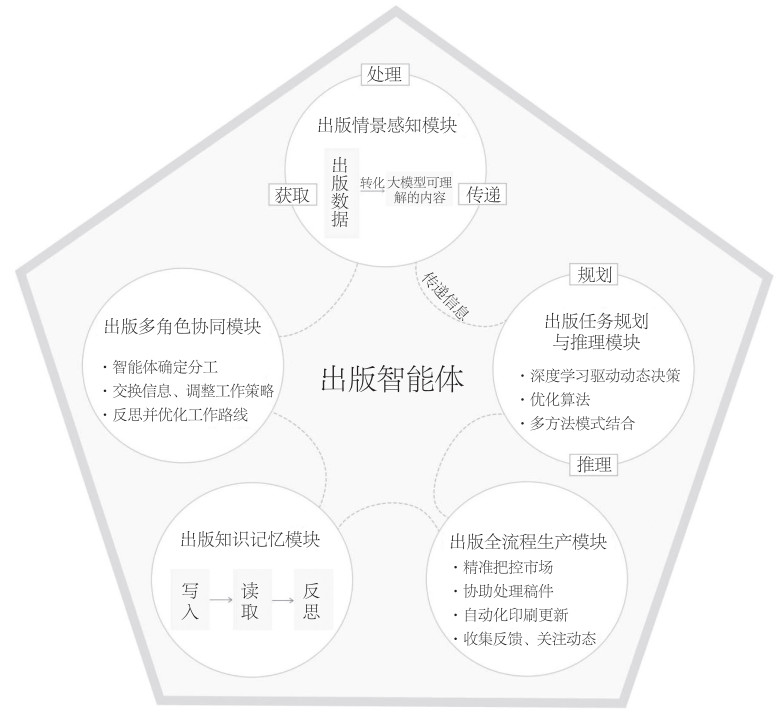
《智能体规范应用与创新发展实施意见》指出要强化智能体应用牵引,积极稳妥推动智能体典型场景应用,探索内容创作智能体、教育教学智能体、网络内容建设管理智能体等示范场景。出版智能体是具备出版领域自主感知、记忆、决策、交互与执行能力的智能体系,是智能出版产品服务的重要形态,是数字出版发展的新产品、新服务。基于此,本文将出版智能体的构成划分为出版情景感知模块、出版任务规划与推理模块、出版全流程生产模块、出版知识记忆模块,以及出版多角色协同模块,进一步归纳出四类智能体:面向出版环节的专用智能体、基于出版场景反馈的自主智能体、服务于出版生产的生成式智能体、覆盖出版全链路的多智能体系统。最后,文章以“空间—主体—要素”的视角,深入剖析了出版智能体在扩展融合出版空间、创新智能出版主体和优化数据、技术等新要素方面的价值功能。

关键词 智能体出版智能体数字出版智能出版智能体出版生成式人工智能“十五五”规划纲要具身智能    
Abstract

The Implementation Opinions on the Standardized Application and Innovative Development of Agents emphasizes strengthening application-driven development of agents, actively and prudently promoting their deployment in typical scenarios, and exploring demonstration use cases such as content creation agents, educational and instructional agents, and agents for online content construction and management. An agent is an intelligent system capable of autonomous perception, memory, decision-making, interaction, and execution. A publishing agent is such a system with domain-specific capabilities applied to the publishing field, constituting an important form of intelligent publishing products and services and a new category of product in digital publishing development. Based on this, this paper divides the architecture of a publishing agent into five modules: the publishing context perception module, the publishing task planning and reasoning module, the full-process publishing production module, the publishing knowledge memory module, and the multi-role collaboration module. Specifically, the perception module converts heterogeneous data (e.g., text, sound, images) into content understandable by large models and transmits it to subsequent reasoning and decision-making stages. The task planning and reasoning module—the agent’s cognitive core—plans, learns from, and makes decisions based on information acquired during perception. The full-process production module acts as the "operator" of the publishing agent, converting decisions from the reasoning module into concrete behaviors and actions, with key technologies including robot control, action generation, and content output. The knowledge memory module stores historical interaction data to support ongoing decision-making. The multi-role collaboration module, critical in multi-agent systems, handles interactions among users and agents, agents and agents, and agents and the environment; this paper focuses specifically on inter-agent communication. The paper further summarizes four types of publishing agents: dedicated agents for specific publishing processes, autonomous agents that learn from feedback in publishing scenarios, generative agents serving publishing production, and multi-agent systems covering the entire publishing workflow. Finally, from the perspective of "space-subject-element", the paper provides an in-depth analysis of the value and functions of publishing agents in expanding the space of integrated publishing, innovating intelligent publishing subjects, and optimizing new elements such as data and technology.

Key wordsagent    publishing agent    digital publishing    intelligent publishing    agent publishing    generative artificial intelligence    Outline of the 15th Five-Year Plan (2026–2030)    embodied intelligence
出版日期: 2026-06-15
基金资助:国家社会科学基金重大项目“全媒体传播体系下出版深度融合发展研究”(23&ZD218)

引用本文:

张新新,杜欢欢,席媛媛. 具身智能视域的出版智能体:概念、构成与价值——基于《智能体规范应用与创新发展实施意见》的研究视角[J]. 科技与出版, 2026, 45(5): 37-48.
ZHANG Xinxin,DU Huanhuan,XI Yuanyuan. Publishing Agents from the Perspective of Embodied Intelligence: Concept, Architecture, and Value Functions. Science-Technology & Publication, 2026, 45(5): 37-48.

链接本文:

http://kjycb.tsinghuajournals.com/CN/      或      http://kjycb.tsinghuajournals.com/CN/Y2026/V45/I5/37

图 1  出版智能体的构成图
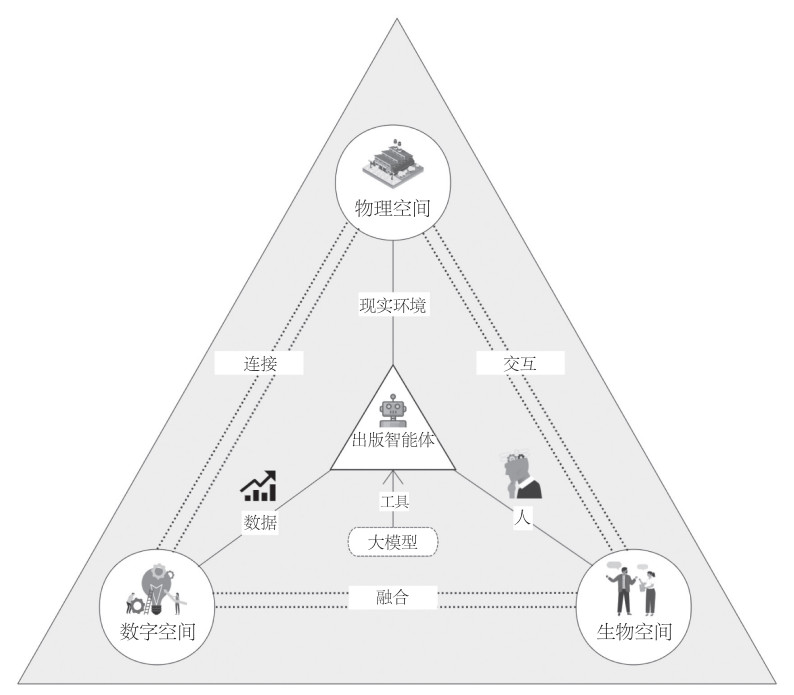
图 2  出版智能体的三层空间联通图
1 中华人民共和国国民经济和社会发展第十五个五年规划纲要[EB/OL].(2026-03-13)[2026-03-16]. https://www.gov.cn/yaowen/liebiao/202603/content_7062633.htm.
2 国务院关于深入实施“人工智能+”行动的意见[EB/OL].(2025-09-10)[2025-10-31]. https://www.gov.cn/gongbao/2025/issue_12266/202509/content_7039598.html.
3 智能体规范应用与创新发展实施意见[EB/OL].(2026-05-08)[2026-05-10]. https://www.cac.gov.cn/2026-05/08/c_1779979789523320.htm.
4 张新新, 刘华东. 出版+人工智能:未来出版的新模式与新形态:以《新一代人工智能发展规划》为视角[J]. 科技与出版, 2017 (12): 38- 43.
doi: 10.16510/j.cnki.kjycb.20171129.001
5 陈昌凤. 智能平台兴起与智能体涌现:大模型将变革社会与文明[J]. 新闻界, 2024 (2): 15- 24.
6 沈甜雨, 陶子锐, 王亚东, 等. 具身智能研究的关键问题:自主感知、行动与进化[J]. 自动化学报, 2025, 51 (1): 43- 71.
7 李珍. 身体何为:论具身智能的“具身悖论”[J]. 华中科技大学学报(社会科学版), 2026, 40 (1): 8- 16.
8 张新新, 孙瑾. “人工智能+”文化建构:未来出版的新视野:以《关于深入实施“人工智能+”行动的意见》为研究视角[J]. 科技与出版, 2025 (10): 38- 49.
9 周灵. 超越工具理性:生成式人工智能嵌入知识生产的逻辑与路向[J]. 编辑之友, 2026 (2): 41- 48.
10 卢宇, 余京蕾, 陈鹏鹤. 基于大模型的教学智能体构建与应用研究[J]. 中国电化教育, 2024 (7): 99- 108.
11 张新新, 黄馨月, 付亚娟. 敏捷治理:融合出版管理的一种新视角[J]. 出版广角, 2025 (10): 11- 19.
12 张新新, 周姝伶. 新质生产力推动全媒体出版传播体系构建:推动出版深度融合发展的新要素新动能新路径[J]. 中国编辑, 2024 (6): 11- 20.
13 匡文波, 曹萩儿. 智能体嵌入与平台化转型:AI驱动下的数字出版产业升级[J]. 出版广角, 2024 (23): 43- 50.
14 张新新, 丁靖佳, 韦青. 元宇宙与出版(上):元宇宙本体论与出版远景展望[J]. 科技与出版, 2022 (5): 47- 59.
doi: 10.16510/j.cnki.kjycb.20220523.005
15 东阳, 杨培宇. 大模型智能体重构出版行业行动者网络研究[J]. 编辑学刊, 2025 (5): 21- 25.
16 张新新. 新闻出版业智能机器人的应用原理与场景分析[J]. 科技与出版, 2018 (11): 43- 48.
[1] 孙冠豪. 生成式人工智能赋能学术期刊出版的挑战与应对策略[J]. 科技与出版, 2026, 45(4): 59-68.
[2] 毛文思,王飚. 2025年中国数字出版发展态势盘点与2026年发展展望[J]. 科技与出版, 2026, 45(3): 14-27.
[3] 徐丽芳,田峥峥,张蒂,曹天天,王一雪. 公正导向下的开放与治理重构:2025海外科技期刊出版观察[J]. 科技与出版, 2026, 45(3): 38-55.
[4] 周蔚华,梁乾. 人工智能赋能出版的政策导向、理论研究与产业实践——2025年出版业人工智能应用报告[J]. 科技与出版, 2026, 45(3): 82-92.
[5] 叶娟. 教育数字化背景下高校出版社融合出版模式研究[J]. 科技与出版, 2026, 45(3): 146-151.
[6] 曾伟明,余佳佳. 构建“全球南方”学术数字出版平台  推动全球自主知识体系公平化[J]. 科技与出版, 2026, 45(2): 51-58.
[7] 刘超. 人工智能时代的教育出版:挑战、机遇与转型路径探索[J]. 科技与出版, 2025, 44(9): 21-28.
[8] 刘普,孙婉婷. 社科学术期刊的AI使用政策图谱与治理进阶——基于50家社科学术期刊生成式人工智能使用政策文本的分析[J]. 科技与出版, 2025, 44(9): 52-62.
[9] 郑恩. 数字版权价值评估的多维动态路径研究[J]. 科技与出版, 2025, 44(8): 16-27.
[10] 吕晓峰,孟祥晴,詹洪春. 人工智能时代出版业知识服务的伦理挑战、价值重构与实践进路[J]. 科技与出版, 2025, 44(8): 47-55.
[11] 王鹏飞,毛志慧. 2024年出版学研究的十大热点话题[J]. 科技与出版, 2025, 44(6): 5-17.
[12] 王钧,王飚,李苏航. 出版行业构建高质量数据集的优势分析与方法研究[J]. 科技与出版, 2025, 44(6): 64-72.
[13] 陈强,张钢花. 适老化数字出版的现实与未来:基于数字可供性视角[J]. 科技与出版, 2025, 44(6): 73-79.
[14] 陈矩弘,封采龄. 生成式人工智能赋能出版营销的技术逻辑与实践进路[J]. 科技与出版, 2025, 44(4): 76-84.
[15] 范文婷. 平台生态系统视角下多边数字阅读平台价值共创与多元主体协同创新路径优化[J]. 科技与出版, 2025, 44(4): 94-102.