Please wait a minute...
科技与出版  2026, Vol. 45 Issue (6): 68-75    
融媒之光
算法逻辑下的场景重构:教育出版人工智能应用的三重层级与实现框架
张窈1,吴媛媛2
1. 西安交通大学新闻与新媒体学院,710049,西安
2. 西北大学公共管理学院,710127,西安
Algorithmic Logic and Scene Reconstruction: The Three-Tier Structure and Implementation Framework of Artificial Intelligence Applications in Educational Publishing
ZHANG Yao1,WU Yuanyuan2
1. School of Journalism and New Media, Xi'an Jiaotong University, 710049, Xi'an, China
2. School of Public Management, Northwest University, 710127, Xi'an, China
全文: HTML    PDF(1869 KB)  
输出: BibTeX | EndNote (RIS)      
摘要: 

伴随媒介环境变迁,算法逻辑正强势重构教育出版的运行机制与交互边界。本研究基于场景理论,系统剖析人工智能介入教育出版的逻辑演进与实现框架。结合真实教学情境,人工智能的应用被解构为递进的三重层级,即在嵌入层实现技术场景转译与流程规则化重塑,在服务层达成教学情境响应与过程性知识供给,最终在融合层推进平台枢纽建构与生态协同重组。研究认为,人工智能的架构成效取决于其与场景深层要素的适配程度。为此,亟须循着三条路径推进实践:基于规则前置的媒介环境适配、贯通教学时序的动态反馈闭环,以及统合多元主体价值的平台协同治理。唯有实现制度兼容与生态统合,人工智能方能驱动教育出版向过程性知识服务深度转型。

关键词 算法逻辑场景理论人工智能教育出版知识服务    
Abstract

Amid the accelerating penetration of artificial intelligence into the educational domain, algorithmic logic is powerfully reshaping the operational mechanisms and interactional boundaries of educational publishing, reshaping the underlying paradigm of knowledge services and reconfiguring the rules governing their constitutive elements. Prevailing practice, however, tends toward a technological-determinist trap, treating AI adoption as a context-free, uniform process of efficiency gain. Against this backdrop, this study introduces the perspective of scene theory (Scene Theory) to move beyond a narrow functional evaluation of technology and conceptualize educational publishing as a dynamic field in which technological logic, content provision, and pedagogical situations are mutually nested. Methodologically, the study proceeds through conceptual clarification and structured case analysis: it first delimits the analytical construct of the educational-publishing "scene, " decomposing it into four interacting dimensions—the material–media environment, temporal rhythm and task structure, subject roles and power relations, and value norms and evaluation systems—and then uses this framework to analyze the process by which AI intervenes in educational publishing. Drawing on a range of illustrative cases from Chinese and international publishers, the analysis deconstructs AI applications into three progressive layers. At the embedding layer, AI operates chiefly as an auxiliary tool that enters established workflows with low disturbance, translating general-purpose technology into situated capability and restructuring production processes through rule-based governance; as evidenced by the conversion of external rigid constraints into internal compliance routines, situated adaptation of platforms, and the encoding of editors' tacit expertise into explicit system rules. At the service layer, AI shifts from back-end production to front-line teaching, acting as a service medium that links publishers, teachers, and students, thereby driving a transition from static product delivery to dynamic, process-oriented knowledge provision, reconfiguring organizational structures and the interaction logic between publishers and the teaching site. At the integration layer, technology turns toward building platform infrastructure and organizing ecological coordination, extending the publisher's role to that of rule-maker, resource organizer, and ecosystem coordinator, and advancing data-driven content co-creation and multi-stakeholder governance. The study argues that the effectiveness of AI-based restructuring depends not on platform scale or computational power per se but on the degree of fit between AI and the deep-seated structural elements of educational scenes. Accordingly, it proposes three coordinated implementation paths: media-environment adaptation grounded in prior rule-setting and system compatibility, which compresses operational friction and embeds external regulation as automated underlying processes; dynamic feedback loops that run through the temporal sequence of lesson preparation, teaching, assignment, and assessment, establishing fine-grained mappings between content and learning behavior while preserving teachers' control over pedagogical rhythm; and platform-based collaborative governance that integrates the interests of multiple stakeholders and educational value norms through codified rights-and-responsibilities lists, institutional constraints on algorithmic boundaries, and periodic rule review. The study concludes that only through institutional compatibility and ecological integration can artificial intelligence drive educational publishing toward its deeper transformation into process-oriented knowledge services, while publishers must concurrently assume the role of value steward and ecological gatekeeper.

Key wordsalgorithmic logic    scene theory    artificial intelligence (AI)    educational publishing    knowledge service
出版日期: 2026-07-14
基金资助:人民教育出版社“十四五”规划2024年度重点项目(2024GHB13);中国音像与数字出版协会2025年度科研项目(KY-SZCB2025-13);中央高校基本科研业务费支持项目的阶段性研究成果(SK2024012)

引用本文:

张窈,吴媛媛. 算法逻辑下的场景重构:教育出版人工智能应用的三重层级与实现框架[J]. 科技与出版, 2026, 45(6): 68-75.
ZHANG Yao,WU Yuanyuan. Algorithmic Logic and Scene Reconstruction: The Three-Tier Structure and Implementation Framework of Artificial Intelligence Applications in Educational Publishing. Science-Technology & Publication, 2026, 45(6): 68-75.

链接本文:

http://kjycb.tsinghuajournals.com/CN/      或      http://kjycb.tsinghuajournals.com/CN/Y2026/V45/I6/68

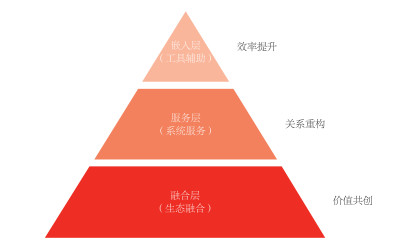
图 1  人工智能介入教育出版的应用层级
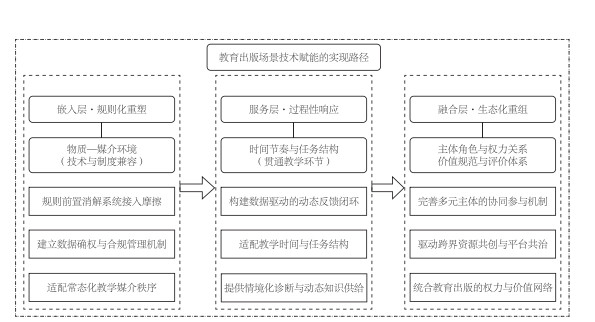
图 2  人工智能架构教育出版场景的三重路径
1 Goffman E. The presentation of self in everyday life[M]//Social Theory re-Wired. New York: Routledge, 2023: 450-459.
2 任媛媛, 詹亚飞. 智能化媒介治理: 场景视域下的新型表征、现实挑战与路径探索[J]. 中国出版, 2025 (12): 66- 69.
3 卜玉华, 于金申. 试析未来教育的"未来理念取向": 类型、合理性及其伦理风险[J]. 教育发展研究, 2023, 43 (24): 1- 10.
4 刘芳. 数智技术赋能教学场景化: 何谓、何畏及何为[J]. 教育科学研究, 2026 (1): 68- 75.
5 何梦祎. 媒介情境论: 梅罗维茨传播思想再研究[J]. 现代传播(中国传媒大学学报), 2015, 37 (10): 14- 18.
6 王晴锋. 情境互动论: 戈夫曼社会学的理论范式[J]. 理论月刊, 2019 (1): 138- 144.
7 赵赫栋, 申素平. 数字平台的社会教育权及其规制[J]. 清华大学教育研究, 2024, 45 (6): 38- 49.
8 吴军其, 戴新菊, 吴飞燕, 等. GenAI赋能科学教育的应用场景、现实挑战和推进路径[J/OL]. 当代教育论坛, 2025-11-28. https://doi.org/10.13694/j.cnki.ddjylt.20251128.001.
9 Scoble R , Israel S , Benioff M . Age of context: Mobile, sensors, data and the future of privacy[J]. (No Title), 2014,
10 郭宇. 生成式人工智能嵌入教育出版路径优化[J]. 中国出版, 2024 (12): 42- 47.
11 徐伟韬, 廖望者. 国际出版巨头应对生成式人工智能技术策略观察[J]. 中国数字出版, 2025, 3 (6): 151- 161.
12 赵宇翔, 景雨田, 宋士杰, 等. AIGC赋能的提示素养: 生成式AI时代的人智交互能力重构[J]. 情报资料工作, 2025, 46 (3): 14- 25.
13 李丽. 外研社: 数字化相关收入占比达到30%[J]. 出版人, 2024 (1): 32- 33.
14 本刊编辑部. 九位院士、校长谈"人工智能赋能高等教育": "'人工智能赋能教育'中国工程科技论坛"会议综述[J]. 西安交通大学学报(社会科学版), 2023, 43 (3): 1- 15.
15 Cornelsen. Mit künstlicher Intelligenz Lehrkr?fte entlasten und Bildung verbessern[EB/OL]. (2024-02-15)[2025-08-25]. https://www.cornelsen.de/presse/pressemitteilungen/mit-kuenstlicher-intelligenz-lehrkraefte-entlasten-und-bildung-verbessern.
[1] 刘普,蔡英辉. 学术期刊在科研诚信建设中的职责定位与实践路径——基于近年来曝光的涉刊学术不端典型案例的分析[J]. 科技与出版, 2026, 45(6): 5-15.
[2] 沈悦,赵新毅,孙露铭. 数智时代实体书店空间体验优化与场景营销探新[J]. 科技与出版, 2026, 45(6): 136-149.
[3] 申尧. AI时代影像档案出版的真实性机制与成果链[J]. 科技与出版, 2026, 45(6): 36-42.
[4] 李嘉宁,李梦竹. 沉淀与涌现:数智时代出版业知识库建设的现实样态、困局机理及未来进路[J]. 科技与出版, 2026, 45(6): 43-57.
[5] 张弘杨,吴瑜,肖进,彭熙,别思瑶,唐定国. 人工智能辅助期刊审稿责任认定规则构建研究[J]. 科技与出版, 2026, 45(6): 106-114.
[6] 肖晓羽,姜钰,李佳. 人工智能视域下中小学数字教材的实践省思与进路展望[J]. 科技与出版, 2026, 45(5): 28-36.
[7] 张新新,杜欢欢,席媛媛. 具身智能视域的出版智能体:概念、构成与价值——基于《智能体规范应用与创新发展实施意见》的研究视角[J]. 科技与出版, 2026, 45(5): 37-48.
[8] 葛欣. 数字化转型背景下教育出版社C端市场发展路径研究[J]. 科技与出版, 2026, 45(5): 49-56.
[9] 马伊颀. 新时代教育出版质量管理探索[J]. 科技与出版, 2026, 45(5): 57-65.
[10] 范晔. 出版内容语料库建设的逻辑前提、现状检视与实践路径[J]. 科技与出版, 2026, 45(5): 93-102.
[11] 孙冠豪. 生成式人工智能赋能学术期刊出版的挑战与应对策略[J]. 科技与出版, 2026, 45(4): 59-68.
[12] 刘玥,黄楚新,李一凡. 人工智能赋能数智出版的平台化实践[J]. 科技与出版, 2026, 45(4): 77-85.
[13] 冯立君,鲍柳康. AI赋能科普图书内容“二次创作”及多模态转化的路径探析[J]. 科技与出版, 2026, 45(4): 94-103.
[14] 徐丽芳,田峥峥,张蒂,曹天天,王一雪. 公正导向下的开放与治理重构:2025海外科技期刊出版观察[J]. 科技与出版, 2026, 45(3): 38-55.
[15] 王鹏飞,高智晖. 人工智能驱动与情绪价值引领:2025年出版营销与运营[J]. 科技与出版, 2026, 45(3): 28-37.