Please wait a minute...
科技与出版  2026, Vol. 45 Issue (6): 76-86    
融媒之光
基于数字孪生的学术出版知识服务用户体验影响因素研究
邹巧玲1,*,冯娟2
1. 江南大学,214122,江苏无锡
2. 青岛大学期刊社,266071,山东青岛
Influencing Factors of User Experience in Digital Twin-Based Academic Publishing Knowledge Services
ZOU Qiaoling1,*,FENG Juan2
1. Jiangnan University, 214122, Wuxi, China
2. Qingdao University Periodical Press, 266071, Qingdao, China
全文: HTML    PDF(2127 KB)  
输出: BibTeX | EndNote (RIS)      
摘要: 

为响应出版业数字化转型、新质生产力培育的战略要求,本文旨在探索基于数字孪生技术的场景化知识服务设计路径。通过整合信息系统成功理论、具身认知理论与知识创造理论,构建以用户体验为导向的理论模型,并利用问卷调查与结构方程模型检验。结果显示,系统质量与知识呈现保真度共同驱动知识服务效能提升。研究进一步提出数字孪生学术出版知识服务系统的设计框架,从功能研发、内容制作与系统设计三个维度明确具体设计策略。

关键词 数字孪生用户体验系统设计出版融合发展新质生产力    
Abstract

To address the strategic demands of digital transformation and the cultivation of new quality productive forces in academic publishing, this study explores scenario-based knowledge services using digital twin technology. By investigating the key factors influencing user experience in such services, it aims to provide theoretical and practical guidance for system optimization. Integrating the Information System Success Model (ISSM), embodied cognition theory, and knowledge creation theory, this study constructs a user experience-oriented theoretical model. Six latent variables are identified: system quality, knowledge presentation fidelity, immersive experience, behavioral intention, cognitive empowerment, and knowledge service effectiveness. A dual-experiment repeated-measures design was implemented across universities and enterprises in five Chinese provinces. Experiment 1 used a neutral immersive geography knowledge service based on digital twin principles, with high-definition real-captured scenes and real-time interaction. This neutral content isolated the basic effects of core digital twin features on user experience without interference from professional knowledge. Experiment 2 used a self-developed digital twin academic publishing system presenting professional academic papers through 3D modeling and real-time rendering. All participants completed both experiments in sequence and filled out identical seven-point Likert questionnaires after each session. A total of 656 questionnaires were collected, and data were analyzed using structural equation modeling. The path analysis and mediation tests revealed several key findings. First, contrary to classic ISSM expectations, system quality did not directly enhance immersive experience or behavioral intention in the neutral context; its influence was fully mediated by knowledge presentation fidelity. Only in the professional context did system quality show a direct effect on behavioral intention. Second, knowledge presentation fidelity emerged as the central driver, directly and positively affecting both immersive experience and behavioral intention across both experiments. Third, immersive experience significantly influenced behavioral intention and directly contributed to knowledge service effectiveness, while behavioral intention strongly predicted cognitive empowerment. Most importantly, cognitive empowerment was identified as the strongest direct predictor of knowledge service effectiveness, surpassing the direct effect of immersive experience. Mediation analyses confirmed that the effect of system quality on behavioral intention was transmitted through immersive experience, and the effect of immersive experience on cognitive empowerment was transmitted through behavioral intention. Based on these findings, this study extends the ISSM and proposes a digital twin-based academic publishing knowledge service system model including five functional modules: content production, virtual mapping, immersive interaction, intelligent service, and real time feedback. Practically, the study offers actionable strategies from three dimensions: technology research and application, content production, and system design. Publishers are advised to prioritize high-fidelity knowledge presentation and cognitive engagement, collaborate with professional design firms for 3D modeling, develop reusable discipline-specific templates, and embed cognitive guidance tools such as knowledge tags, structural highlighting, and path navigation. These findings provide theoretical and practical guidance for developing effective digital twin-based knowledge services in academic publishing, supporting the industry's digital transformation and the cultivation of new quality productive forces.

Key wordsdigital twin    user experience    system design    integrated publishing development    new quality productive forces
出版日期: 2026-07-14
基金资助:山东省社会科学规划研究项目(25CXWJ01)
通讯作者: 邹巧玲   
Corresponding author: Qiaoling ZOU   

引用本文:

邹巧玲,冯娟. 基于数字孪生的学术出版知识服务用户体验影响因素研究[J]. 科技与出版, 2026, 45(6): 76-86.
ZOU Qiaoling,FENG Juan. Influencing Factors of User Experience in Digital Twin-Based Academic Publishing Knowledge Services. Science-Technology & Publication, 2026, 45(6): 76-86.

链接本文:

http://kjycb.tsinghuajournals.com/CN/      或      http://kjycb.tsinghuajournals.com/CN/Y2026/V45/I6/76

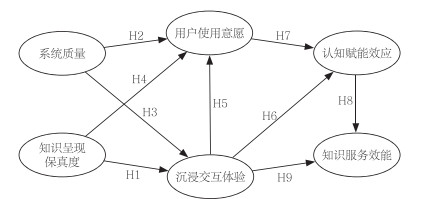
图 1  理论模型与研究假设
表 1  被试者人口特征统计信息
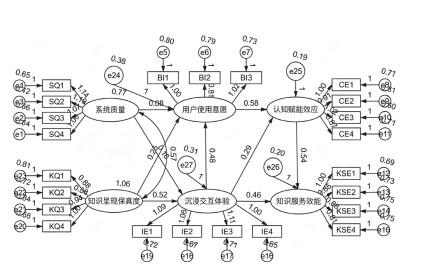
图 2  实验一结构方程模型路径结果
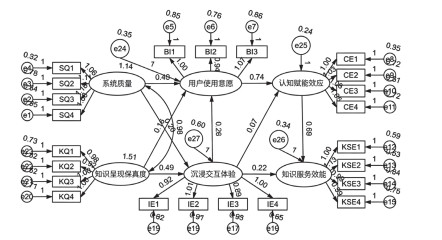
图 3  实验二结构方程模型路径结果
表 2  路径系数和显著性检验结果
表 3  Bootstrap中介效应检验结果(实验一)
表 4  Bootstrap中介效应检验结果(实验二)
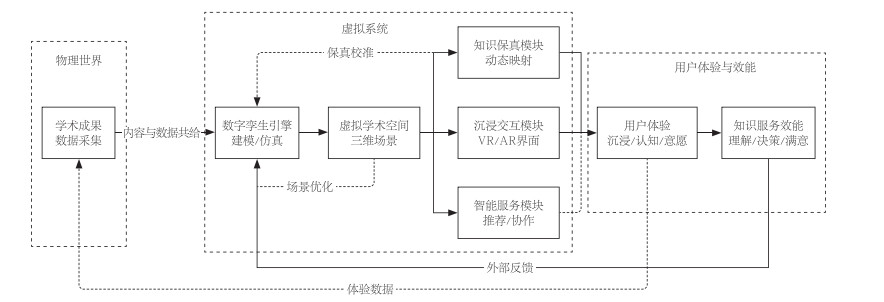
图 4  数字孪生学术出版知识服务系统模型
1 国家新闻出版署关于组织实施2025年度出版融合发展工程的通知[EB/OL]. (2025-03-21)[2025-11-01]. https://www.nppa.gov.cn/xxfb/tzgs/202503/t20250321_888045.html.
2 国家新闻出版署等关于印发《网络出版科技创新引领计划》的通知[EB/OL]. (2025-04-18)[2025-11-13]. https://www.gov.cn/zhengce/zhengceku/202504/content_7019838.htm.
3 张波, 张钰婷. 基于数字孪生模式的科普期刊创新路径与取向[J]. 中国科技期刊研究, 2025 (2): 199- 206.
4 DeLone W , McLean E . Information systems success: The quest for the dependent variable[J]. Information Systems Research, 1992, 3 (1): 60- 95.
doi: 10.1287/isre.3.1.60
5 张诗瑶, 沈阳. "可视化+出版": 数智时代学术出版发展的新模式[J]. 中州学刊, 2023 (8): 171- 176.
6 Li Y , Wang J . Evaluating the impact of information system quality on continuance intention toward cloud financial information system[J]. Frontiers In Psychology, 2021, 12, 713353.
doi: 10.3389/fpsyg.2021.713353
7 王玥兮, 陈幸, 刘顺芳, 等. 人工智能背景下学术期刊出版伦理规范内容建设研究[J]. 新闻研究导刊, 2025 (9): 197- 201.
8 Yuan H B , Williams B A , Fang J B , et al. A systematic review of selected evidence on improving knowledge and skills through high-fidelity simulation[J]. Nurse Education Today, 2012, 32 (3): 294- 298.
doi: 10.1016/j.nedt.2011.07.010
9 郑志亮, 闫璐. 纸质图书编辑出版中的多感官交互体验应用探索: 以《光明博物馆》纸质交互书编创为例[J]. 中国编辑, 2020 (10): 43- 46.
10 王剑飞, 林松. 媒介升维与空间重构: 可交互空中成像技术对出版业的范式革新研究[J]. 科技与出版, 2025 (8): 28- 37.
11 丁楠, 汪亚珉. 虚拟现实在教育中的应用: 优势与挑战[J]. 现代教育技术, 2017 (2): 19- 25.
12 欧阳霞, 白龙. 理解智能传播的理论通径: 德克霍夫的数字媒介哲学思想[J]. 国际新闻界, 2022 (11): 160- 176.
13 郝祥军, 顾小清. AI重塑知识观: 数据科学影响下的知识创造与教育发展[J]. 中国远程教育, 2023 (5): 13- 23.
14 于杨, 张豪永. 具身智能驱动图书馆知识服务: 基于用户视角[J]. 图书与情报, 2025 (3): 114- 123.
15 Petter S , Delone W , McLean E . Measuring information systems success: Models, dimensions, measures, and interrelationships[J]. European Journal of Information Systems, 2008, 17 (3): 236- 263.
doi: 10.1057/ejis.2008.15
16 Kulkarni U R , Ravindran S , Freeze R D . A knowledge management success model: Theoretical development and empirical validation[J]. Journal of Management Information Systems, 2006, 23 (3): 309- 347.
doi: 10.2753/MIS0742-1222230311
17 Lessiter J , Freeman J , Keogh E , et al. A cross-media presence questionnaire: The ITC-sense of presence inventory[J]. Presence: Teleoperators & Virtual Environments, 2001, 10 (3): 282- 297.
18 Venkatesh V , Morris M G , Davis G B , et al. User acceptance of information technology: Toward a unified view[J]. MIS Quarterly, 2003, 27 (3): 425- 478.
doi: 10.2307/30036540
19 Rovai A P , Wighting M J , Baker J D , et al. Development of an instrument to measure perceived cognitive, affective, and psychomotor learning in traditional and virtual classroom higher education settings[J]. The Internet and Higher Education, 2009, 12 (1): 7- 13.
doi: 10.1016/j.iheduc.2008.10.002
20 赵小虎, 陈飞燕, 何宏建, 等. 大脑行动网络[J]. 科学通报, 2026 (2): 433- 448.
21 Leder J , Horlitz T , Puschmann P , et al. Comparing immersive virtual reality and powerpoint as methods for delivering safety training: Impacts on risk perception, learning, and decision making[J]. Safety Science, 2019, 111 (2): 271- 286.
22 Feldon D , Brockbank R B , Litson K . Direct effects of cognitive load on self-efficacy during instruction[J]. Journal of Educational Psychology, 2024, 116 (7): 1153- 1171.
doi: 10.1037/edu0000826
23 Grieves M , Vickers J . Transdisciplinary perspectives on complex systems: New findings and approaches[M]. Cham: Springer International Publishing, 2016: 85- 113.
24 鲁道夫·阿恩海姆. 艺术与视知觉[M]. 滕守尧, 译. 成都: 四川人民出版社, 2019: 9.
[1] 王海燕,张莉,严美娟,吴年华,刘明寿. 前沿科技企业与科技期刊的共生发展路径探索[J]. 科技与出版, 2026, 45(3): 105-112.
[2] 王鹏飞,毛志慧. 2024年出版学研究的十大热点话题[J]. 科技与出版, 2025, 44(6): 5-17.
[3] 王鹏飞,褚晓雨. 新局面下的多方求索:2024年的出版营销与运营[J]. 科技与出版, 2025, 44(3): 27-34.
[4] 杨燕. 我国科技期刊的投审稿系统功能优化需求分析——基于作者、编辑、审稿专家和编委的调查[J]. 科技与出版, 2025, 44(3): 106-114.
[5] 左仲海,王淑月. 出版业高质量发展路径研究:以新质生产力为核心驱动[J]. 科技与出版, 2025, 44(2): 51-58.
[6] 张馨文,李春丽,朱明. 新质生产力视角下学术期刊编辑能力框架构建研究[J]. 科技与出版, 2025, 44(11): 94-102.
[7] 张新新,陈少志. 加快建设数字出版三大体系,切实推动数字出版理论创新——数字出版“十四五”学术热点分析与“十五五”重要议题展望[J]. 科技与出版, 2025, 44(1): 61-76.
[8] 张立科. 新质生产力推动出版深度融合的逻辑必然与实践路径[J]. 科技与出版, 2024, 43(9): 40-46.
[9] 高虹. 新质生产力推动学术期刊高质量发展的理论逻辑与实践路径*[J]. 科技与出版, 2024, 43(7): 70-78.
[10] 宋吉述,杨阳. 2023—2024年出版业融合发展现状及趋势研判[J]. 科技与出版, 2024, 43(6): 26-37.
[11] 李子星,张新新,李佰珏. 数字出版十大学术热点分析*[J]. 科技与出版, 2024, 43(4): 99-111.
[12] 张新新,周静虹,陈少志,王健. 全媒体传播体系视角的出版深度融合发展指数研究*[J]. 科技与出版, 2024, 43(3): 75-89.
[13] 范军,邹开元,田静瑶. 新质生产力推动出版业高质量发展的理论逻辑、价值意蕴、实践要求[J]. 科技与出版, 2024, 43(3): 90-95.
[14] 金会平,吴治平. 科技期刊在促进科技创新、推动新质生产力发展中的路径思考[J]. 科技与出版, 2024, 43(12): 76-82.
[15] 杨涵,庄红权. 基于新质生产力视阈的数字出版科技创新体系完善:问题与路径*[J]. 科技与出版, 2024, 43(12): 69-75.