Please wait a minute...
科技与出版  2026, Vol. 45 Issue (6): 16-25    
产业观察
创新价值链视角下出版业科技创新的结构及发展趋势研究——基于上市出版企业专利与软件著作权的实证分析
林青,张立,孙晓翠*
山东大学新闻传播学院/出版学院,250100,济南
Structure and Development Trends of Technological Innovation in China's Publishing Industry from an Innovation Value Chain Perspective: Evidence from Patents and Software Copyright Registrations of Listed Publishing Companies
LIN Qing,ZHANG Li,SUN Xiaocui*
School of Journalism and Communication/School of Publishing, Shandong University, 250100, Jinan, China
全文: HTML    PDF(1961 KB)  
输出: BibTeX | EndNote (RIS)      
摘要: 

“十四五”时期,科技创新成为出版业高质量发展的重要推动力,但出版业科技创新在产业链各环节中的结构特征及其技术演进路径仍有待系统分析。基于创新价值链理论,本文以A股上市出版企业专利与软件著作权为样本,通过计量统计与BERTopic主题建模,分析出版业科技创新的规模特征、技术主题及其在创新价值链中的分布。研究发现:出版业创新活动呈现非均衡结构,创新主要集中于中游生产与下游应用环节,上游投入仍处于探索阶段;整体呈现出由生产技术改进向应用服务拓展的发展趋势,并在平台化与智能化方向上不断深化。本文旨在为出版业优化创新布局、提升创新质量和培育新质生产力提供实证参考。

关键词 出版业科技创新创新价值链    
Abstract

During the 14th Five-Year Plan period (2021–2025), technological innovation has become a key driver of the high-quality development of China's publishing industry. With the rapid advancement of artificial intelligence (AI), big data, and other emerging digital technologies, innovation activities have increasingly permeated all segments of the industry. However, limited attention has been paid to the structural distribution of innovation activities across the publishing industry chain and their evolutionary trajectories based on objective innovation output data. With this in mind, this study applies the Innovation Value Chain (IVC) framework to examine the structural characteristics and development trends of technological innovation in China's publishing industry. Drawing on 28 A-share listed publishing companies as the sample, this study collected patent data from the China National Intellectual Property Administration (CNIPA) database and software copyright registration data from enterprise information platforms. A total of 889 patents and 2, 148 software copyright registrations filed between 2021 and 2025 were analyzed. Through bibliometric analysis and BERTopic-based topic modeling, the study investigates the scale, thematic structure, and distribution of innovation outputs across the innovation value chain. Innovation themes were further mapped onto upstream, midstream, and downstream segments of the publishing industry chain to reveal the allocation of innovation resources. The findings indicate that technological innovation in the publishing industry exhibits a markedly uneven structure. Innovation outputs are concentrated among a small number of leading firms and display evident regional agglomeration effects. Software copyright registrations substantially outnumber patents, suggesting that publishing enterprises place greater emphasis on platform construction, application development, and service innovation. Innovation activities are mainly concentrated in the midstream production stage and downstream application stage. Patent-based innovations primarily focus on production process optimization, digital reading technologies, equipment improvement, and user-oriented applications, whereas software-based innovations are largely devoted to digital platforms, copyright management, content creation support, and intellectual property (IP) commercialization. By contrast, upstream innovation related to original content technologies, copyright governance, and data infrastructure remains relatively limited. Consequently, the current innovation landscape is dominated by short-chain and medium-chain innovation, while long-chain innovation remains comparatively underdeveloped. The study further suggests that technological innovation in the publishing industry is undergoing a transition from production-oriented technological improvement toward application-oriented service expansion. Innovation activities are increasingly moving from technology adaptation to publishing-specific technological development, from isolated process optimization to full-process digital collaboration, and from single-content monetization to platform-based and multi-scenario value realization. Platform-based development, AI-enabled transformation, and data-driven innovation are emerging as major development trends. By revealing the structural distribution and evolutionary trends of technological innovation, this study enriches the application of the Innovation Value Chain theory in publishing research and provides empirical evidence for optimizing innovation allocation, improving innovation quality, and fostering new-quality productive forces in the publishing industry.

Key wordspublishing industry    technological innovation    innovation value chain
出版日期: 2026-07-14
通讯作者: 孙晓翠   
Corresponding author: Xiaocui SUN   

引用本文:

林青,张立,孙晓翠. 创新价值链视角下出版业科技创新的结构及发展趋势研究——基于上市出版企业专利与软件著作权的实证分析[J]. 科技与出版, 2026, 45(6): 16-25.
LIN Qing,ZHANG Li,SUN Xiaocui. Structure and Development Trends of Technological Innovation in China's Publishing Industry from an Innovation Value Chain Perspective: Evidence from Patents and Software Copyright Registrations of Listed Publishing Companies. Science-Technology & Publication, 2026, 45(6): 16-25.

链接本文:

http://kjycb.tsinghuajournals.com/CN/      或      http://kjycb.tsinghuajournals.com/CN/Y2026/V45/I6/16

表 1  创新价值链阶段与出版产业链环节的对应关系
表 2  28家上市出版企业样本(按照拼音首字母排序)
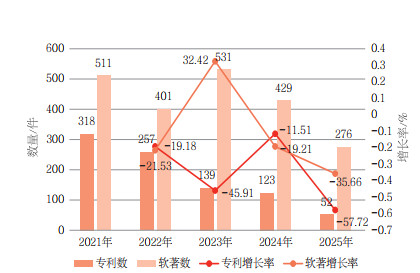
图 1  28家上市出版企业专利、软件著作权年度申请数量与增长率
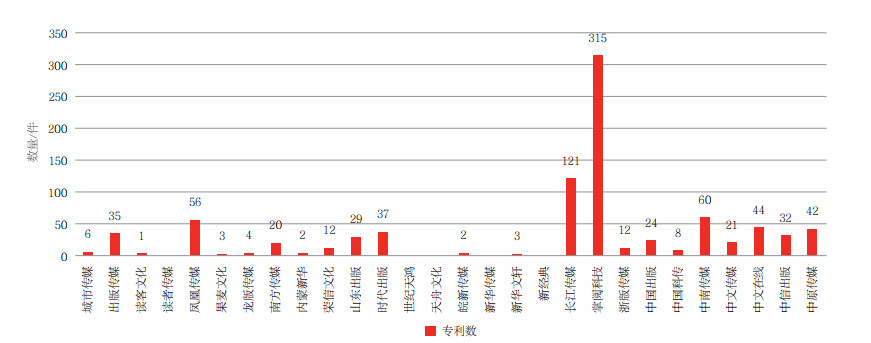
图 2  专利创新主体分布
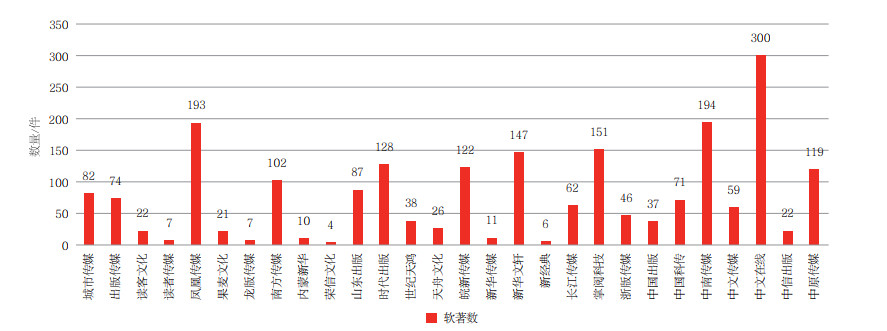
图 3  软件著作权创新主体分布
表 3  专利主题分布及其出版产业链环节映射
表 4  软件著作权主题分布及其出版产业链环节映射
1 国家新闻出版署. 出版业"十四五"时期发展规划[EB/OL]. (2021-12-28)[2026-05-29]. https://www.nppa.gov.cn/xxfb/tzgs/202112/P020221129376042550150.pdf.
2 中共中央关于制定国民经济和社会发展第十五个五年规划的建议[EB/OL]. (2025-10-28)[2026-05-29]. https://www.gov.cn/zhengce/202510/content_7046050.htm.
3 庄红权. 新质生产力赋能出版业高质量发展的内涵动力、价值意蕴与实践进路[J]. 中国编辑, 2024 (11): 4- 10.
4 屈明颖. 出版业如何以新质生产力服务高质量发展[J]. 出版广角, 2024 (9): 50- 56.
5 杨涵, 庄红权. 基于新质生产力视阈的数字出版科技创新体系完善: 问题与路径[J]. 科技与出版, 2024 (12): 69- 75.
6 孙晓翠, 张怡曼. 政产学研协同视域下出版业科技创新体系建设[J]. 中国出版, 2024 (20): 31- 34.
7 杨阳, 宋吉述. 智能驱动与生态重构: 中国出版业人工智能应用的现状挑战与趋势研判[J]. 科技与出版, 2025 (10): 13- 24.
8 方卿, 丁靖佳. 出版深度融合发展科学内涵的三维分析: 内容、技术与治理[J]. 出版广角, 2024 (16): 4- 10.
9 杨方铭, 尹召凯, 刘满成. 科技创新与中国出版业高质量发展耦合关系研究[J]. 中国出版, 2023 (24): 34- 39.
10 中国数字出版产业年度报告课题组. 2024-2025中国数字出版产业年度报告[M]. 北京: 中国书籍出版社, 2025: 15.
11 Hansen M T , Birkinshaw J . The Innovation Value Chain[J]. Harvard Business Review, 2007 (6): 121- 130.
12 王伟光, 张钟元, 侯军利. 创新价值链及其结构: 一个理论框架[J]. 科技进步与对策, 2019 (1): 36- 43.
13 张窈, 储鹏. 我国数字出版政策工具选择体系及其优化策略研究[J]. 科技与出版, 2021 (2): 31- 42.
14 李红澄, 王念祖. 人工智能应用对出版产业的影响研究: 基于出版产业链的视角[J]. 出版广角, 2025 (3): 97- 104.
[1] 刘忠波,兰诗雨. 日本漫画出版社国际传播策略研究——以四大漫画出版社为例[J]. 科技与出版, 2026, 45(2): 33-41.
[2] 周杨. 现代出版的“三个时代”与编辑的“三型”能力建设[J]. 科技与出版, 2026, 45(2): 127-136.
[3] 左仲海,王淑月. 出版业高质量发展路径研究:以新质生产力为核心驱动[J]. 科技与出版, 2025, 44(2): 51-58.
[4] 汤雪梅,杨春兰,杨玥涵. “十四五”时期中国出版业的回顾与思考[J]. 科技与出版, 2025, 44(1): 6-16.
[5] 戚天姣,吴怡频. 英美知名出版企业数字化发展策略*[J]. 科技与出版, 2024, 43(5): 76-83.
[6] 杨涵,庄红权. 基于新质生产力视阈的数字出版科技创新体系完善:问题与路径*[J]. 科技与出版, 2024, 43(12): 69-75.
[7] 金会平,吴治平. 科技期刊在促进科技创新、推动新质生产力发展中的路径思考[J]. 科技与出版, 2024, 43(12): 76-82.
[8] 彭昱剑,范军. 生成式人工智能视角下的出版品牌资源建设[J]. 科技与出版, 2023, 42(9): 29-35.
[9] 李春燕. 科技期刊助力科技创新路径研究*[J]. 科技与出版, 2023, 42(7): 108-113.
[10] 周霞. 美国青少年“高兴趣易读书”的出版实践及其借鉴意义[J]. 科技与出版, 2023, 42(7): 136-143.
[11] 卢先和. 出版业高质量发展的内涵、要求与路径[J]. 科技与出版, 2023, 42(6): 27-32.
[12] 张晶. 国际标准体系下我国出版业建立新标识标准应遵循的标识原则探究[J]. 科技与出版, 2023, 42(5): 106-114.
[13] 刘坚. 新文科视野下的出版业:核心价值与创新发展*[J]. 科技与出版, 2023, 42(5): 130-136.
[14] 朱小妮, 柳斌杰. 凝心聚力 攻坚克难 率先实现中国式出版现代化[J]. 科技与出版, 2023, 42(2): 5-11.
[15] 王忠,胡锐翔. 特区定位的呈现与对接:澳门出版业的现状、机遇及展望*[J]. 科技与出版, 2023, 42(12): 51-61.