Please wait a minute...
科技与出版  2026, Vol. 45 Issue (8): 101-110    
编辑实务
“小角色,大作用”:科技期刊参与国家战略推进的作用机制与实施路径
董丰1,文彦杰2,*,张超3,陈琳4,5
1. 安徽工程大学经济与管理学院,241000,安徽芜湖
2. 中国科学院科技战略咨询研究院,100190,北京
3. 南京航空航天大学经济与管理学院,211106,南京
4. 中国科学院工程热物理研究所,100190,北京
5. 中国工程热物理学会,100190,北京
"A Minor Player, a Major Role": Mechanisms and Implementation Pathways for Science and Technology Journals' Engagement in Advancing National Strategies
DONG Feng1,WEN Yanjie2,*,ZHANG Chao3,CHEN Lin4,5
1. School of Economics and Management, Anhui Polytechnic University, 241000, Wuhu, China
2. Institutes of Science and Development, Chinese Academy of Sciences, 100190, Beijing, China
3. School of Economics and Management, Nanjing University of Aeronautics and Astronautics, 211106, Nanjing, China
4. Institute of Engineering Thermophysics, Chinese Academy of Sciences, 100190, Beijing, China
5. Chinese Society of Engineering Thermophysics, 100190, Beijing, China
全文: HTML    PDF(1769 KB)  
输出: BibTeX | EndNote (RIS)      
摘要: 

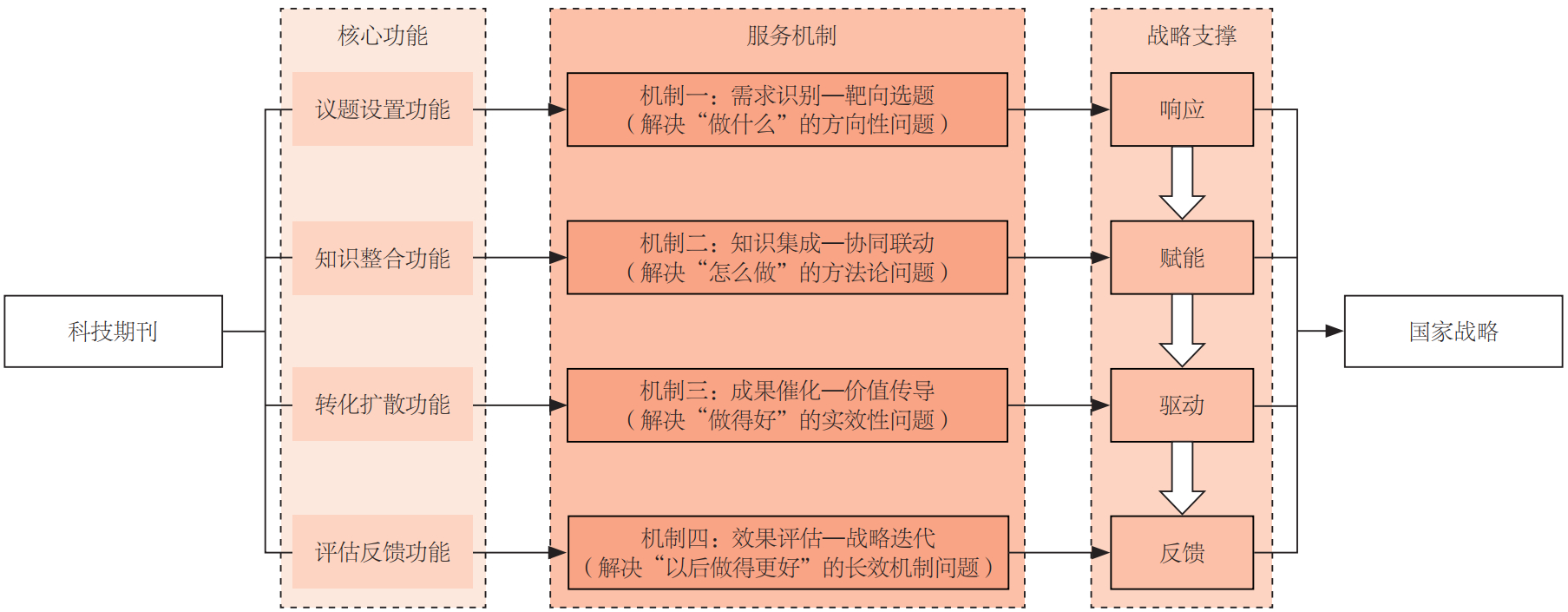
为阐释国家战略推进过程中科技期刊发挥作用的内涵和逻辑,本文基于科技期刊的核心功能,构建系统性分析框架,以《中国科学院院刊》《煤炭学报》《光学精密工程》《自然资源学报》等为例,深度剖析科技期刊服务国家战略的内在机制及其实施路径,提炼出科技期刊服务国家战略的“需求识别—靶向选题”响应、“知识集成—协同联动”赋能、“成果催化—价值传导”驱动和“效果评估—战略迭代”反馈四大机制,构建“核心功能—服务机制—战略支撑”的理论框架。研究发现,科技期刊应主动突破“被动传播”惯性定位,通过机制化设计与资源整合,实现向国家创新生态关键枢纽的跃升,充分释放其“小角色,大作用”的战略服务价值。

关键词 : 科技期刊,  国家战略,  作用机制,  实施路径    
Abstract:

To elucidate the role and operating logic of science and technology journals in the advancement of national strategic agendas, this study constructs a systematic analytical framework grounded in their core functions. Against the backdrop of building a world-leading science and technology powerhouse and achieving high-level self-reliance in science and technology, China's science and technology journals are undergoing a profound transformation from "platforms for publishing scientific achievements" to "platforms for supporting national strategies". While national policies such as the "Action Plan for Excellent STM Journals" have significantly enhanced the international influence of Chinese journals, a structural contradiction persists between high-level policy promotion and the absence of systematic service mechanisms. Existing research predominantly focuses on the inherent functions of journals as knowledge carriers and academic communication media, treating their service to national strategies as an external value extension rather than an endogenous mechanism. To address this gap, this paper identifies four core functions of these journals, i.e., agenda setting, knowledge integration, transformation and diffusion, and dynamic assessment, which serve as the logical starting point and driving force for serving national strategies. Drawing upon representative cases, including the Bulletin of the Chinese Academy of Sciences, the Journal of China Coal Society, Optics and Precision Engineering, and the Journal of Natural Resources, this paper conducts an in-depth exploration of the intrinsic mechanisms and practical implementation pathways. The analysis identifies four principal mechanisms: (1) the "demand identification and targeted topic selection" response mechanism, which ensures research directions align with national strategic needs; (2) the "knowledge integration and collaborative linkage" empowerment mechanism, which provides theoretical support and intellectual backing for strategy implementation; (3) the "achievement catalysis and value transmission" driving mechanism, which accelerates the transformation of key core technologies into industrial applications; and (4) the "effect evaluation and strategy iteration" feedback mechanism, which constructs a closed-loop monitoring system to safeguard the sustainability and adaptability of strategic development. On this basis, the study proposes an integrative theoretical framework that articulates the linkage among "core functions—service mechanisms—strategic support", systematically revealing how these journals can achieve comprehensive support for national strategies through the synergistic operation of these mechanisms. Furthermore, this paper proposes actionable implementation pathways across four dimensions: (1) establishing a strategic perception and targeted planning demand response system; (2) building a cross-boundary integration and knowledge co-creation empowerment ecosystem; (3) developing an achievement dissemination and industry linkage value transformation chain; and (4) improving an evidence-based assessment and decision consultation iterative feedback loop. Building upon these findings, this paper argues that these journals should proactively transcend their conventional positioning as passive disseminators of research outputs. Through systematic mechanism design and strategic resource integration, journals can evolve into pivotal nodes within the national innovation ecosystem, thereby realizing their strategic service value as "a minor player with a major role" in national development.

Key words: science and technology journals    national strategies    service mechanisms    implementation pathways
出版日期: 2026-09-08
基金资助:安徽省哲学社会科学规划项目(AHSKQ 2025D32);中华人民共和国人与生物圈国家委员会青年人才支持计划项目;科学出版社科技期刊研究课题“国家战略需求选题的知识服务系统研究”(SP2026-KT-A07)
通讯作者: 文彦杰   
Corresponding author: Yanjie WEN   

引用本文:

董丰,文彦杰,张超,陈琳. “小角色,大作用”:科技期刊参与国家战略推进的作用机制与实施路径[J]. 科技与出版, 2026, 45(8): 101-110.
DONG Feng,WEN Yanjie,ZHANG Chao,CHEN Lin. "A Minor Player, a Major Role": Mechanisms and Implementation Pathways for Science and Technology Journals' Engagement in Advancing National Strategies. Science-Technology & Publication, 2026, 45(8): 101-110.

链接本文:

http://kjycb.tsinghuajournals.com/CN/      或      http://kjycb.tsinghuajournals.com/CN/Y2026/V45/I8/101

表 1  科技期刊服务国家战略的四大核心机制
图 1  科技期刊服务国家战略的“核心功能—服务机制—战略支撑”理论框架
1 关于深化改革培育世界一流科技期刊的意见[EB/OL]. (2019-08-16)[2026-06-24]. https://www.cast.org.cn/xw/TTXW/art/2019/art_b5da1323b57c4d16b779172ad533cd88.html.
2 曾建勋. 对实施"中国科技期刊卓越行动计划"的思考[J]. 编辑学报, 2025, 37 (4): 374- 378.
3 中国科学技术信息研究所. 《2025年中国科技论文统计报告》发布我国高水平国际期刊论文数量及被引次数保持世界第一[EB/OL]. (2025-10-30)[2026-06-24]. https://www.stdaily.com/web/gdxw/2025-10/30/content_423884.html.
4 任红梅, 张恬, 刘晶晶, 等. 我国科技期刊产业服务能力建设的调查与思考[J]. 中国科技期刊研究, 2024, 35 (5): 586- 592.
5 王敏, 韩丽, 郝丽芳, 等. 科技期刊服务国家创新发展的路径研究[J]. 中国科技期刊研究, 2020, 31 (2): 127- 134.
doi: 10.11946/cjstp.201910140697
6 吕鹏瑞. 地学科技期刊服务国家重大战略的若干思考: 以《西北地质》为例[J]. 新闻研究导刊, 2023, 14 (18): 72- 75.
7 初景利, 闫群. 我国科技期刊国际化战略与策略[J]. 中国科学院院刊, 2018, 33 (12): 1358- 1365.
8 颜帅, 张昕. 科技期刊如何服务于创新型国家建设: 中国科技期刊的"三步走"[J]. 科技与出版, 2014 (1): 22- 25.
9 李艳红, 杨保华, 丁仕琼. 科技创新生态系统中科技期刊功能协同机制[J]. 科技进步与对策, 2025, 42 (16): 155- 160.
10 徐卓仕. 强化科技期刊在有组织科研创新体系中的核心作用[J]. 科技与出版, 2026 (4): 69- 76.
11 杨柳春, 文彦杰, 董丰, 等. 科技期刊在国家创新体系中的地位、作用和使命[J]. 编辑学报, 2024, 36 (2): 119- 123.
12 何春娥, 吴浩, 朱晓华. 中文科技期刊应服务国家重大战略需求: 以《自然资源学报》为例[J]. 编辑学报, 2022, 34 (1): 26- 30.
13 夏丽云. 我国科技期刊参与破解"两头在外"问题义不容辞[J]. 编辑学报, 2025, 37 (2): 126- 130.
14 张琪, 王蕴嘉. 科技期刊深耕"四个面向"的办刊实践与成效探讨[J]. 编辑学报, 2026, 38 (S1): 159- 163.
15 陈思睿. 科技期刊参与科学传播的理论构想与实现路径[J]. 科技与出版, 2019 (10): 112- 116.
16 蒋建斌. 开放科学背景下行业科技期刊的功能转型及其运行机制重构[J]. 中国科技期刊研究, 2025, 36 (11): 1508- 1515.
17 文彦杰, 武一男, 杨彦波. 科技期刊发挥科技战略咨询作用: 应然逻辑、实然挑战、使然建议[J]. 智库理论与实践, 2025, 10 (5): 69- 78.
18 王嘉昀, 文彦杰, 杨柳春. 我国科技期刊创新评审方式的概念、现状与对策分析[J]. 中国科技期刊研究, 2023, 34 (10): 1247- 1254.
19 潘教峰, 何子豪, 鲁晓. 科技创新战略-政策体系研究: "3+5"框架体系的提出与分析[J]. 中国科学院院刊, 2024, 39 (1): 70- 78.
20 孔垂辉. 科技期刊创新转型, 服务"一带一路"建设[J]. 编辑学报, 2017 (S2): 1- 4.
21 王丽娜. 科技期刊策划国家重大战略专题的实践与思考[J]. 中国科技期刊研究, 2024, 35 (3): 292- 297.
22 汤梅, 金延秋, 陈禾. 中文科技期刊服务国家重大工程需求的实践与成效[J]. 中国科技期刊研究, 2025, 36 (3): 276- 283.
23 常湘萍. 《中国工程科学》杂志社《工程(英文)》: 引领工程科技创新服务国家战略需求[N]. 中国新闻出版广电报, 2025-12-02(8).
24 高媛, 徐秀玲, 张冰姿, 等. 提质增量, 卓越发展: 《国家科学评论》办刊实践与进展[J]. 中国科技期刊研究, 2022, 33 (2): 215- 221.
25 张耀铭. 学术期刊高质量发展的新趋势[J]. 江南大学学报(人文社会科学版), 2024, 23 (1): 5- 22.
26 文彦杰, 黄延红, 张艳红, 等. 面向世界一流科技期刊建设的专职编辑人才分类体系研究[J]. 编辑学报, 2026, 38 (3): 347- 358.
27 杨柳春, 岳凌生, 武一男, 等. 国家高端科技智库多元化传播平台建设之路: 《中国科学院院刊》创刊40年回顾与展望[J]. 中国科学院院刊, 2026, 41 (5): 1067- 1076.
28 李翠霞. 打造一流高端智库传播平台推动智库期刊高质量发展: 杨柳春博士访谈录[J]. 中国科技期刊研究, 2022, 33 (11): 1587- 1591.
29 "建设世界科技强国"专刊编者按[J]. 中国科学院院刊, 2023, 38(05): 675.
30 冀伦文, 王慧, 张红霞. 科技期刊编辑部组织力的内涵与提升策略[J]. 中国科技期刊研究, 2024, 35 (6): 705- 711.
31 首都科技期刊风采录《煤炭学报》: 守正创新、引领发展, 打造高端学术交流平台[J/OL]. 2025-08-26[2026-06-24]. https://mp.weixin.qq.com/s__biz=MzI4ODAyODQ1Nw==&mid=2652655332&idx=3&sn=26d0e65182d0b75aa338196680a233cb&poc_token=HNv9XmmjLSiLJORinwBYps6TlCkntVklkHm7I1sk.
32 丛挺, 王媛, 高远卓. 面向开放科学的科技期刊出版服务能力评价研究: 出版服务能力内涵与构成要素[J]. 出版广角, 2024 (2): 47- 55.
33 金会平, 吴治平. 科技期刊在促进科技创新、推动新质生产力发展中的路径思考[J]. 科技与出版, 2024 (12): 76- 82.
doi: 10.16510/j.cnki.kjycb.20241216.004
34 以学术为引擎?助力地方发展: 《光学精密工程》期刊的创新实践[EB/OL]. (2026-01-20)[2026-07-30]. https://www.news.cn/sci-tech/20260120/d1d6b255ae62465ca3fb0b0b876429f5/c.html.
35 《自然资源学报》编辑部. "国土空间规划监测评估与绩效评价"虚拟专题[EB/OL]. (2024-12-26)[2026-06-24]. https://mp.weixin.qq.com/s__biz=MzU1NjQzMjczNQ==&chksm=faccc3fc1ca8d8c6188aa8fd1d80ba4c93875b7c91856447543ec11a2c1df01ceccca9670c9a&idx=1&mid=2247506369&scene=27&sn=48f9617bdd49a56c9bf98f6ac43271dd.
[1] 丁佐奇,殷紫轩,李楚威. 中国高校英文科技期刊海外传播模式及影响力提升策略研究[J]. 科技与出版, 2026, 45(7): 6-17.
[2] 张辉洁,张彤,冉明会,胡小洋. 全球出版语种生态格局下中文科技期刊国际学术影响力发展特征及提升路径[J]. 科技与出版, 2026, 45(7): 18-29.
[3] 万倩芸,曾群,杨玙. AI赋能中文科技期刊参与破解“两头在外”困局的应然愿景、实然困境与使然策略[J]. 科技与出版, 2026, 45(7): 30-38.
[4] 姜曼. 基于SECI模型的科技期刊资源科普化“场—路”耦合机制研究[J]. 科技与出版, 2026, 45(7): 110-119.
[5] 张宏. 科技期刊封面的“学术意义前置”功能研究[J]. 科技与出版, 2026, 45(5): 66-75.
[6] 贺思,陈红兵,王景周,贺嫁姿. 高APC限制:政策动因剖析与协同治理路径探索[J]. 科技与出版, 2026, 45(4): 43-51.
[7] 秦福强,贺斌,胡玉景. 从评价驱动到价值驱动:地方科技期刊深度服务区域创新生态的路径探索[J]. 科技与出版, 2026, 45(4): 52-58.
[8] 徐卓仕. 强化科技期刊在有组织科研创新体系中的核心作用[J]. 科技与出版, 2026, 45(4): 69-76.
[9] 徐丽芳,田峥峥,张蒂,曹天天,王一雪. 公正导向下的开放与治理重构:2025海外科技期刊出版观察[J]. 科技与出版, 2026, 45(3): 38-55.
[10] 任胜利,俞征鹿,宁笔,陈哲. 2025年我国英文科技期刊发展回顾[J]. 科技与出版, 2026, 45(3): 56-67.
[11] 王婧,张芳英,吴领叶,刘志强,张铁明,张昕. 收官“十四五”:从“卓越计划”到“卓越生态”——2025年我国中文科技期刊发展盘点[J]. 科技与出版, 2026, 45(3): 68-81.
[12] 沈锡宾,李鹏,黄丽洋,刘红霞,赵巍,吕相征,魏均民. 中国科技期刊集群加盟期刊协同发展与生态治理机制研究[J]. 科技与出版, 2026, 45(3): 93-104.
[13] 王海燕,张莉,严美娟,吴年华,刘明寿. 前沿科技企业与科技期刊的共生发展路径探索[J]. 科技与出版, 2026, 45(3): 105-112.
[14] 李慧,苏莉娜,周会霞,黎霜霜,王梦婷,谢邦彦,刘广宇. 中国科技期刊使用人工智能政策的研究及对策建议——基于40份科技核心期刊政策文本的Nvivo分析[J]. 科技与出版, 2026, 45(2): 96-107.
[15] 秦明阳,牛晓娜,杨保华,范泓洋. 培育世界一流科技期刊背景下高校角色重塑与实践路径[J]. 科技与出版, 2026, 45(1): 85-92.