Please wait a minute...
科技与出版  2026, Vol. 45 Issue (8): 89-100    
编辑实务
农业期刊赋能乡村文化振兴的现实思考
何承凤1,何莉2,*
1. 安徽农业大学学报编辑部,230036,合肥
2. 安徽工业大学学报编辑部,243002,安徽马鞍山
Agricultural Journals and Rural Cultural Revitalization: Current Challenges and Strategies for Knowledge-Based Empowerment
HE Chengfeng1,HE Li2,*
1. Editorial Office of the Journal of Anhui Agricultural University, 230036, Hefei, China
2. Editorial Office of the Journal of Anhui University of Technology, 243002, Ma'anshan, China
全文: HTML    PDF(1760 KB)  
输出: BibTeX | EndNote (RIS)      
摘要: 

乡村文化振兴是全面推进乡村振兴的铸魂工程,也是传承中华农耕文明的历史必然。农业期刊作为发表科研成果与传播科学研究的重要载体,在服务乡村文化振兴中肩负着重要历史使命。本文依据国家统计局关于东部、中部、西部及东北地区的区域划分标准,选取15本农业期刊作为研究样本,基于2018—2025年的发文统计和内容分析,探讨农业期刊赋能乡村文化振兴的目标定位、现实困境和创新策略。研究发现,农业期刊在赋能乡村文化振兴过程中普遍面临内容生产能力不足、文化服务意识不强和传播效能不高的现实困境。为此,提出强化内容生产能力、增强文化服务意识、构建多元传播生态,以期为农业期刊赋能乡村文化振兴提供方案。

关键词 : 农业期刊,  乡村文化振兴,  高质量发展,  创新策略,  知识传播    
Abstract:

Rural cultural revitalization is both a foundational component of China's broader rural revitalization agenda and a means of sustaining the country's agrarian civilization. Agricultural journals, as established channels for publishing research and disseminating scientific knowledge, have a responsibility to connect academic production with the cultural needs of rural communities. Their potential contribution depends on more than publishing a small number of culture-related articles: it requires a stable editorial orientation, content that reflects regional experience, and communication channels capable of reaching audiences beyond specialist research communities. This study examines how such journals can define their role, identify the constraints that limit their contribution, and develop strategies that make academic and practical knowledge more accessible and useful in rural cultural development. The study conceptualizes this contribution as a progressive process of empowerment. Knowledge-based empowerment transforms localized and dispersed agricultural experience into structured and preservable knowledge. Legitimization-based empowerment interprets relevant policies and provides value-oriented guidance for rural cultural development. Subjectification-based empowerment focuses on strengthening farmers' cultural awareness and creative capacity. These three stages are analytically distinct but mutually reinforcing: knowledge provides a basis for recognition and transmission, policy interpretation helps connect knowledge with development priorities, and the participation of rural actors enables cultural practices to be sustained rather than externally imposed. For the empirical analysis, 15 agricultural journals were selected according to the National Bureau of Statistics' classification of China into eastern, central, western, and northeastern regions. Publication statistics and content analysis were conducted for articles published from 2018 to 2025. The findings identify three common constraints. Content-production capacity remains insufficient, as reflected in a limited volume of relevant articles and uneven regional distribution. Cultural-service awareness is weak, with few journals maintaining regular culture-focused sections and a low share of relevant publications. Dissemination effectiveness is also limited because communication channels are restricted and complex academic knowledge is not consistently translated into forms that general readers and rural communities can readily use. The study proposes corresponding strategies in content production, cultural service, and communication. Journals should strengthen the supply of rural cultural content by refining manuscript-solicitation guidelines and developing regional journal alliances. They should make cultural service a stable editorial responsibility by establishing dedicated columns where appropriate and cultivating editors with interdisciplinary knowledge. They should also build a diversified communication ecosystem through full-time and part-time science-popularization teams, all-media platforms, and formats suited to different audiences. These measures are intended to address the three identified constraints as a connected set: stronger content supply supports regular cultural service, while broader communication increases the social reach and practical value of that content. They can help move research findings beyond journal publication and into rural communities while preserving editorial quality and contextual relevance. By coordinating content supply, service awareness, and dissemination, agricultural journals can provide more sustained support for rural cultural revitalization and improve the practical reach of agricultural knowledge.

Key words: agricultural journals    rural cultural revitalization    high-quality development    innovation strategies    knowledge dissemination
出版日期: 2026-09-08
基金资助:2025年度中国农业期刊网研究基金项目(CAJW2025-016);全国高等学校文科学报研究会编辑学研究课题(PY2025029)
通讯作者: 何莉   
Corresponding author: Li HE   

引用本文:

何承凤,何莉. 农业期刊赋能乡村文化振兴的现实思考[J]. 科技与出版, 2026, 45(8): 89-100.
HE Chengfeng,HE Li. Agricultural Journals and Rural Cultural Revitalization: Current Challenges and Strategies for Knowledge-Based Empowerment. Science-Technology & Publication, 2026, 45(8): 89-100.

链接本文:

http://kjycb.tsinghuajournals.com/CN/      或      http://kjycb.tsinghuajournals.com/CN/Y2026/V45/I8/89

表 1  调研样本期刊来源
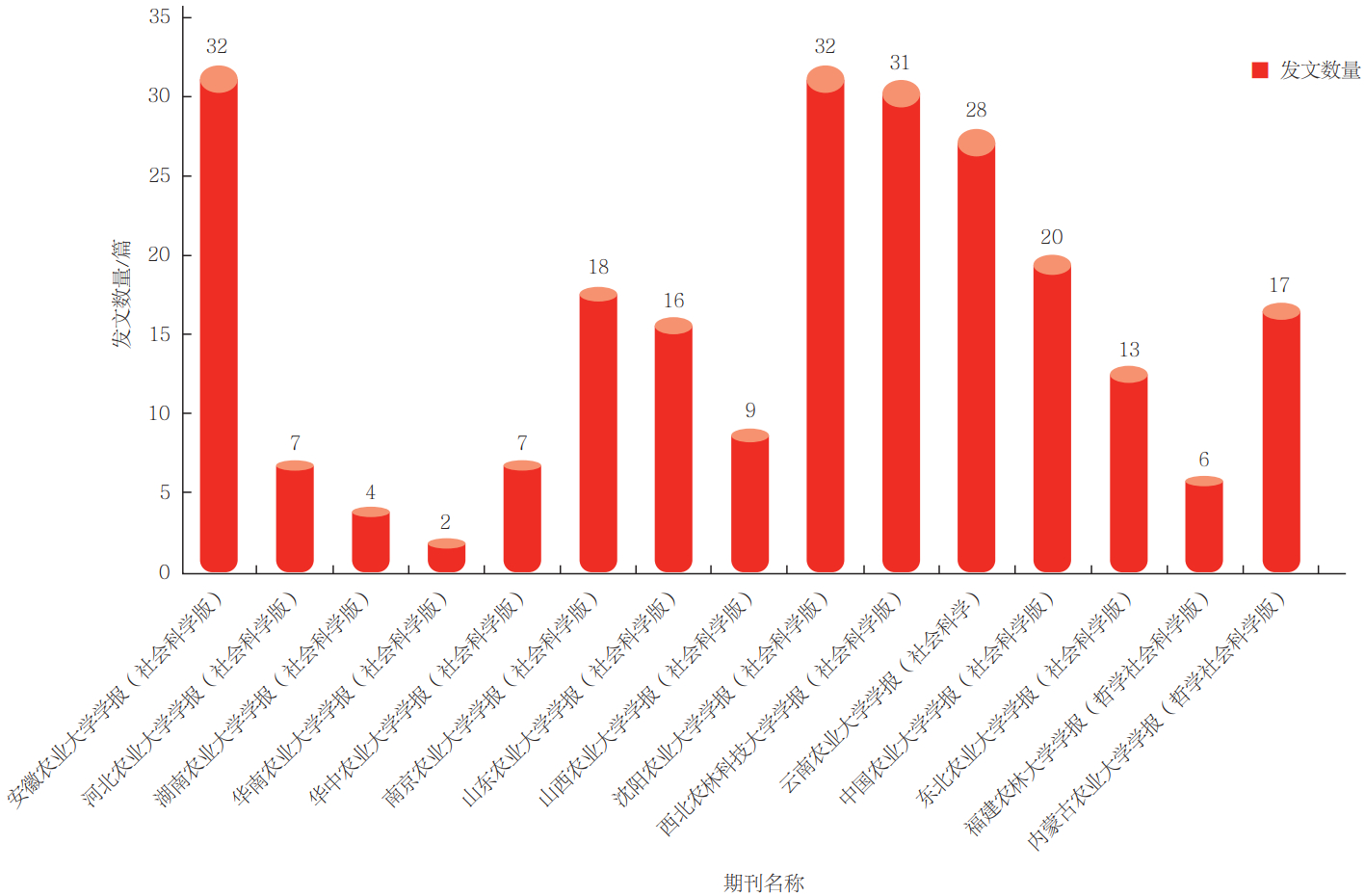
图 1  2018—2025年15本农业期刊乡村文化类发文统计
表 2  2018—2025年15本农业期刊乡村文化类发文与栏目匹配度统计
1 陈燕, 兰宗宝. 践行乡村振兴使命: 农业学术期刊的困境及破局策略[J]. 江苏农业科学, 2025, 53 (15): 271-276, 284.
2 李柯. 融媒体背景下农业期刊服务乡村振兴的困境及破局策略研究[J]. 中州大学学报, 2026, 43 (1): 40- 45.
3 裴雪昆, 陈瑶, 徐源. 农业经济类学术期刊服务乡村振兴的探索与实践: 以《农业经济与管理》为例[J]. 东北农业大学学报(社会科学版), 2023, 21 (4): 90- 96.
4 王小红, 孙小岚, 胡吉凤, 等. 农业期刊服务地方特色蜂糖李产业发展的实证与创新路径[J]. 编辑学报, 2025, 37 (S2): 248- 251.
5 赵赟, 佘小宁. 以农业科技传播创新助力乡村产业振兴: 基于农业科技期刊集群构建的山西农业科技传播协同创新联盟实践[J]. 出版广角, 2021 (18): 20- 22.
6 王珂, 张莉, 和静, 等. 融媒体时代农业科技期刊服务乡村振兴的实践[J]. 编辑学报, 2024, 36 (S1): 128- 131.
7 习近平主持中共中央政治局第八次集体学习并讲话[EB/OL]. (2018-09-22)[2026-03-25]. https://www.gov.cn/xinwen/2018-09/22/content_5324654.htm.
8 王飞, 骆小春. 习近平文化思想视域下乡村文化振兴的价值意义与实践路径[J]. 南京农业大学学报(社会科学版), 2024, 24 (6): 74- 83.
9 习近平出席全国宣传思想工作会议并发表重要讲话[EB/OL]. (2018-08-22)[2026-03-25]. https://www.gov.cn/xinwen/2018-08/22/content_5315723.htm.
10 范军, 徐冬皓, 周建军, 等. 出版在新时代党的创新理论阐释传播中的功能价值与创新路径[J]. 科技与出版, 2024 (11): 6- 11.
doi: 10.16510/j.cnki.kjycb.20241113.001
11 曹立, 石以涛. 乡村文化振兴内涵及其价值探析[J]. 南京农业大学学报(社会科学版), 2021, 21 (6): 111- 118.
12 中国高校科技期刊研究会农业期刊专业委员会. 农业期刊服务乡村振兴太原共识(2025)[J]. 中国科技期刊研究, 2025, 36 (5): 684.
13 王礞礞, 王亚辉, 彭华, 等. 农业期刊集群科普功能拓展的优势、存在问题与建议[J]. 中国科技期刊研究, 2026, 37 (3): 421- 428.
14 代沁雯. 学术期刊联盟推进期刊高质量发展: 基于共享理念[J]. 传播与版权, 2023 (23): 69- 71.
15 赵爱清, 李俭国. 我国学术期刊联盟内在凝聚力提升路径[J]. 东北农业大学学报(社会科学版), 2024, 22 (5): 87- 92.
16 杨洋, 江雨莲, 刘爽. 专科医学期刊集群化发展探索: 聚焦"血液学期刊联盟"创新发展[J]. 科技与出版, 2024 (8): 44- 50.
doi: 10.16510/j.cnki.kjycb.2024.08.015
[1] 姚玲. 全国青少年学生读书行动实施背景下青少年主题出版高质量发展研究[J]. 科技与出版, 2026, 45(7): 49-56.
[2] 邹贞,金梦瑶. 如何推进新时代科普图书出版高质量发展?——“国家科技进步奖”(2005—2023年度)获奖图书的启示[J]. 科技与出版, 2026, 45(5): 5-15.
[3] 马伊颀. 新时代教育出版质量管理探索[J]. 科技与出版, 2026, 45(5): 57-65.
[4] 吴徐莉. 综合性社科期刊高质量发展的实践困境与路径重构[J]. 科技与出版, 2026, 45(2): 137-144.
[5] 王一帆,王星. 深度融合视域下地方出版业高质量发展路径研究——以辽宁省为例[J]. 科技与出版, 2026, 45(2): 14-21.
[6] 倪轶,王露露. 面向“十五五”时期的中国期刊出版业发展思考[J]. 科技与出版, 2026, 45(1): 24-32.
[7] 罗启元,焦霖. 数智化时代馆社共建与创新路径思考[J]. 科技与出版, 2025, 44(6): 44-51.
[8] 戚裴诺. 综合性社科期刊高质量发展探索[J]. 科技与出版, 2025, 44(6): 122-130.
[9] 金会平,罗斌. 科技期刊高质量发展的哲学思考:矛盾、规律与目标[J]. 科技与出版, 2025, 44(5): 60-69.
[10] 吕永峰,陈惊涛,王创业. 流量泡沫还是营销变革?——图书直播电商的模式困境与路径优化[J]. 科技与出版, 2025, 44(5): 119-130.
[11] 沈银书. 乡村全面振兴背景下农业科技图书出版高质量发展的几点思考[J]. 科技与出版, 2025, 44(3): 97-105.
[12] 刘志强,王婧,张芳英,吴领叶,张铁明,张昕. 政策引领 拓新致远——2024年我国中文科技期刊盘点与展望[J]. 科技与出版, 2025, 44(3): 66-77.
[13] 常昕. 联结知识与读者:阅读推广视角下出版企业社会责任考察[J]. 科技与出版, 2025, 44(2): 26-36.
[14] 左仲海,王淑月. 出版业高质量发展路径研究:以新质生产力为核心驱动[J]. 科技与出版, 2025, 44(2): 51-58.
[15] 蔡晨露. 地方科技出版社学术出版高质量发展路径探析——基于国家出版基金视角[J]. 科技与出版, 2025, 44(2): 99-106.