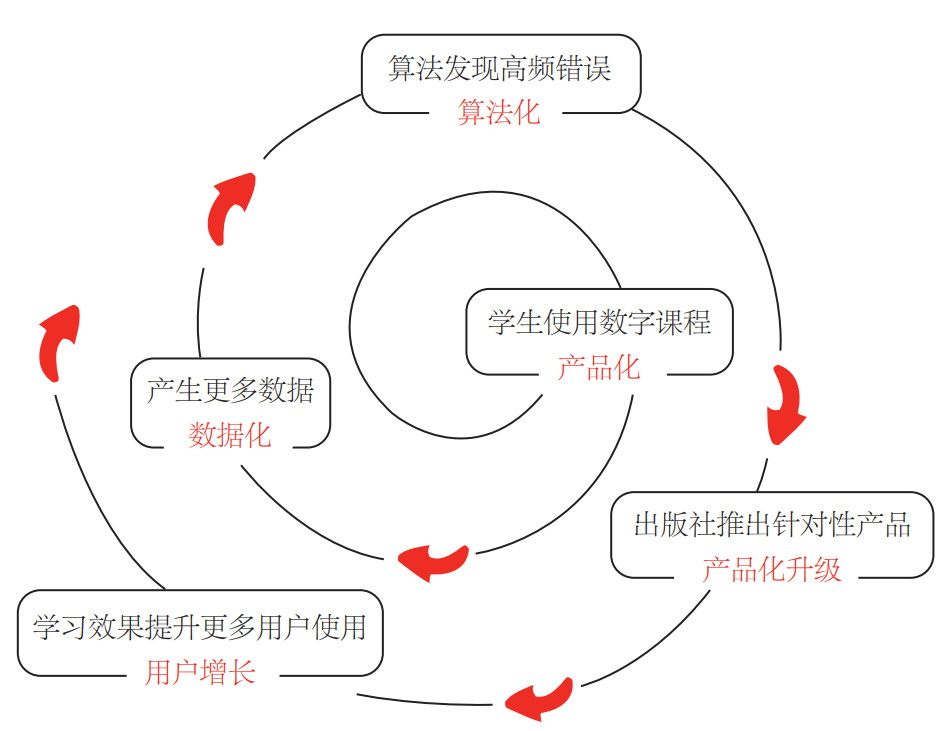
随着人工智能技术的加速演进,生成式AI正在深度重构出版业的内容生产方式与商业逻辑,教育出版数智化转型已成为出版业融合发展的核心命题。本文首先厘清数智化的内涵与边界,明确其是数字化与智能化的有机融合,是数字化发展的高级阶段;并基于其核心特征及相关实证研究,判断教育出版社是数智化转型潜在收益最大的行业类型之一。其次,本文从供给侧、需求侧和数据能力三个维度,系统梳理当前教育出版数智化面临的主要问题。在此基础上,本文提出教育出版数智化的双螺旋实践路径:一是整合全链条角色,构建以在线化为基础、以多方互动为驱动的实时互动教育生态;二是建立从数据初始化、算法精准化到产品落地化的数据智能价值链,推动数据在使用中持续驱动产品进化。两条路径相辅相成,共同推动教育出版社从供给端壁垒向需求端壁垒的战略跃迁,实现数智化时代竞争壁垒的重构。
With the accelerating evolution of artificial intelligence technologies, generative AI is profoundly reshaping the content production methods and business logic of the publishing industry, and the digital–intelligent transformation of educational publishing has become a central issue in the integrated development of the publishing industry. This paper defines digital–intelligent transformation as the integration of digitalization and AI-enabled capabilities, positioning it as an advanced stage of digitalization. Digital–intelligent transformation, driven by data and AI, enables personalized content generation and continuous, user-responsive educational services, with emphasis on AI-powered analytics, self-optimizing decision-making, and continuous self-improvement. Drawing on the characteristics of digital–intelligent transformation, the paper argues that educational publishing is among the sectors with the greatest potential gains. It refers to empirical findings that suggest that digital and intelligent transformation significantly enhances productivity, with the strongest effects observed in mature, non-high-tech, labor-intensive, and less market-oriented enterprises—characteristics that match those of educational publishers. Across three dimensions—the supply side, the demand side, and data capabilities, this paper systematically reviews the major problems currently facing the digital–intelligent transformation of educational publishing. On the supply side, AI is rapidly filling the supplementary content gap around textbooks, while attention-driven business models and the shortening of distribution chains erode brand and distribution advantages. On the demand side, users are shifting from passive recipients to active choosers, from purchasing content to demanding outcomes, and from fixed scenarios to personalized learning. Many publishers still make limited use of data; the data value chain from collection to decision-making has yet to be established. On this basis, it proposes a double-helix pathway for such transformation: First, integrating roles across the entire value chain to build a real-time interactive educational ecosystem based on online delivery and driven by multi-party interaction. Online delivery requires that users’ learning activities actually take place on the platform, be fully recorded and be fed back into product improvement, thereby creating a closed loop among students, teachers, and publishers. Multi-party interaction shifts publishers’ core capability from producing content to operating an interactive network. Second, establishing a data-intelligence value chain from initial data preparation and algorithm refinement to product deployment, thereby promoting the continuous evolution of products through data use. Initial data preparation focuses on data quality and dimensions rather than volume; algorithm refinement transforms data into insights, a threshold lowered by Algorithm-as-a-Service and open-source tools; and product deployment incorporates data and algorithms into functions that teachers and students can use, forming a virtuous cycle in which data and algorithms continually improve products. These paths are complementary, jointly driving educational publishers to achieve a strategic leap from supply-side competitive advantages to demand-side competitive advantages, thus reshaping barriers to entry in the era of digital intelligence. The interactive ecosystem and data intelligence are mutually reinforcing: The ecosystem provides the foundation by generating high-frequency, closed-loop, real-world data, while data intelligence turns accumulated data into targeted services, forming an upward spiral. The deep logic of this transformation is the reconstruction of competitive barriers: First-movers in the strategic leap will gain an early competitive advantage.
王芳. 教育出版数智化升级:现实挑战与实践路径[J]. 科技与出版, 2026, 45(10): 16-22. WANG Fang. Digital–Intelligent Upgrading of Educational Publishing: Challenges and Practical Pathways. Science-Technology & Publication, 2026, 45(10): 16-22.
http://kjycb.tsinghuajournals.com/CN/ 或 http://kjycb.tsinghuajournals.com/CN/Y2026/V45/I10/16
Cited