Please wait a minute...
科技与出版  2026, Vol. 45 Issue (10): 62-70    
融媒之光
基于人智共创的自适应叙事生产与出版
吕文杉1,段青玉1,2,王晓光1,2
1. 武汉大学信息管理学院,430072,武汉
2. 武汉大学出版研究院,430072,武汉
Adaptive Narrative Production and Publishing through Human–AI Co-Creation
LYU Wenshan1,DUAN Qingyu1,2,WANG Xiaoguang1,2
1. School of Information Management, Wuhan University, 430072, Wuhan, China
2. Research Institute of Publishing, Wuhan University, 430072, Wuhan, China
全文: HTML    PDF(1876 KB)  
输出: BibTeX | EndNote (RIS)      
摘要: 

随着生成式人工智能发展,人智协同叙事正逐步成为出版内容生产的新范式。在人工智能参与下,叙事生产和消费的过程呈现出显著的自适应特征,对传统出版模式产生了深远影响。本文融合广义叙述学和数字交互叙事理论,站在出版商的视角,提出人智共创环境中的自适应叙事生产模式,并依据出版应用场景与人机协同方式,将其划分为“效能加速型”“体验增值型”与“开放体验型”三类,旨在系统阐释其理论外延与实践路径,为出版领域的内容创新与服务转型提供理论参照。

关键词 : 数字叙事,  自适应叙事,  人智共创,  数字出版    
Abstract:

Generative artificial intelligence is reshaping how narrative content is produced, delivered, and experienced in publishing. However, existing discussions often treat AI as a writing tool or focus on isolated interactive products, leaving the relationships among collaborative actors, narrative control, and publishing applications insufficiently explained. This study develops a conceptual framework for adaptive narrative production and publishing through human–AI co-creation, examining how publishers can organize narrative resources and allocate creative roles and agency across production and consumption. The study combines theoretical analysis with illustrative examples of selected applications. Drawing on general narratology and interactive digital narrative theory, it uses the distinction between fabula (story events) and sjuzhet (their narrative arrangement) to explain how underlying narrative materials are selected, combined, and transformed into particular narrative realizations. Adaptive narrative is defined as an iterative process in which a system responds to human input or interaction states within specified goals, resources, and constraints. This definition distinguishes adaptive co-creation from isolated text generation. The analysis examines collaboration at different stages, the distribution of narrative authority, and the strength of constraints imposed by underlying story materials, using examples from assisted writing, interactive literary experiences, and open narrative platforms. The resulting framework comprises three layers: narrative resources, content processing, and content consumption. It identifies two collaborative pathways. In the first, AI supports content creation by working with authors, editors, and publishers before delivery. In the second, AI becomes part of the delivered content experience, allowing narratives to develop through interaction with readers or users. Across both pathways, AI functions as a narrative generation and control mechanism, producing responses while regulating narrative development. The balance between responsiveness and intervention depends on how narrative authority is allocated and how firmly the underlying materials constrain possible developments. The analysis further distinguishes strong and weak fabula constraints. Strong constraints anchor essential events, character relationships, knowledge, or value commitments while permitting variation in presentation and local interaction. Weak constraints provide initial settings or rules while allowing users and AI to develop events and storyworlds more freely. Combining these mechanisms with the two pathways yields three publishing models. The efficiency-oriented model supports iterative writing and editorial work under human direction. The experience-enhancing model enables responsive engagement with existing works or knowledge resources within defined boundaries. The open-experience model supports exploratory storytelling, community participation, and the continuing expansion of fictional worlds. The three models address different publishing needs and may be combined according to available resources, user expectations, and application contexts. The framework explains how adaptive narrative shifts publishing from control concentrated before release toward continuing coordination during production and use. Greater openness creates opportunities for participation and personalized experiences but also complicates coherence, thematic direction, and content accountability. Within this framework, publishers remain responsible for organizing resources, defining rights and editorial boundaries, and maintaining trustworthy content. As a conceptual contribution, the study provides an analytical basis for selecting and combining adaptive narrative models, connecting content innovation with the development of publishing services while preserving professional judgment and the cultural purposes of publishing.

Key words: digital narrative    adaptive narrative    human-AI co-creation    digital publishing
出版日期: 2026-11-17
基金资助:社科基金重大项目“文化遗产智慧数据资源建设与服务研究(21&ZD334);中央高校基本科研业务费专项资金项目“面向深阅读的人机共读脆弱性及引导策略研究(2042026rw177)

引用本文:

吕文杉,段青玉,王晓光. 基于人智共创的自适应叙事生产与出版[J]. 科技与出版, 2026, 45(10): 62-70.
LYU Wenshan,DUAN Qingyu,WANG Xiaoguang. Adaptive Narrative Production and Publishing through Human–AI Co-Creation. Science-Technology & Publication, 2026, 45(10): 62-70.

链接本文:

http://kjycb.tsinghuajournals.com/CN/      或      http://kjycb.tsinghuajournals.com/CN/Y2026/V45/I10/62

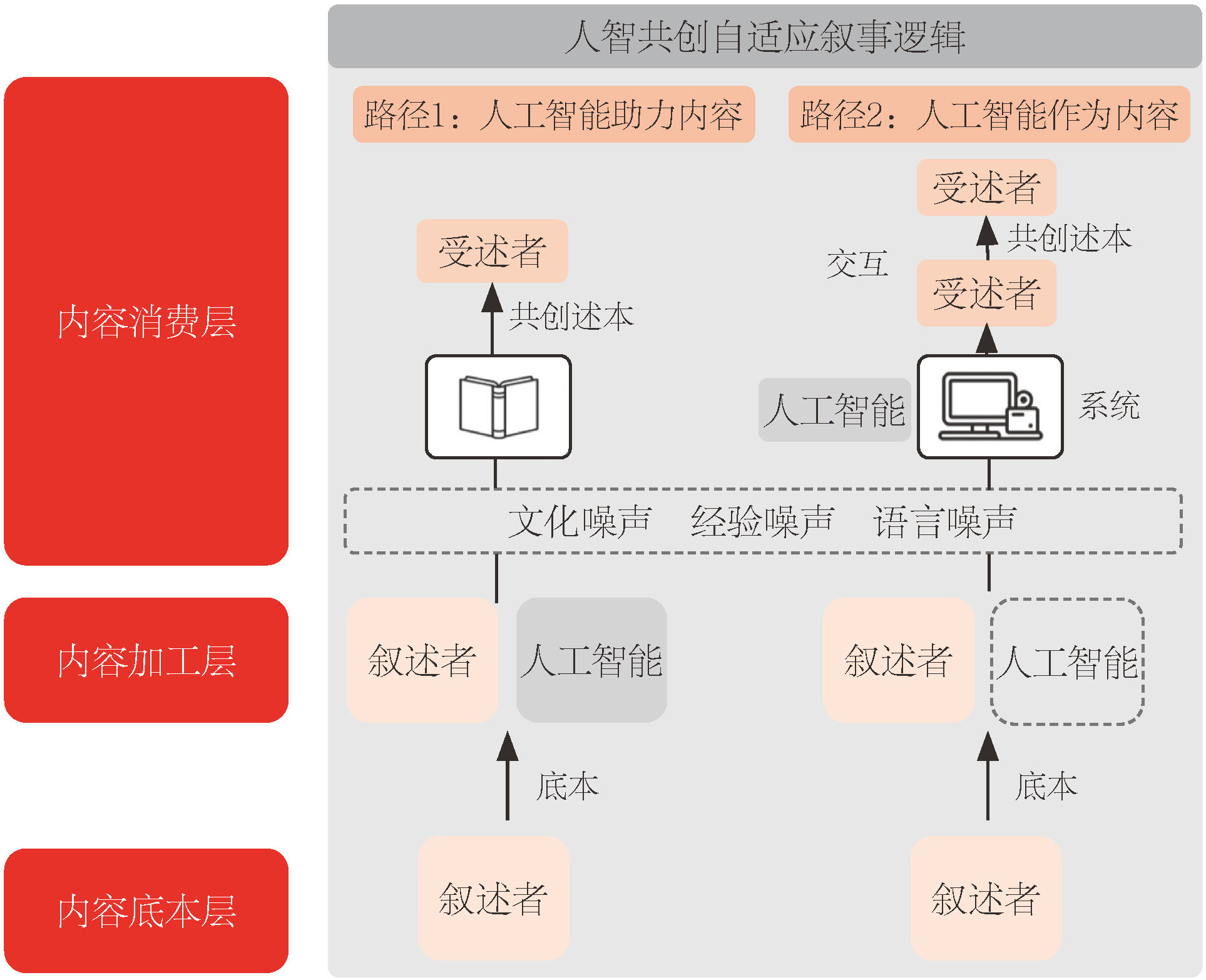
图 1  人智共创自适应叙事系统框架
1 许洁. 论以知识为内容的出版: 兼答出版在哪里[J]. 现代出版, 2024 (3): 57- 65.
2 谭君强. 叙事学导论: 从经典叙事学到后经典叙事学[M]. 北京: 高等教育出版社, 2008: 190.
3 赵毅衡. 广义叙述学[M]. 成都: 四川大学出版社, 2013.
4 V. 厄利希. 俄国形式主义: 历史与学说[M]. 张冰译. 北京: 商务印书馆, 2017: 360-361.
5 徐丽芳, 周伊. 虚拟现实媒介叙事主体研究: 故事生成的视角[J]. 中州学刊, 2023 (12): 158- 164.
6 Colton S, Wiggins G A. Computational creativity: The final frontier?[C]//ECAI 2012-20th European Conference on Artificial Intelligence, 27-31 August 2012, Montpellier, France-Including Prestigious Applications of Artificial Intelligence (PAIS-2012) System Demonstration. Montpellier: IOS Press, 2012, 242: 21-26.
7 Green M C , Jenkins K M . Interactive narratives: Processes and outcomes in user-directed stories: Interactive narratives[J]. Journal of Communication, 2014, 64 (3): 479- 500.
doi: 10.1111/jcom.12093
8 Busselle R , Bilandzic H . Fictionality and perceived realism in experiencing stories: A model of narrative comprehension and engagement[J]. Communication Theory, 2008, 18 (2): 255- 280.
doi: 10.1111/j.1468-2885.2008.00322.x
9 约翰·霍兰(John Holland). 涌现: 从混沌到有序[M]. 陈禹, 方美琪, 译. 上海: 上海科学技术出版社, 2006: 2.
10 Kybartas B A , Verbrugge C , Lessard J . Tension space analysis for emergent narrative[J]. IEEE Transactions on Games, 2021, 13 (2): 146- 159.
doi: 10.1109/TG.2020.2989072
11 Jenkins H . Convergence Culture: Where Old and New Media Collide[M]. New York: New York University Press, 2006: 114.
12 Bellemare-Pepin A , Lespinasse F , Thlke P , et al. Divergent creativity in humans and large language models[J]. Scientific Reports, 2026, 16, 1279.
doi: 10.1038/s41598-025-25157-3
13 虞婧. 阅文发布行业首个网文大模型"阅文妙笔"[EB/OL]. (2023-07-19). [2026-09-05]. https://www.chinawriter.com.cn/n1/2023/0719/c404023-40039252.html.
14 Wang Y, Zhou Q, Ledo D. StoryVerse: Towards co-authoring dynamic plot with LLM-based character simulation via narrative planning[C]//Proceedings of the 19th International Conference on the Foundations of Digital Games. ACM, 2024: 1-4.
15 Wu W, Wu H, Jiang L, et al. From role-play to drama-interaction: An LLM solution[C]//Findings of the Association for Computational Linguistics ACL 2024. Bangkok, Thailand and virtual meeting. ACL, 2024: 3271-3290.
16 Riedl M O , Stern A , Dini D M , et al. Dynamic experience management in virtual worlds for entertainment, education, and training[J]. International Transactions on Systems Science and Applications, 2008, 4 (2): 23- 42.
17 Sun Y, Wang P J, Chung J J Y, et al. Drama llama: An LLM-powered storylets framework for authorable responsiveness in interactive narrative[PP/OL]. arXiv(2025-01-15)[2026-05-11]. https://doi.org/10.48550/arXiv.2501.09099.
18 Wang T, Sun Y, Wang Y, et al. Dramamancer: Interactive narratives with LLM-powered storylets[C]//Proceedings of the 38th Annual ACM Symposium on User Interface Software and Technology. ACM, 2025: 1-5.
19 Takahashi D. Hidden Door launches social role-playing platform with AI[EB/OL]. (2025-08-13). [2026-09-05]. https://gamesbeat.com/hidden-door-launches-social-role-playing-platform-with-ai/.
20 Character. AI Blog. Introducing c. ai books: classic literature, now playable[EB/OL]. (2026-04-16). [2026-09-05]. https://blog.character.ai/cai-books/.
[1] 张新新,杜欢欢,席媛媛. 具身智能视域的出版智能体:概念、构成与价值——基于《智能体规范应用与创新发展实施意见》的研究视角[J]. 科技与出版, 2026, 45(5): 37-48.
[2] 毛文思,王飚. 2025年中国数字出版发展态势盘点与2026年发展展望[J]. 科技与出版, 2026, 45(3): 14-27.
[3] 徐丽芳,田峥峥,张蒂,曹天天,王一雪. 公正导向下的开放与治理重构:2025海外科技期刊出版观察[J]. 科技与出版, 2026, 45(3): 38-55.
[4] 周蔚华,梁乾. 人工智能赋能出版的政策导向、理论研究与产业实践——2025年出版业人工智能应用报告[J]. 科技与出版, 2026, 45(3): 82-92.
[5] 曾伟明,余佳佳. 构建“全球南方”学术数字出版平台  推动全球自主知识体系公平化[J]. 科技与出版, 2026, 45(2): 51-58.
[6] 王梓薇,王纪坤,程阳雯斐,冯涵钰,杨依帆. AIGC赋能视阈下数字出版产业链韧性提升路径——基于扎根理论的质性研究视角[J]. 科技与出版, 2026, 45(10): 47-61.
[7] 郑恩. 数字版权价值评估的多维动态路径研究[J]. 科技与出版, 2025, 44(8): 16-27.
[8] 吕晓峰,孟祥晴,詹洪春. 人工智能时代出版业知识服务的伦理挑战、价值重构与实践进路[J]. 科技与出版, 2025, 44(8): 47-55.
[9] 陈强,张钢花. 适老化数字出版的现实与未来:基于数字可供性视角[J]. 科技与出版, 2025, 44(6): 73-79.
[10] 范文婷. 平台生态系统视角下多边数字阅读平台价值共创与多元主体协同创新路径优化[J]. 科技与出版, 2025, 44(4): 94-102.
[11] 毛文思,王飚. 2024年中国数字出版发展态势盘点与2025年趋势展望[J]. 科技与出版, 2025, 44(3): 14-26.
[12] 马文欢,王梓薇,陈磊,王纪坤,曹凯. AIGC赋能视阈下数字出版产业链韧性的评价模型研究[J]. 科技与出版, 2025, 44(12): 36-46.
[13] 顾青,秦钠,刘文杰. 数字叙事理论视域下社科学术期刊短视频传播研究——基于CSSCI期刊实践分析[J]. 科技与出版, 2025, 44(12): 47-57.
[14] 韩璐,杨军. 数据要素赋能出版企业价值创造的作用机理、现实困境与纾困路径[J]. 科技与出版, 2025, 44(12): 58-65.
[15] 邱乾,张森. 超越“融合之困”:数智技术赋能儿童出版的现实困境、生发逻辑及其矫治之道[J]. 科技与出版, 2025, 44(1): 89-100.