Please wait a minute...
科技与出版  2025, Vol. 44 Issue (8): 16-27    
产业观察
数字版权价值评估的多维动态路径研究
郑恩
清华大学新闻与传播学院,100084,北京
Multidimensional and Dynamic Pathways for the Value Assessment of Digital Copyrights
ZHENG En
School of Journalism and Communication, Tsinghua University, 100084, Beijing, China
全文: HTML    PDF(1847 KB)  
输出: BibTeX | EndNote (RIS)      
摘要: 

随着数字经济的迅猛发展,数字版权资产在出版业中的重要性日益凸显。传统静态评估方法难以全面反映数字版权资产的多维动态价值。文章从数据资产化视角出发,构建了一个涵盖内容价值、关系网络价值、数据价值及衍生开发价值四大维度的多维动态评估模型。该模型深入考量了数据增长潜力、用户基数等长期影响要素,并整合了用户行为、社交互动和市场反馈的动态特性。通过引入数字技术作为价值生成与演化的核心驱动要素,采用层次分析法(AHP)与熵值法相结合的组合赋权方法,辅以市场与用户行为变化指数进行动态调整,确保了权重分配的科学性与实时响应性。实证分析表明,该模型显著提升了版权价值评估的准确性与科学性,为出版机构的版权管理和商业决策提供了可靠的数据支持。研究结果进一步揭示,构建科学的评估体系能够有效优化版权管理与商业化路径,并通过产业生态协同与技术深度融合,实现数字版权价值的全链条高效释放。

关键词 数字版权资产价值评估数据资产化多维动态模型数字出版    
Abstract

With the rapid advancement of the digital economy, digital copyright assets have become a pivotal indicator of competitiveness and innovation for publishing institutions. Traditional static evaluation approaches prove insufficient in capturing the multifaceted, dynamic nature of digital copyrights, especially in contexts where user interaction, social sharing, and data-driven feedback loops continuously reshape asset value. This study constructs a comprehensive evaluation framework based on the concept of data assetization, aiming to quantify the real-time, multi-dimensional value of digital copyrights. The proposed “four-dimensional dynamic coupling model” integrates content value, relational network value, data value, and derivative development value, capturing the synergistic effects across these dimensions. The model’s theoretical foundation rests on complex systems theory and industrial ecology, highlighting how non-linear interactions—such as user behavior, content quality, and derivative product potential—drive value emergence.To ensure accuracy and scientific rigor, this study implements a hybrid weighting approach combining the Analytic Hierarchy Process (AHP) and entropy-based methods, with dynamic weight adjustment mechanisms reflecting market trends and user activity indices. Data collection includes content quality metrics (e.g., citation counts, ratings), network value indicators (user scale, interaction frequency, and influencer contributions), behavioral data (both structured and unstructured), and derivative development factors (intellectual property (IP) adaptability and cross-media potential). The reliability and validity of the proposed model were verified through multiple tests, including Cronbach’s α (>0.85), confirmatory factor analysis (CFI > 0.93), and historical case back-testing of 15 prominent IPs (e.g., Joy of Life, Battle Through the Heavens), achieving an average deviation of 9.6% compared with actual transaction values. Empirical results indicate that content with the higher user engagement and data richness demonstrates significantly greater value amplification through social media interaction and derivative commercialization. Case studies, including Netflix’s recommendation system and the #BookTok phenomenon, illustrate how dynamic user feedback and algorithmic distribution mechanisms enhance copyright value, providing insights into the non-linear growth trajectory of digital assets. Furthermore, the model reveals that derivative development (e.g., spin-offs, merchandise, cross-media adaptations) not only increases revenue streams but also feeds back into content and network value, thereby establishing a self-reinforcing cycle of value co-creation.The findings provide actionable strategies for publishers and digital content owners, highlighting the integration of big data analytics, AI-driven recommendation systems, and blockchain-based copyright tracking to optimize value management. While the model demonstrates high adaptability and precision, challenges such as data governance, privacy protection, and cross-platform collaboration remain critical for its large-scale application. Future research directions include refining the model automation, enhancing real-time evaluation capabilities, and establishing unified industry standards for digital copyright valuation.In summary, this study advances both theoretical breakthrough by combining data assetization with multi-dimensional dynamic modeling and delivers a practical tool for strategic decision-making in the publishing industry. By aligning content production, user interaction, and technological innovation, the proposed framework facilitates the maximization of both economic and social value of digital copyrights, ultimately contributing to the sustainable evolution of the digital publishing ecosystem.

Key wordsdigital copyright assets    value assessment    data assetization    multidimensional dynamic model    digital publishing
出版日期: 2025-09-09
基金资助:国家社科基金重大项目“中国文化对外传播话语构建、叙事策略与效果评价研究”(24&ZD214);清新计算传播学与智能媒体实验室研究支持计划(2023TSLCLAB001)

引用本文:

郑恩. 数字版权价值评估的多维动态路径研究[J]. 科技与出版, 2025, 44(8): 16-27.
ZHENG En. Multidimensional and Dynamic Pathways for the Value Assessment of Digital Copyrights. Science-Technology & Publication, 2025, 44(8): 16-27.

链接本文:

http://kjycb.tsinghuajournals.com/CN/      或      http://kjycb.tsinghuajournals.com/CN/Y2025/V44/I8/16

表 1  传统出版物版权与数字版权价值特征对比
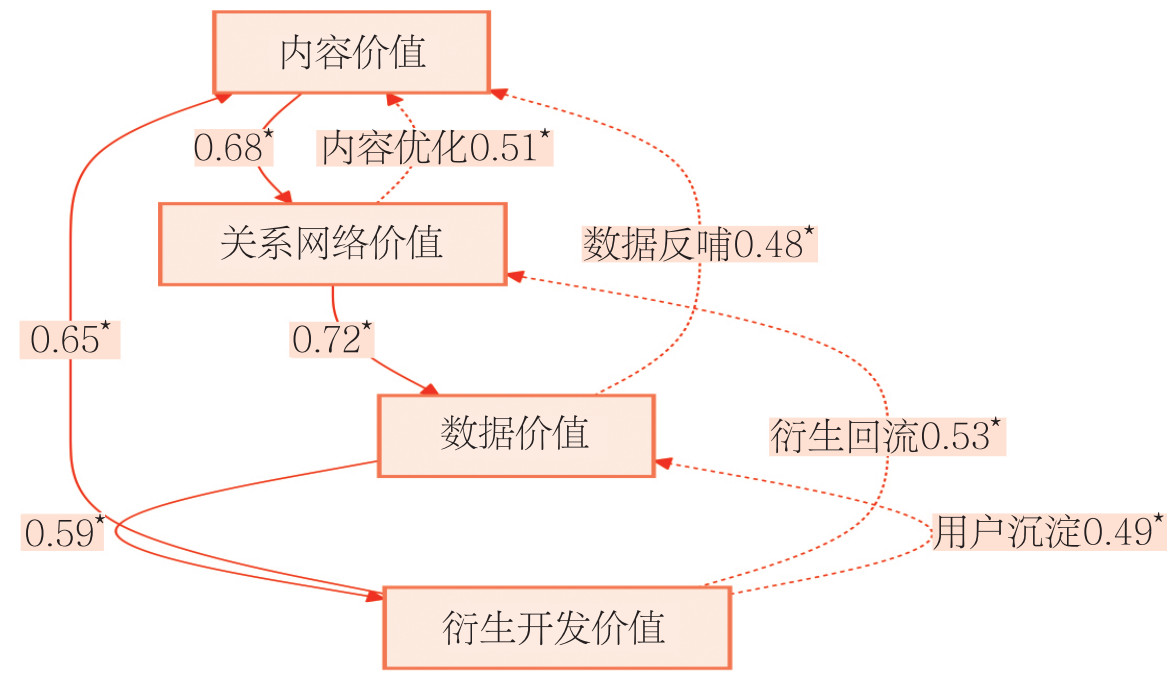
图 1  四维动态耦合模型要素作用路径
注:*表示路径系数通过p<0.05显著性检验。
表 2  数字版权价值评估的指标体系
表 3  数字版权资产价值评估维度及权重分配
1 史辉. 数字版权价值评估法律影响因素分析[J]. 经济与社会发展, 2016 (4): 49- 53.
2 崔波. 双循环新格局下数字版权贸易理论体系构建:概念、框架与路径[J]. 出版发行研究, 2023 (6): 8- 9.
3 张颖, 毛昊. 中国版权产业数字化转型:机遇、挑战与对策[J]. 中国软科学, 2022 (1): 22- 23.
4 张韵. 技术规制:数字平台版权价值体系的重构[J]. 中国出版, 2020 (11): 57- 58.
5 史竞男,刘博,余俊杰. 规模超1.6万亿元!数字出版产业活力强劲[EB/OL].(2024-09-22)[2024-11-24]. https://www.gov.cn/yaowen/liebiao/202409/content_6975805.htm.
6 章红雨,李美霖. 《2023—2024中国出版业发展报告》发布?九大趋势直击出版业发展与变革[EB/OL].(2024-12-16)[2024-12-16]. https://www.nppa.gov.cn/xxfb/ywdt/202412/t20241216_877437.html.
7 蒋柯楠,罗培,关瑞玲. 数据资产的评估方法探讨[EB/OL].(2023-08-22)[2024-12-16]. https://www.iii.tsinghua.edu.cn/info/1131/3565.htm.
8 许潇菲, 周志雄. 网络小说中的电子游戏经验及其反思[J]. 湖北大学学报(哲学社会科学版), 2025 (1): 72- 81.
9 刘鲲翔, 王飚. “数据要素×”背景下关于出版业数据资产化的思考[J]. 出版发行研究, 2024 (8): 5- 15.
10 胡毓婧. 阅文集团2023年收入70.1亿元,《庆余年2》等IP改编剧今年播出[EB/OL].(2024-03-19)[2024-12-16]. https://www.sohu.com/a/765192304_313745.
11 SCHAUTEN M B J , STEGINK R , de GRAAFF G . The discount rate for discounted cash flow valuations of intangible assets[J]. Managerial Finance, 2010 (9): 799- 811.
12 KOSSECKI P , AKIN O . Valuation of copyrights to audiovisual works:Transparency practices of the copyright management organizations in the European Union[J]. Ekonomia i Prawo, 2021 (3): 543- 571.
13 LOSEVA O , KOSORUKOVA I , FEDOTOVA M , et al. Valuation of digital intellectual assets:Principles,factors,approaches and methods[J]. Finance:Theory and Practice, 2022 (4): 6- 28.
14 XIAO L,HUANG W,XIE Y,et al.(2020). A blockchain-based traceable IP copyright protection algorithm[J]. IEEE Access,2020(8):49532-49542.
15 蔡斐, 王啸洋. 出版数据确权的动因、挑战与进路[J]. 出版发行研究, 2024 (8): 16- 22.
16 PARADISI P , KANIADAKIS G , SCARFONE AM . The emergence of self-organization in complex systems– Preface[J]. Chaos Solitons & Fractals, 2015, 81 (part B): 407- 411.
17 薛晗. 基于区块链技术的数字版权交易机制完善路径[J]. 出版发行研究, 2020 (6): 51-56,26.
18 GóMEZ-URIBE C A , HUNT N . The Netflix recommender system:Algorithms,business value,and innovation[J]. ACM Transactions on Management Information Systems, 2016 (4): 1- 19.
19 MORO-Visconti R . The valuation of digital intangibles:Technology, marketing and internet[M]. Cham: Palgrave Macmillan, 2020: 267- 291.
20 RICHERT D , MASAUD K , MACNAB C J B . Discrete-time weight updates in neural-adaptive control[J]. Soft Computing, 2013 (3): 431- 444.
21 BALLING G,MARTENS M. BookTok helped us sell it:How TikTok disrupts publishing and fuels the #Romantasy boom[EB/OL]. [2025-02-10]. https://www.researchgate.net/publication/385827727_BookTok_Helped_Us_Sell_It_How_TikTok_Disrupts_Publishing_and_Fuels_the_Romantasy_Boom.
22 阎晓宏. 数字经济中的版权力量[J]. 中国出版, 2023 (8): 3- 6.
[1] 陈强,张钢花. 适老化数字出版的现实与未来:基于数字可供性视角[J]. 科技与出版, 2025, 44(6): 73-79.
[2] 范文婷. 平台生态系统视角下多边数字阅读平台价值共创与多元主体协同创新路径优化[J]. 科技与出版, 2025, 44(4): 94-102.
[3] 毛文思,王飚. 2024年中国数字出版发展态势盘点与2025年趋势展望[J]. 科技与出版, 2025, 44(3): 14-26.
[4] 邱乾,张森. 超越“融合之困”:数智技术赋能儿童出版的现实困境、生发逻辑及其矫治之道[J]. 科技与出版, 2025, 44(1): 89-100.
[5] 张新新,陈少志. 加快建设数字出版三大体系,切实推动数字出版理论创新——数字出版“十四五”学术热点分析与“十五五”重要议题展望[J]. 科技与出版, 2025, 44(1): 61-76.
[6] 马文欢,王梓薇,黄超兰. AIGC影响数字出版产业链韧性机制模型研究*[J]. 科技与出版, 2024, 43(9): 54-62.
[7] 傅爱雯,王跃,邵波. 数字出版融合生态:体系构建与业务组织[J]. 科技与出版, 2024, 43(9): 63-70.
[8] 杨阳,宋昱霖. 出版企业数据资产的概念、分类与建设*[J]. 科技与出版, 2024, 43(7): 92-102.
[9] 宋吉述,杨阳. 2023—2024年出版业融合发展现状及趋势研判[J]. 科技与出版, 2024, 43(6): 26-37.
[10] 戚天姣,吴怡频. 英美知名出版企业数字化发展策略*[J]. 科技与出版, 2024, 43(5): 76-83.
[11] 张立,王扬,李梦竹,孙晓翠. 对近年来数字出版评优产品的追踪测评及分析(Ⅵ)[J]. 科技与出版, 2024, 43(4): 48-63.
[12] 揭其涛,王奕诺. 玫瑰荆棘:生成式AI赋能数字出版内容生产的逻辑、机遇与隐忧[J]. 科技与出版, 2024, 43(4): 64-70.
[13] 李子星,张新新,李佰珏. 数字出版十大学术热点分析*[J]. 科技与出版, 2024, 43(4): 99-111.
[14] 王飚,毛文思. 2023年中国数字出版发展态势盘点及2024年发展展望[J]. 科技与出版, 2024, 43(3): 14-25.
[15] 徐丽芳,周伊,罗婷,田峥峥. 理念革新与技术驱动:2023年海外科技期刊出版的挑战与新思路*[J]. 科技与出版, 2024, 43(3): 33-45.