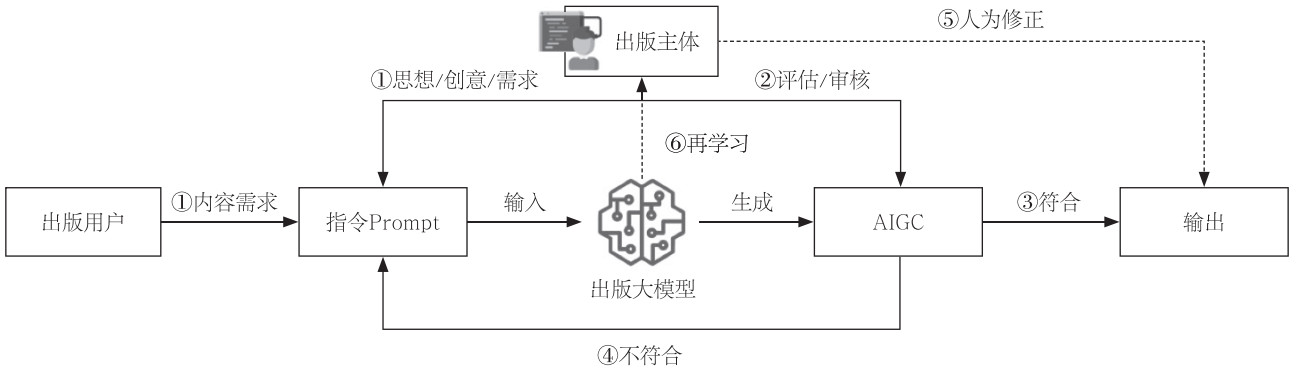
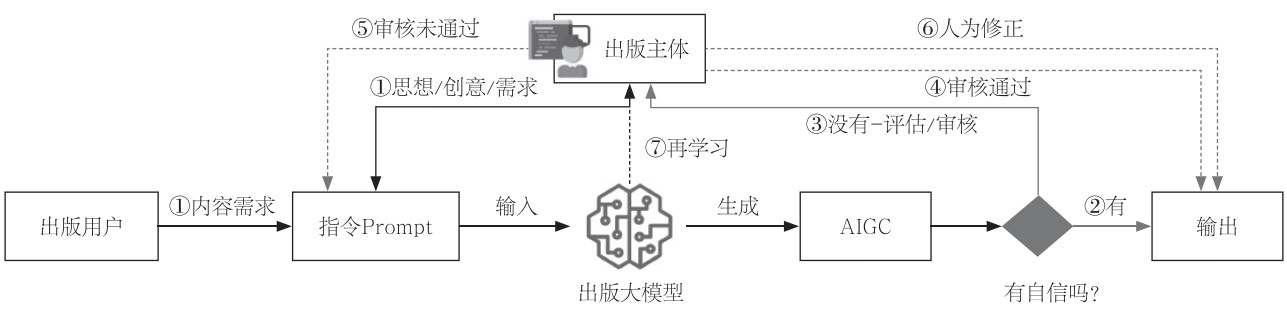
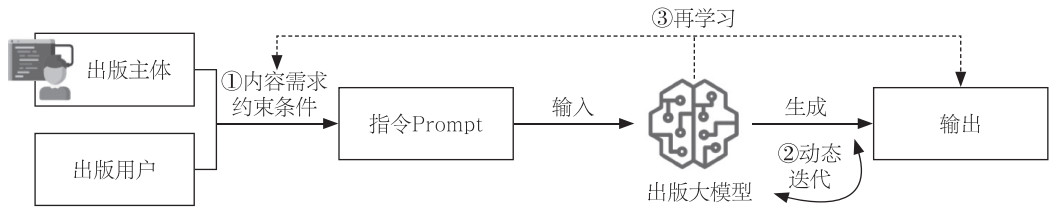
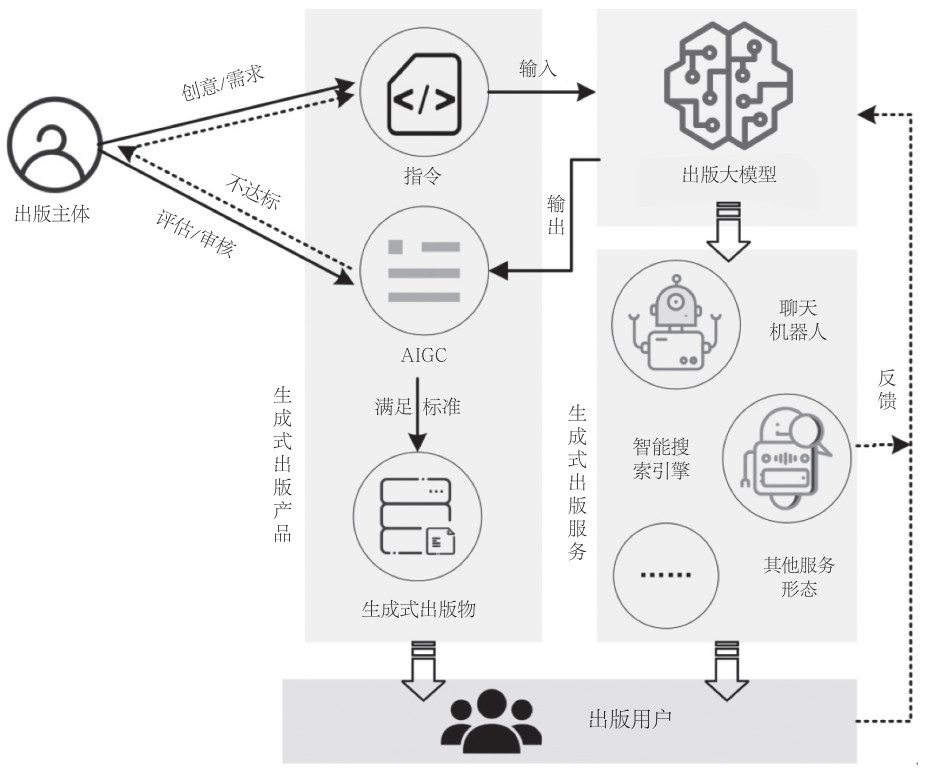
生成式人工智能与出版的融合将触发一场从底层逻辑到顶层业态的范式革命,出版业亟需培育“生成式出版”新业态以适应前沿科技与产业革新之势。生成式出版是以出版大模型为技术底座,由出版机构主导,以人机协同为内容生成逻辑,以打造生成式出版产品和服务为目的,进而满足用户个性化需求的出版新业态。其外延包括出版主体主导的控制型生成式出版、人机耦合的交互型生成式出版和机器主导的自主型生成式出版三类,出版大模型、生成式出版物和生成式出版服务则成为该业态的核心构件。
The deep integration of generative artificial intelligence (AI) with publishing is driving a paradigm shift in the industry, fundamentally transforming its underlying logic and overarching forms. Against this backdrop, this paper introduces and systematically elaborates on the novel concept of "generative publishing". Generative publishing is defined as an emerging publishing paradigm that utilizes large language models as its technical foundation, is led by publishing institutions, adopts human?machine collaboration as its core content generation logic, and aims to produce generative publications and services tailored to users’ personalized needs. Its conceptual essence can be deconstructed across five dimensions: it relies on large language models as the technical base for autonomous content production; it redefines the role of publishing institutions from intermediaries to leaders in content creation, engaging directly with users; it prioritizes human agency within human?machine collaboration to ensure content quality and value alignment; its outputs manifest in two primary forms—generative publications and generative publishing services; and collectively, it signifies a distinct developmental phase beyond traditional publishing formats. On the basis of the dynamics of human?machine collaboration, the extension of generative publishing can be categorized into three types: (1) Controlled generative publishing: Human professionals retain full control, provide precise instructions and perform rigorous quality checks. The large language model functions as an advanced tool within a tightly defined human-led framework. (2) Interactive generative publishing: Characterized by a bidirectional feedback loop, this model involves iterative co-creation. The large language model generates content and performs initial assessments, while human experts provide selective calibration and creative input. (3) Autonomous Generative Publishing: The large language model operates with substantial independence within predefined objectives and ethical boundaries. Human oversight shifts from direct process control to ex-post review, exercising veto authority while relying on embedded governance rules. To operationalize this paradigm, this paper constructs an actionable framework comprising three core components: (1) The publishing large language model, serving as the technical cornerstone, developed through strategic planning, data preparation, training and fine-tuning, and deployment and maintenance. (2) Generative publications as the core products, including compiled types (intelligent reorganization and systematization of existing knowledge), derivative types (creative transformation of classical content), and original types (dual innovation in both conceptual and formal dimensions). (3) Generative publishing services, embodying the knowledge-service attribute, with representative forms such as knowledge service robots and intelligent reading interaction interfaces. Generative publishing represents the industry’ s evolution toward a dynamic, intelligent, and knowledge-service-oriented ecosystem. While promising, its advancement inevitably confronts challenges related to copyright, authenticity, professional restructuring, and ethical governance, necessitating a balanced approach that fosters innovation while upholding the core values of publishing.
丁靖佳,宋宁远. 生成式出版:内涵、外延与框架[J]. 科技与出版, 2026, 45(1): 112-120. DING Jingjia,SONG Ningyuan. Generative Publishing: Connotation, Extension, and Framework. Science-Technology & Publication, 2026, 45(1): 112-120.
http://kjycb.tsinghuajournals.com/CN/ 或 http://kjycb.tsinghuajournals.com/CN/Y2026/V45/I1/112
Cited