Please wait a minute...
科技与出版  2026, Vol. 45 Issue (1): 53-62    
编辑实务
科技期刊同行评议双向隐私智能脱敏策略研究
左双燕1,张昕2,陈丽文3,高武强4,5,*
1. 中南大学湘雅医院 湘雅医学学术促进中心《中国感染控制杂志》编辑部,410008,长沙
2. 中国高校科技期刊研究会,100083,北京
3. 中南大学出版社《中南大学学报(医学版)》编辑部,410078,长沙
4. 中南大学湘雅医院 医院感染控制中心,410008,长沙
5. 中南大学湘雅医院 信息中心,410008,长沙
Intelligent Bidirectional Privacy Anonymization Strategy for Peer Review in STM Journals
ZUO Shuangyan1,ZHANG Xin2,CHEN Liwen3,GAO Wuqiang4,5,*
1. Editorial Office of Chinese Journal of Infection Control, Xiangya Medical Academic Promotion Center, Xiangya Hospital Central South University, 410008, Changsha, China
2. Society of China University Journals, 100083, Beijing, China
3. Editorial Office of the Journal of Central South University (Medical Sciences), Central South University Press, 410078, Changsha, China
4. Center for Healthcare-associated Infection Control, Xiangya Hospital, Central South University, 410008, Changsha, China
5. Information Center, Xiangya Hospital, Central South University, 410008, Changsha, China
全文: HTML    PDF(9238 KB)  
输出: BibTeX | EndNote (RIS)      
摘要: 

文章针对科技期刊同行评议中作者及审稿专家身份暴露风险,提出适配多种文件格式的“规则+大语言模型(LLM)”双向隐私智能脱敏策略,精准清除论文稿件页眉、页脚、批注及作者信息区的姓名、单位、基金等显性标识,同时利用大模型语义理解能力,深度扫描摘要、正文、致谢中的隐性身份线索,并智能豁免文内引用和参考文献,有效弥补传统工具在语义识别上的盲区,显著提升编辑效率与隐私保护水平,为构建公平、可信的学术评价生态提供技术支撑。

关键词 同行评议双向隐私大语言模型智能脱敏    
Abstract

In an era where journals are under mounting pressure to implement double-blind peer review while handling rapidly increasing submission volumes, editorial offices still depend largely on manual redaction or coarse “document inspector” tools to remove identifying details from manuscripts and reviewer reports. These practices are labor intensive, difficult to standardize across editors, and often act as blunt instruments that disrupt the review process by removing useful layout metadata together with sensitive information. They also provide limited protection against implicit semantic leakage, To mitigate these risks and reconcile the tension between robust privacy protection and editorial efficiency, this study proposes an intelligent bidirectional privacy anonymization strategy that integrates rule-based algorithms with large language models (LLMs) and implements it as a scalable browser/server application aligned with editorial workflows. Grounded in an analysis of typical submission materials, the system formalizes three design dimensions: supported file formats, sensitive information categories and high-risk document locations. It supports mainstream word-processing formats, targets core identifiers for authors and reviewers, and concentrates on predefined high-risk locations. On this foundation, we construct a two-layer hybrid engine. A rule-based layer, implemented against the Office Open XML schema, uses regular expressions and structural cues to deterministically locate and neutralize well-structured fields such as author lists, affiliations and email addresses while explicitly protecting in-text citations and reference lists as spans that must not be altered. An LLM-based layer is then invoked through structured prompts that encode editorial heuristics and send only minimal, context-tagged text segments to the model. This layer identifies and masks residual identity cues that escape rule-based detection—the "long tail" of semantic leakage. For PDF files, whose internal structure is less amenable to safe in-place editing, the system adopts a non-destructive “sensitive-information warning” mode in which extracted text is screened and suspected identifiers are flagged for manual verification rather than being automatically rewritten. The hybrid approach is extended symmetrically to reviewer reports. For DOC/DOCX files, the system parses comment and revision nodes and replaces user names and contact details with neutral labels such as "journal editor" or "reviewer A" while preserving the original review content; for PDF reports, suspected identity fields are similarly highlighted for anonymization or human confirmation. The anonymization engine is exposed through a web interface and standardized application programming interfaces, enabling on-demand use by editors and integration with editorial management systems at key workflow stages. An internal evaluation of real manuscripts and reviewer reports by experienced editors indicates that the rule-plus-LLM strategy more reliably removes explicit identifiers and reduces implicit identity cues in high-risk locations than manual or rule-only approaches, without altering in-text citations or reference lists, and substantially shortens the preparation time for double-blind review. Comparison of manual, rule-only, LLM-only and hybrid schemes suggests that the proposed engine achieves a favourable balance of precision, coverage, consistency and operational cost. Overall, this study demonstrates the feasibility of deploying a rules-plus-LLM hybrid engine for intelligent bidirectional anonymization in journal peer review and offers a practical, scalable pathway for journals seeking to strengthen privacy protection and editorial efficiency, while building a fairer and more trustworthy peer-review ecosystem.

Key wordspeer review    bidirectional privacy    large language model    intelligent anonymization
出版日期: 2026-03-19
基金资助:培育世界一流湘版科技期刊建设工程项目梯队项目(2025ZL6003);中国科技期刊卓越行动计划二期项目(卓越二期-B1-096)
通讯作者: 高武强   
Corresponding author: Wuqiang GAO   

引用本文:

左双燕,张昕,陈丽文,高武强. 科技期刊同行评议双向隐私智能脱敏策略研究[J]. 科技与出版, 2026, 45(1): 53-62.
ZUO Shuangyan,ZHANG Xin,CHEN Liwen,GAO Wuqiang. Intelligent Bidirectional Privacy Anonymization Strategy for Peer Review in STM Journals. Science-Technology & Publication, 2026, 45(1): 53-62.

链接本文:

http://kjycb.tsinghuajournals.com/CN/      或      http://kjycb.tsinghuajournals.com/CN/Y2026/V45/I1/53

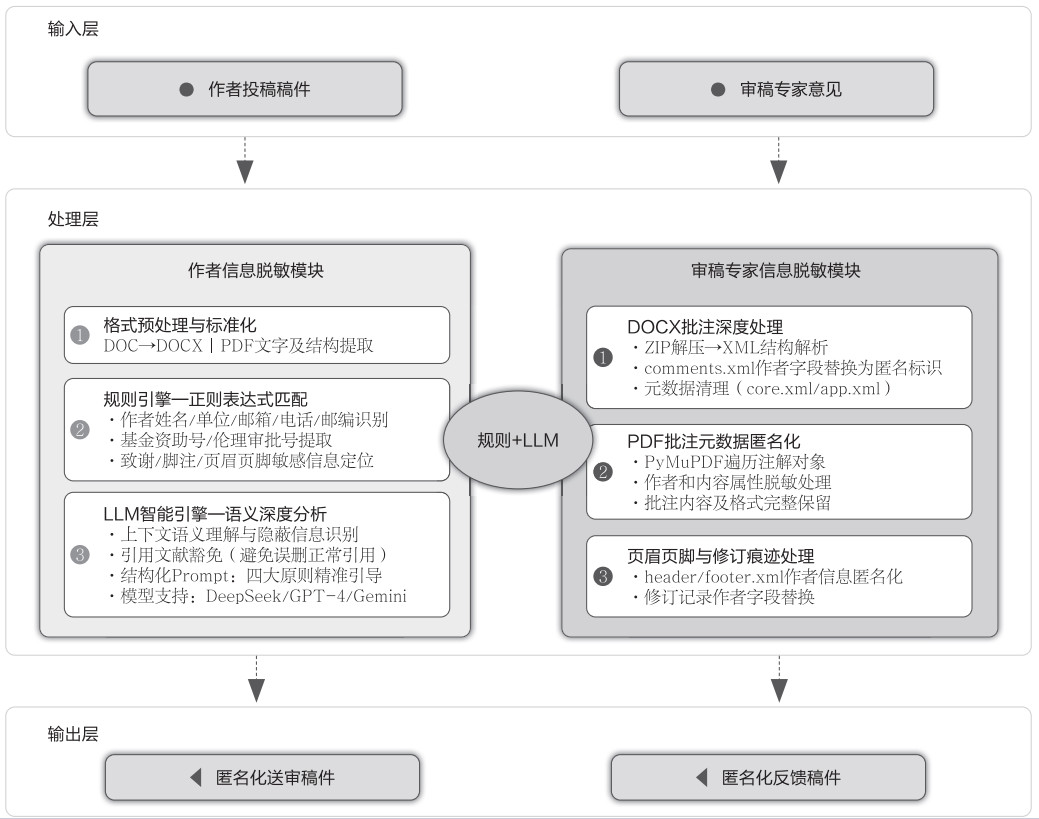
图 1  科技期刊同行评议双向隐私智能脱敏框架
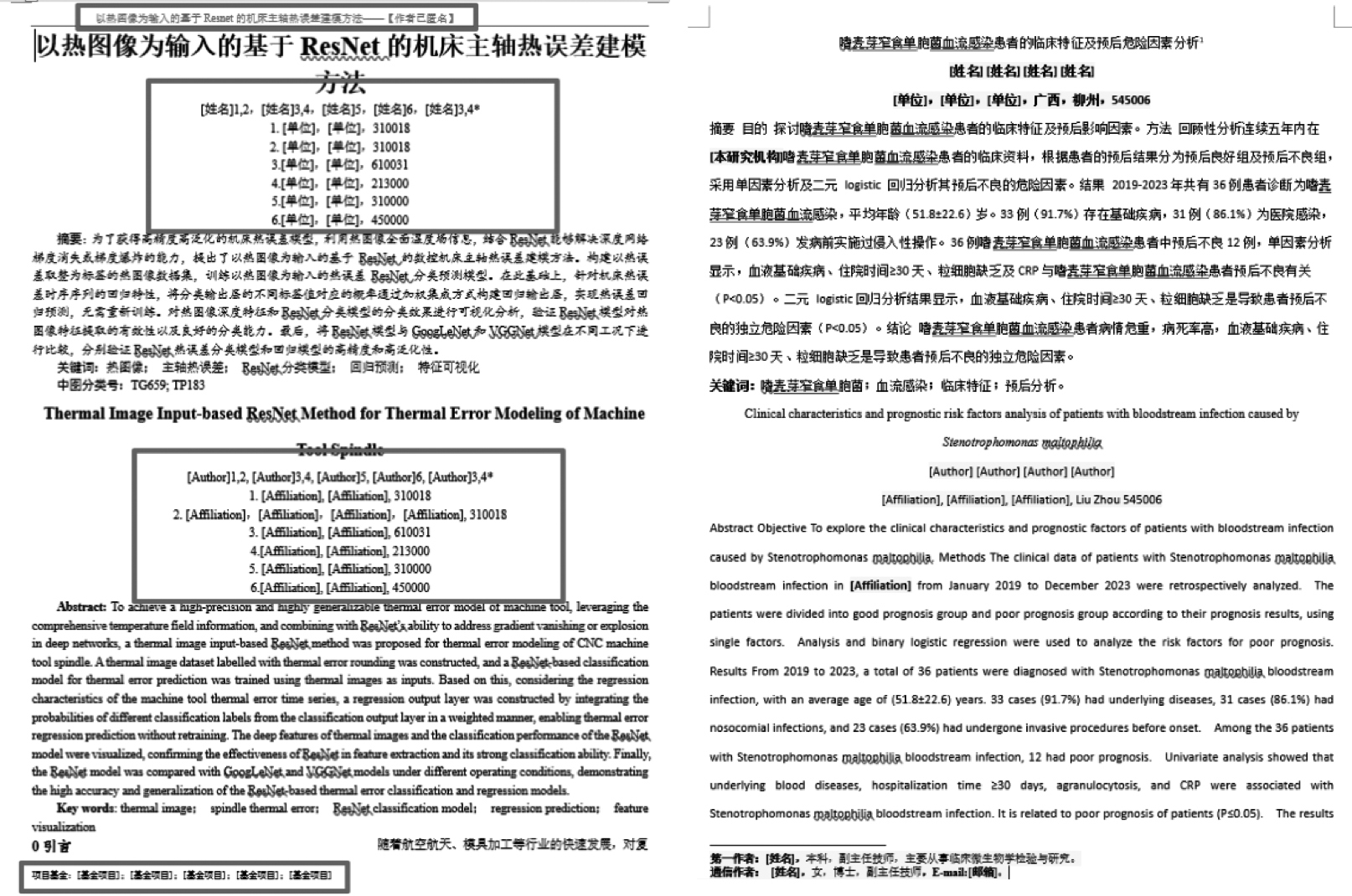
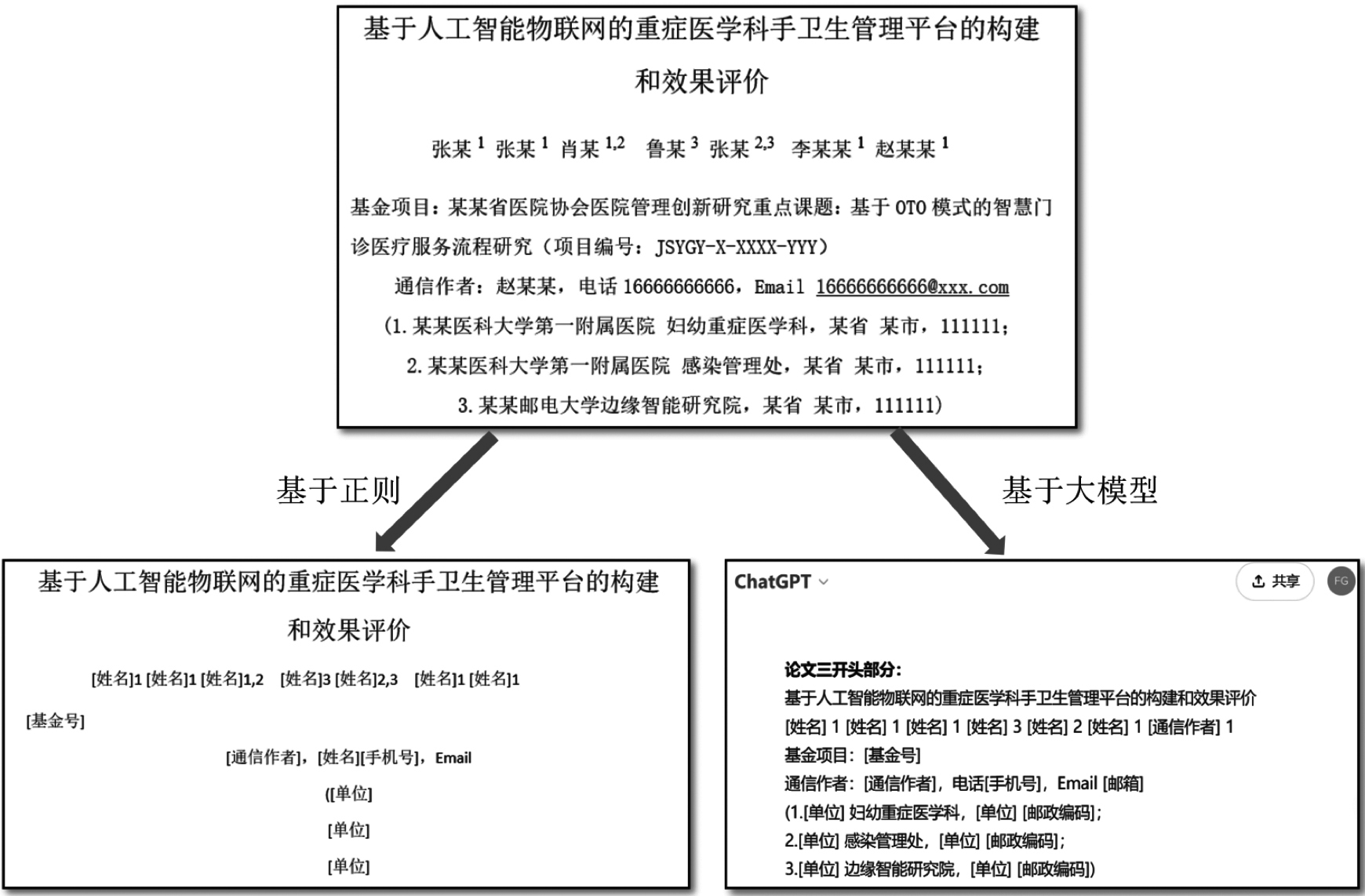
图 2a  规则+LLM混合模型处理效果图
图 2b  作者信息智能脱敏前后对比图
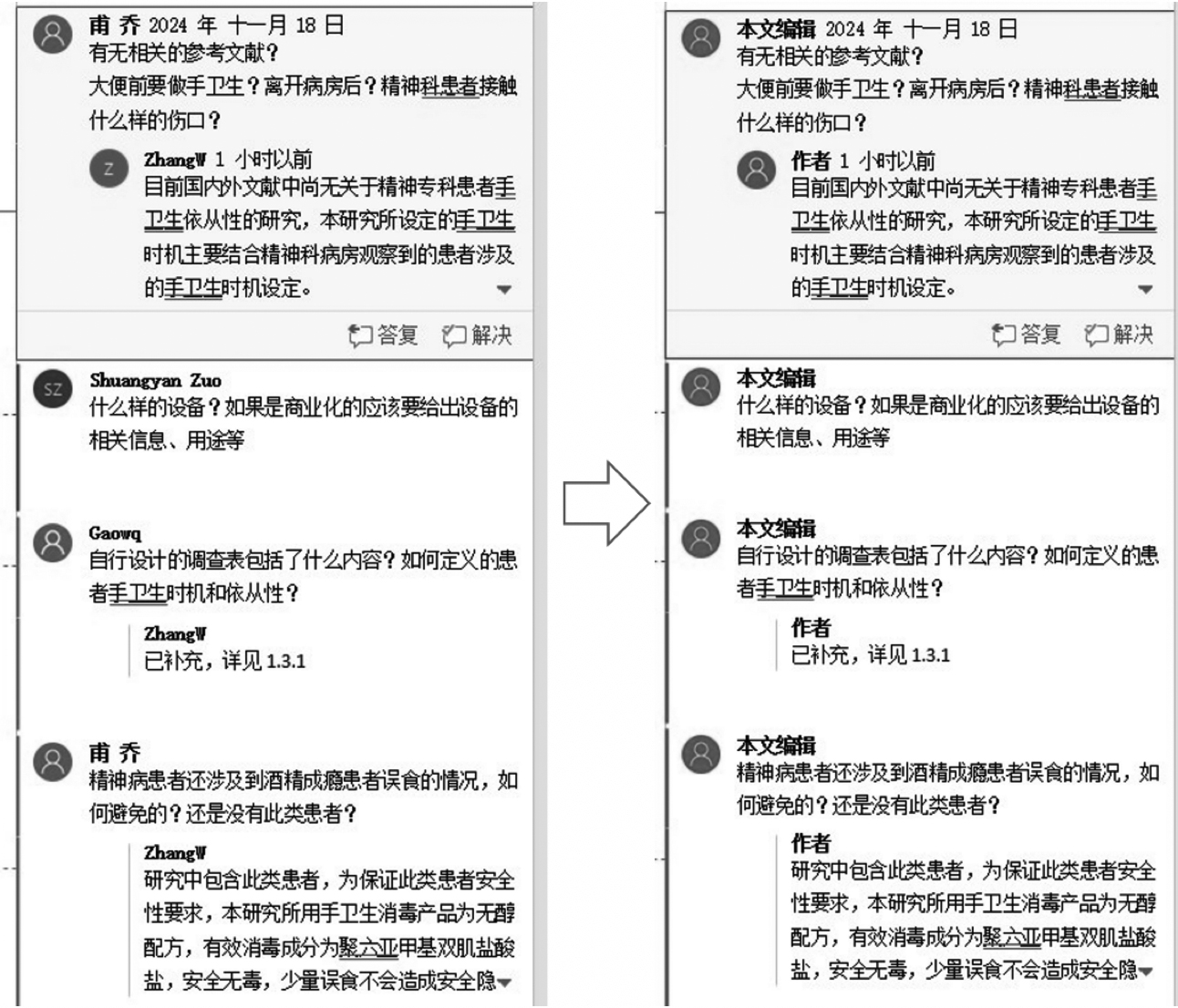
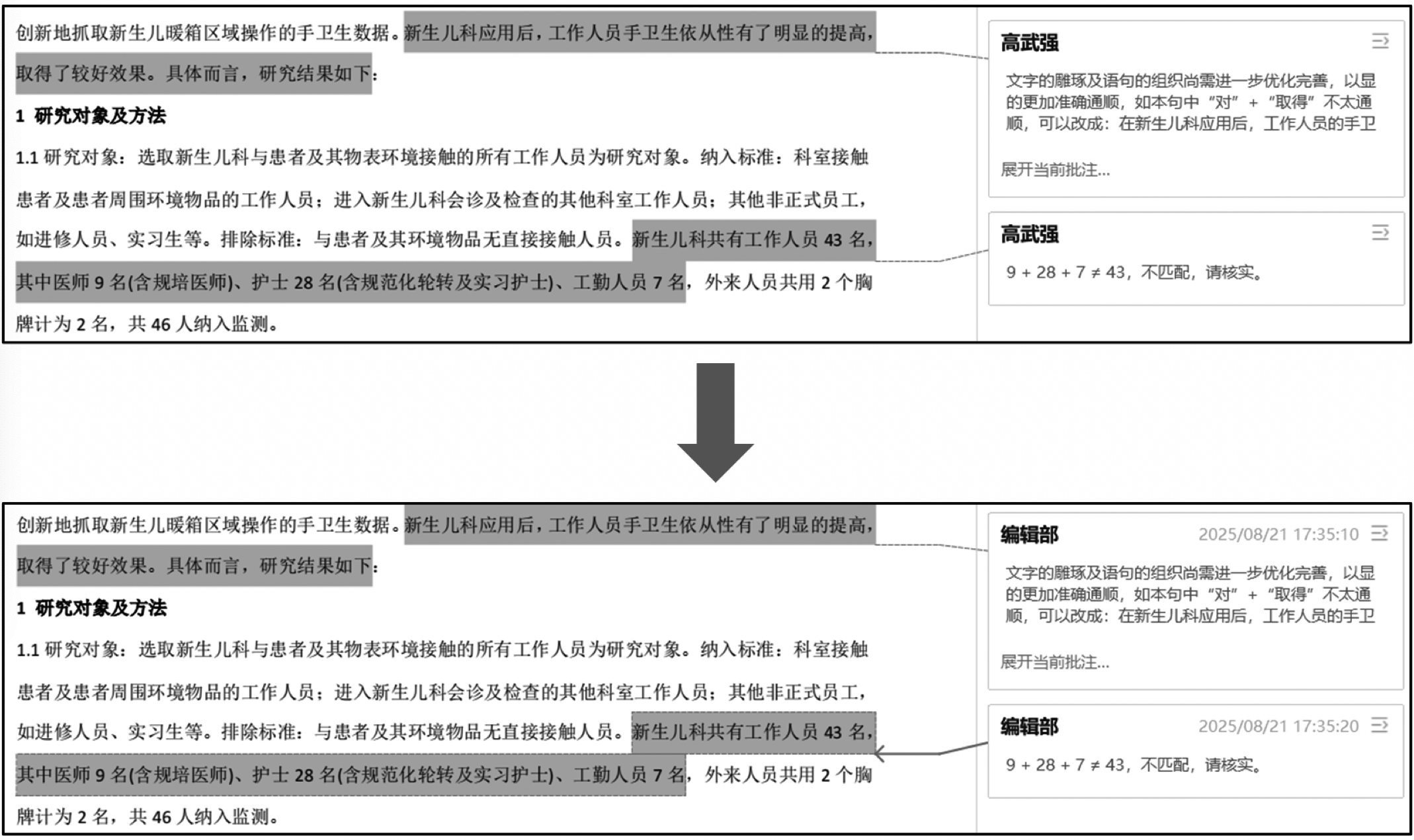
图 3  DOC/DOCX格式稿件中审稿专家信息脱敏前后对比图
图 4  PDF格式稿件中审稿专家姓名脱敏前后对比图
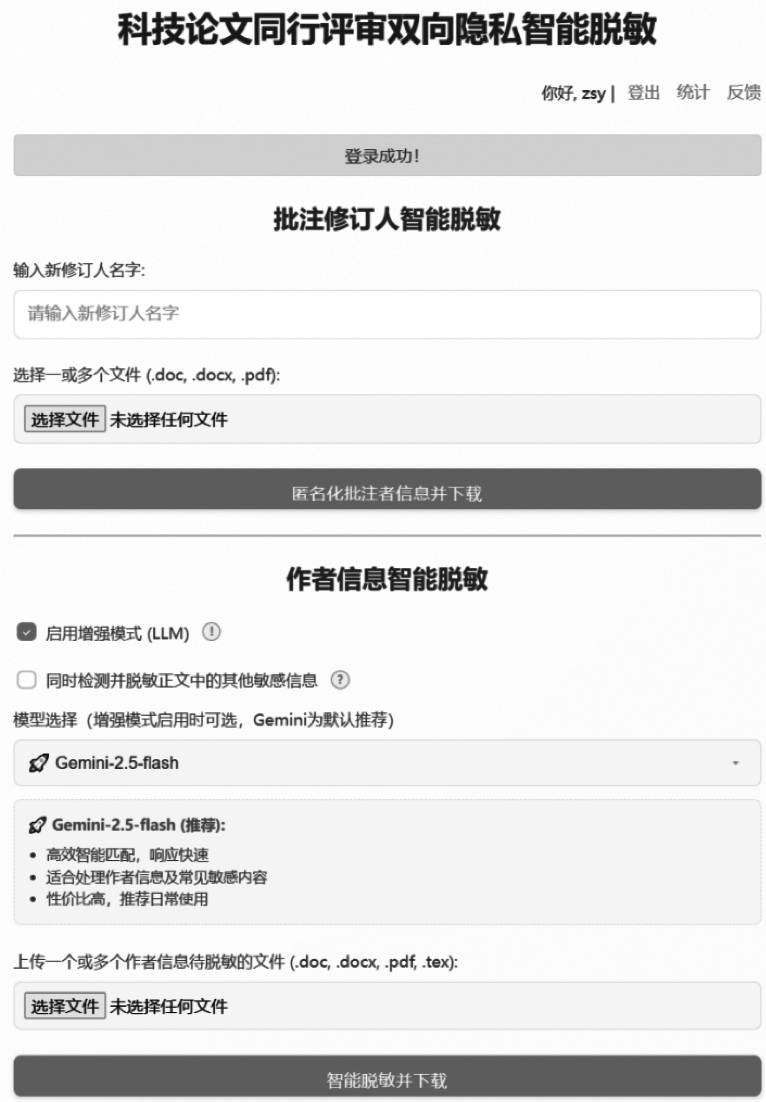
图 5  WEB操作界面
表 1  4种脱敏方案不同维度比较
1 International Committee of Medical Journal Editors. Recommendations for the conduct,reporting,editing,and publication of scholarly work in medical journals[EB/OL]. [2025-09-12]. https://www.icmje.org/recommendations.
2 罗燕,叶赋桂. 同行评议:科学的守门人[EB/OL].(2021-01-12)[2025-09-12]. https://news.gmw.cn/2021-01/12/content_34534901.htm.
3 盛怡瑾, 初景利. 同行评议质量控制方法研究进展[J]. 出版科学, 2018, 26 (5): 46- 53.
4 Huber J , Inoua S , Kerschbamer R , et al. Nobel and novice:Author prominence affects peer review[J]. Proc Natl Acad Sci U S A, 2022, 119 (41): e2205779119.
5 Aczel B , Barwich A S , Diekman A B , et al. The present and future of peer review:Ideas,interventions,and evidence[J]. Proc Natl Acad Sci U S A, 2025, 122 (5): e2401232121.
6 Helmer M , Schottdorf M , Neef A , et al. Gender bias in scholarly peer review[J]. eLife, 2017, 6, e21718.
7 Kern-Goldberger A R , James R , Berghella V , et al. The impact of double-blind peer review on gender bias in scientific publishing:a systematic review[J]. American journal of obstetrics and gynecology, 2022, 227 (1): 43- 50:e4.
8 李艳红, 邓履翔. 科技期刊实施开放同行评议面临的挑战与应对策略[J]. 科技与出版, 2025 (6): 80- 87.
9 王琳. 科技期刊同行评议内容公开的现状调研及策略建议[J]. 中国科技期刊研究, 2022, 33 (6): 776- 783.
10 Tomkins A , Zhang M , Heavlin W D . Reviewer bias in single-versus double-blind peer review[J]. Proc Natl Acad Sci U S A, 2017, 114 (48): 12708- 12713.
doi: 10.1073/pnas.1707323114
11 通过检查文档、演示文稿或工作簿删除隐藏数据和个人信息[EB/OL]. [2025-09-05]. https://support.microsoft.com/zh-cn/office/%E9%80%9A%E8%BF%87%E6%A3%80%E6%9F%A5%E6%96%87%E6%A1%A3-%E6%BC%94%E7%A4%BA%E6%96%87%E7%A8%BF%E6%88%96%E5%B7%A5%E4%BD%9C%E7%B0%BF%E5%88%A0%E9%99%A4%E9%9A%90%E8%97%8F%E6%95%B0%E6%8D%AE%E5%92%8C%E4%B8%AA%E4%BA%BA%E4%BF%A1%E6%81%AF-356b7b5d-77af-44fe-a07f-9aa4d085966f.
12 Sabet C J , Bajaj S S , Stanford F C , et al. Equity in scientific publishing:Can artificial intelligence transform the peer review process?[J]. Mayo Clinic Proceedings:Digital Health, 2023, 1 (4): 596- 600.
doi: 10.1016/j.mcpdig.2023.10.002
13 Perlis R H , Christakis D A , Bressler N M , et al. Artificial intelligence in peer review[J]. JAMA, 2025, 334 (17): No Pagination Specified.
14 Polak M P , Morgan D . Extracting accurate materials data from research papers with conversational language models and prompt engineering[J]. Nature Communications, 2024, 15 (1): 1569.
15 唐栋, 尹欢. 如何修改给作者退修稿word文件里的批注人姓名?[J]. 编辑学报, 2018, 30 (2): 181.
16 Bauersfeld L , Romero A , Muglikar M , et al. Cracking double-blind review:Authorship attribution with deep learning[J]. PLoS ONE, 2023, 17 (6): e0287611.
[1] 李艳红,邓履翔. 科技期刊实施开放同行评议面临的挑战与应对策略[J]. 科技与出版, 2025, 44(6): 80-87.
[2] 王景周,范晴. 学术期刊同行评议代笔行为的表现、原因及对策*[J]. 科技与出版, 2024, 43(9): 19-25.
[3] 龚梦月. 开放科学背景下学术期刊同行评议各方主体权利义务及其辩证关系研究*[J]. 科技与出版, 2024, 43(5): 114-120.
[4] 孙力炜,刘蔚,贺郝钰,迟秀丽,侯春梅. 科技期刊结构化、指标化同行评审单设计研究*[J]. 科技与出版, 2024, 43(4): 80-85.
[5] 王培,高虹. 开放科学环境下学术期刊同行评议的优化路径*[J]. 科技与出版, 2024, 43(3): 136-143.
[6] 王晨,郑建辉,梁霞. “新文科”背景下高校社科学报同行评议优化探究*[J]. 科技与出版, 2023, 42(4): 65-71.
[7] 都平平,彭琳. 利用平台创新期刊出版服务*[J]. 科技与出版, 2021, 40(4): 11-16.
[8] 占莉娟, 方卿, 王涵, 荣翠红. 专家研究方向与稿件精准匹配的难点及原因分析*[J]. 科技与出版, 2020, 39(11): 108-115.
[9] 张建中,夏亚梅. 专著出版同行评议:特点与启示*[J]. 科技与出版, 2020, 39(01): 109-112.
[10] 曾群. Publons对传统审稿模式的改变[J]. 科技与出版, 2018, 37(5): 60-64.
[11] 鹤 袁, 晴 王, 筱秋 骆. 对同行评议形式的思考*——以《国际口腔科学杂志(英文版)》为例[J]. 科技与出版, 2018, 37(10): 157-161.
[12] 丁筠. 新媒体、新技术影响下的科技期刊发展趋势[J]. 科技与出版, 2018, 37(07): 116-120.
[13] 张小利,范晨芳. 医学论文发表过程中涉及的编辑伦理问题及控制策略[J]. 科技与出版, 2017, 36(12): 55-58.
[14] 潘凤云,周巧富,张嘉绚,张蕊,郑朔方. 学术期刊编辑部流程管理要素探讨[J]. 科技与出版, 2017, 36(12): 69-71.
[15] 胡菲. 高校科技期刊同行评议制度调查与分析[J]. 科技与出版, 2012, 31(9): 117-120.