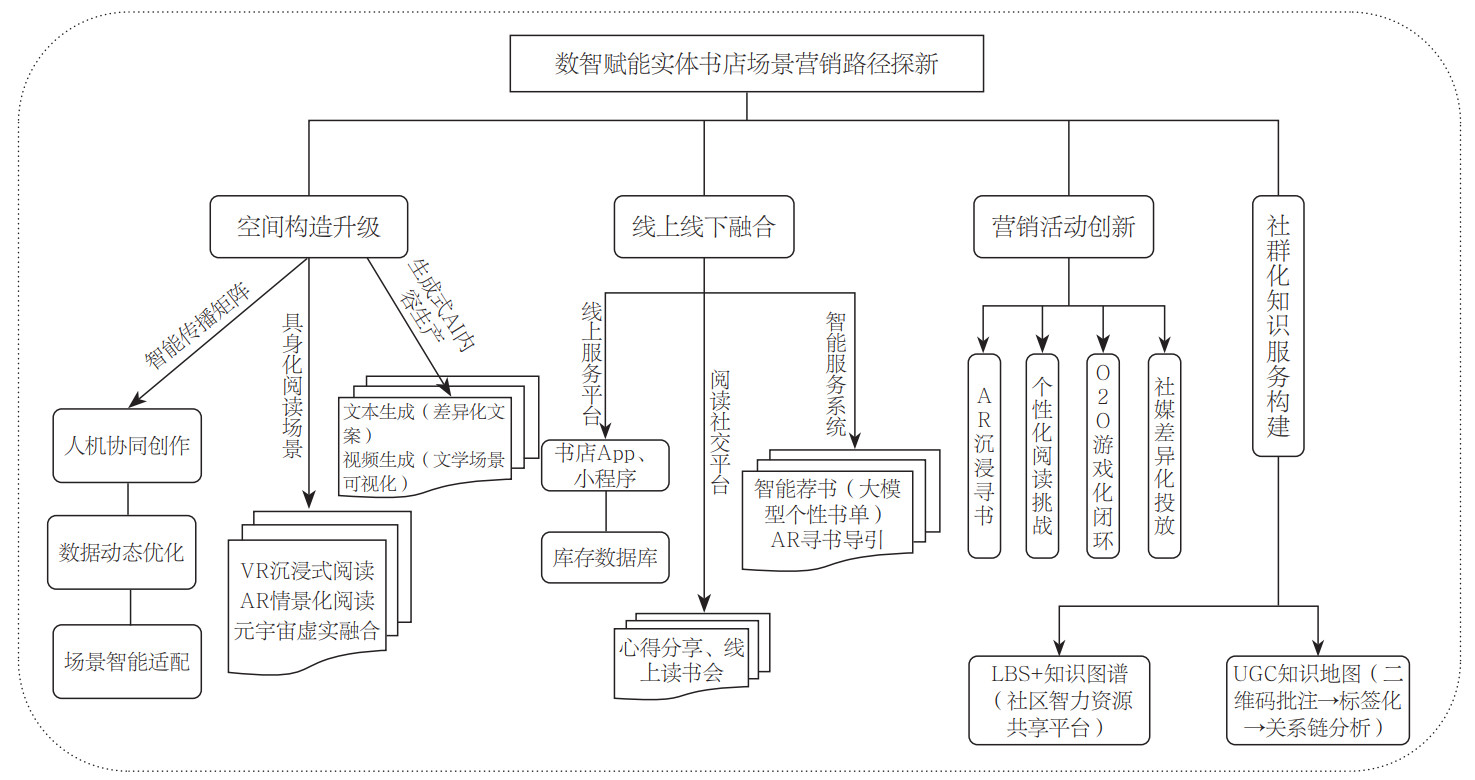
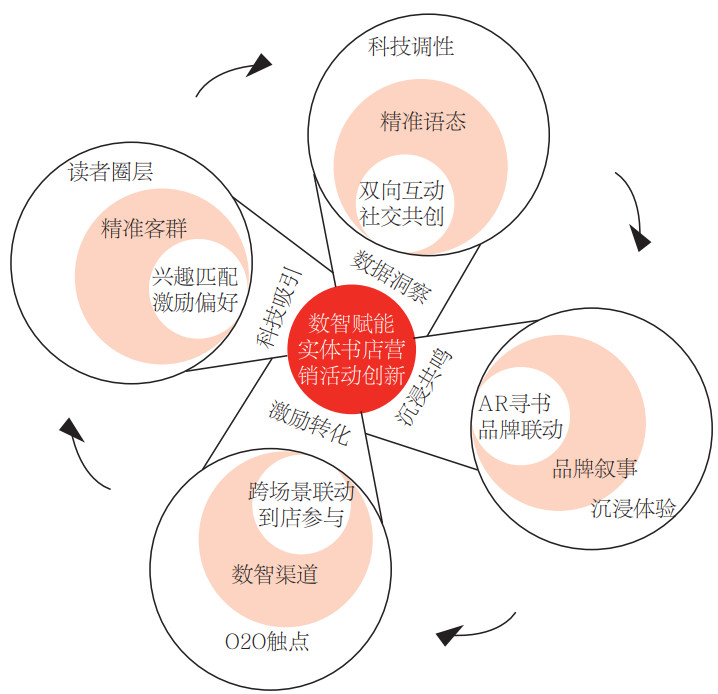
当前,人工智能等新技术的勃兴为实体书店数智化转型注入新动能、带来新契机。实体书店在数智化转型进程中,面临空间设计缺乏科技赋能、技术应用与读者需求脱节、数据挖掘流于浅层等现实困境。本文基于上海代表性实体书店数智化转型的案例分析,回应数智技术能否促成购书转化、吸引读者到店,以及数智技术与实体书店类型、图书类型如何适配等问题。研究发现,实体书店可通过数智赋能空间构造升级、线上线下场景深度融合、营销活动创新、社群化知识服务体系构建等多元路径,提升空间体验与经营效益,实现数智化转型与高质量发展。
This article investigates how physical bookstores can optimize spatial experience and marketing amid artificial intelligence, big data, the Internet of Things, and immersive media. It starts from a practical tension: although digital reading platforms, online bookstores, and reading apps have weakened the traditional sales function of bookstores, emerging intelligent technologies may provide new momentum for their spatial, service, and marketing transformation. The central questions are whether digital-intelligent technologies can drive in-store purchase conversion and how technologies should be matched to different bookstore types, book categories, and reader segments. The digital transformation of physical bookstores should not be understood as a simple accumulation of devices or a pursuit of technological spectacle. Rather, it is a systematic reorganization of value logic, operational structure, and spatial form, shaped by the coupling of a “new retail platform” and a “public cultural space.” Through theoretical discussion and multiple case analysis, the article identifies several current difficulties: weak integration between technology and spatial design, a mismatch between technical applications and readers’ real needs, superficial data mining, privacy risks, rising operational costs, and the erosion of bookstores’ humanistic and social attributes. Empirically, the article examines representative bookstores in Shanghai, including Duoyun Bookstore, Sisyphe Bookstore, and Tsutaya Books, combining questionnaires, interviews, and participant observation. The findings show that digital-intelligent technologies do not generate value uniformly. Their effectiveness depends on bookstore type, location, target readers, content positioning, service model, and communication mechanism. Cultural-landmark bookstores can transform social-media visibility into visits, activity reservations, and cultural consumption; standardized chain bookstores can improve efficiency through membership systems, inventory management, CRM, and precise event promotion; lifestyle-oriented bookstores can strengthen community identification through curated databases, aesthetic narratives, and cross-industry data analysis. Reader groups such as students, parent-child families, young white-collar readers, professional scholars, older adults, tourists, and community readers require differentiated technical touchpoints.The core value of digital-intelligent technologies lies in reducing the cost of book discovery and purchase decisions, enhancing embodied store experience, strengthening community attachment, and optimizing inventory allocation. However, these benefits can be transformed into stable purchasing behavior and business performance only when technology aligns with bookstore positioning, reader needs, book categories, and operational capacity. Therefore, bookstores should avoid blind investment in costly immersive devices or opaque algorithms, especially when such tools are disconnected from content and service conversion.Accordingly, the article proposes four strategies: upgrading spatial quality through generative AI, AR/VR, intelligent guidance, and data-driven scenario design; deepening online-offline integration through apps, mini-programs, real-time inventory, social reading, and precise recommendation; innovating marketing activities through gamified book searching, event-data-driven campaigns, O2O interaction, and technology-based co-branding; and building community-oriented knowledge services through LBS bookstore maps, knowledge graphs, UGC annotation systems, and localized reading networks.Ultimately, the future bookstore should balance technological instrumentality with humanistic value, becoming not merely a retail terminal, but a socially embedded knowledge hub and cultural engine.
沈悦,赵新毅,孙露铭. 数智时代实体书店空间体验优化与场景营销探新[J]. 科技与出版, 2026, 45(6): 136-149. SHEN Yue,ZHAO Xinyi,SUN Luming. Spatial Experience Optimization and Innovative Scenario Marketing for Physical Bookstores in the Digital-Intelligent Era. Science-Technology & Publication, 2026, 45(6): 136-149.
http://kjycb.tsinghuajournals.com/CN/ 或 http://kjycb.tsinghuajournals.com/CN/Y2026/V45/I6/136
Cited