Please wait a minute...
科技与出版  2026, Vol. 45 Issue (6): 124-135    
学术探索
阅读效果导向的国民数字阅读素养提升路径研究
周斌
北京印刷学院,102600,北京
Improvement Pathways of National Digital Reading Literacy Oriented by Reading Effect
ZHOU Bin
School of Publishing, Beijing Institute of Graphic Communication, 102600, Beijing, China
全文: HTML    PDF(1859 KB)  
输出: BibTeX | EndNote (RIS)      
摘要: 

数字阅读正从单一工具形态演进为融合文化涵养、生活体验、技术服务与社交协作的“智慧数字环境”,其发展进程伴生安全健康受损、价值判断失准及文化心理偏移等负向效应。消解数字阅读负向影响的根本抓手在于国民数字阅读素养的系统重塑与层级跃升。本文依托国民数字阅读素养内涵体系及30项测评指标,以消解数字阅读负向影响为目标,借鉴素养冰山模型分层逻辑,将数字阅读素养培育内容划分为“阅读能力·态度·行为”“阅读知识·体验·认知·动力”“阅读观念·修养·性情”三维架构,并阐释其逻辑机理。进而构建“应急干预—系统培育—生态涵养”三阶协同提升范式:立足水上显性层矫正不良阅读行为,阻断即时性安全健康风险;夯实水下浅层素养支撑,推动个体从外部约束向内源自觉转变;涵养水下深层精神底蕴,实现阅读品格与价值信念的长效内化。促进数字阅读素养提质升级,既是全民阅读工程纵深发展的重要内容,也是民众适应数字化生存与数字社会发展的现实需求。

关键词 国民数字阅读素养阅读效果负向影响素养冰山模型提升路径    
Abstract

The optimization of reading effect constitutes the core foothold for the high-quality development of digital reading and a key starting point for tackling the prevalent negative problems in digital reading scenarios. Evolving from a single functional tool, digital reading has gradually become a smart digital environment integrating cultural cultivation, life experience, technical services and social collaboration. Nevertheless, its development brings about a series of adverse outcomes, including impaired personal safety and physical and mental health, biased value judgment, and distorted cultural psychology. The fundamental way to eliminate such negative impacts lies in the systematic reshaping and hierarchical upgrading of national digital reading literacy. On the basis of the connotation system of national digital reading literacy and the corresponding 30 evaluation indicators established by the research team in previous studies, this paper takes reading effect as the core orientation and draws on the hierarchical logic of the literacy iceberg model. It constructs a three-dimensional framework for literacy cultivation, covering reading ability, attitude and behavior, reading knowledge, experience, cognition and motivation, as well as reading concept, accomplishment and temperament, and elaborates the internal logical mechanism of the framework. Furthermore, this paper proposes a three-stage collaborative improvement paradigm of “emergency intervention, systematic cultivation and ecological conservation”. The dominant surface layer of the model corrects undesirable reading behaviors to block immediate safety and health risks; the shallow underwater layer consolidates the foundation of literacy cultivation and facilitates individuals’ transformation from passive external constraint to active internal consciousness; the deep underwater layer nurtures deep spiritual connotations and realizes the long-term internalization of individual reading character and value beliefs. This hierarchical and targeted improvement path effectively compensates for the prominent deficiencies in current digital reading literacy cultivation practices, namely prioritizing formal procedures over practical effects, uniform top-down instruction over hierarchical adaptive training, and short-term behavioral rectification over long-term spiritual cultivation. The upgrading of digital reading literacy is not only a vital part of the in-depth implementation of the national reading initiative, but also an inevitable requirement for adapting to digital survival and social development, as well as promoting the comprehensive literacy and all-round development of citizens.

Key wordsnational digital reading literacy    reading effect    negative impacts    literacy iceberg model    improvement pathway
出版日期: 2026-07-14
基金资助:国家社科基金项目“阅读效果视域下国民数字阅读素养的内涵、评估与提升研究”(22BXW097)

引用本文:

周斌. 阅读效果导向的国民数字阅读素养提升路径研究[J]. 科技与出版, 2026, 45(6): 124-135.
ZHOU Bin. Improvement Pathways of National Digital Reading Literacy Oriented by Reading Effect. Science-Technology & Publication, 2026, 45(6): 124-135.

链接本文:

http://kjycb.tsinghuajournals.com/CN/      或      http://kjycb.tsinghuajournals.com/CN/Y2026/V45/I6/124

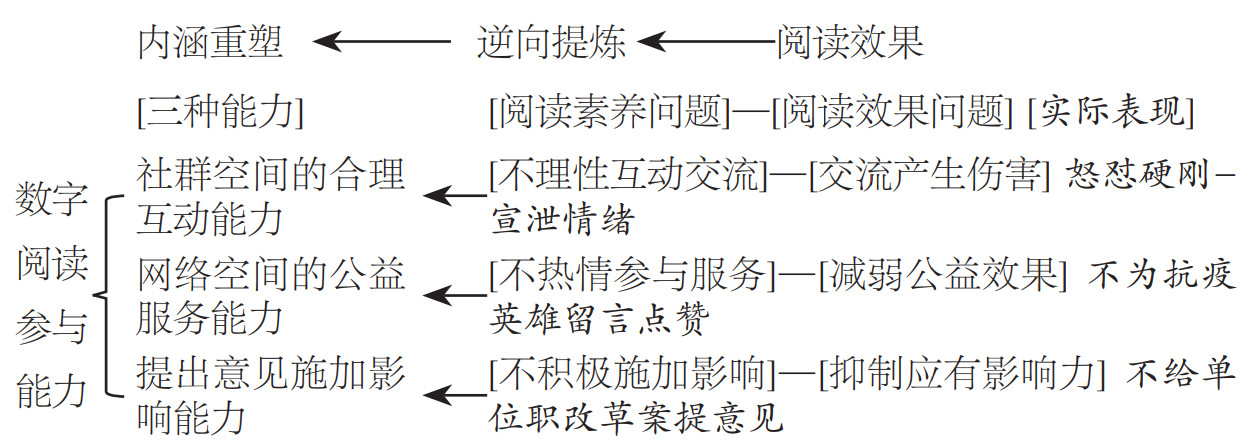
图 1  基于阅读效果的国民数字阅读素养内涵逆向提炼示意图
表 1  阅读效果视域下的国民数字阅读素养内涵体系
1 周斌. 数字阅读负面影响治理研究:难点·遵循·路径[J]. 出版发行研究, 2019 (11): 56- 60.
2 李武, 谢泽杭. 社会化阅读的概念生成、发展演变及实践影响[J]. 现代出版, 2022 (5): 60- 67.
3 张新宇. 5G时代数字阅读的媒介化进程与影响[J]. 编辑学刊, 2021 (4): 33- 38.
4 王佑镁, 宛平, 南希烜, 等. 提升数字阅读素养:国际数字阅读素养测评指标的多维比较与启示[J]. 开放教育研究, 2020, 26 (6): 29- 36.
5 周斌. 数字阅读负面影响的现状调查与分析[J]. 编辑之友, 2018 (3): 14- 20.
6 Vuorikari R,Kluzer S,Punie Y. DigComp 2.2:The digital competence framework for citizens:With new examples of knowledge,skills and attitudes[R]. Luxembourg:Publications Office of the European Union,2022.
7 罗德红, 龚婧. PISA、NAEP和PIRLS阅读素养概念述评[J]. 上海教育科研, 2016 (1): 34- 37.
8 李爱玲. 基于层次分析法的大学生数字阅读素养评价指标体系构建及实证研究[J]. 图书馆研究与工作, 2026 (1): 35- 42.
9 刘司卓, 郭利明, 郑勤华, 等. 面向数字场景的阅读素养测评:内涵界定、要素解构、工具设计与数据表征[J]. 中国电化教育, 2024 (9): 60- 68.
10 周斌. 国民数字阅读素养内涵体系创建[J]. 现代出版, 2024 (6): 42- 51.
11 国家互联网信息办公室.提升全民数字素养与技能行动纲要[EB/OL].(2021-11-05)[2024-04-20]. http://www.cac.gov.cn/2021-11/05/c_1637708867754305.htm.
12 向新阳. 试论出版文化[J]. 出版科学, 2004, 12 (2): 28- 31.
13 千面英雄侠. 经济合作与发展组织(OECD)核心素养框架[EB/OL].(2021-01-14)[2026-01-09]. https://www.jianshu.com/p/279fd5179201.
14 褚宏启. 核心素养与国民素质[J]. 中小学管理, 2016 (5): 60.
15 周斌, 刘晨旭, 姜帆. 基于案例调查的数字阅读负面影响实证研究[M]. 北京: 中华工商联合出版社, 2019: 11- 12.
16 McClelland D C . Testing for competence rather than for“intelligence.”[J]. American Psychologist, 1973, 28 (1): 1- 14.
doi: 10.1037/h0034092
17 Knapp R H . A psychology of rumor[J]. Public Opinion Quarterly, 1944, 8 (1): 22.
doi: 10.1086/265665
18 Livingstone S,Mascheroni G,Staksrud E. Developing a framework for researching children’s online risks and opportunities in Europe[R]. London:London School of Economics and Political Science,2015:1-14.
19 Ajzen I . The theory of planned behavior[J]. Organizational Behavior and Human Decision Processes, 1991, 50 (2): 179- 211.
doi: 10.1016/0749-5978(91)90020-T
20 雷欢, 张文彦. 忻州市乡镇居民数字阅读行为影响因素研究[J]. 参花, 2025 (18): 50- 52.
21 李新祥. 数字时代我国国民阅读行为嬗变及对策研究[D]. 武汉:武汉大学,2013.
22 董奇. 论元认知[J]. 北京师范大学学报(社会科学版), 1989 (1): 68- 74.
23 Ryan R M , Deci E L . Self-determination theory and the facilitation of intrinsic motivation,social development,and well-being[J]. American Psychologist, 2000, 55 (1): 68- 78.
doi: 10.1037/0003-066X.55.1.68
24 Schwartz S H. Universals in the content and structure of values:Theoretical advances and empirical tests in 20 countries[M]//Advances in Experimental Social Psychology(Volume 25). Amsterdam:Elsevier,1992:1-65.
25 皮埃尔·布尔迪厄. 区分:判断力的社会批判[M]. 刘晖,译. 北京:商务印书馆,2015:121-122.
26 约翰·杜威. 我们如何思维[M]. 伍中友,译. 北京:新华出版社,2010:64-65.
27 皮埃尔·布迪厄. 实践感[M]. 蒋梓骅,译. 南京:译林出版社,2003:109.
28 B. J. 福格. 福格行为模型[M]. 徐毅,译. 天津:天津科学技术出版社,2021:42-43.
29 U. S. Department of Health and Human Services. Health Literacy Online(3rd Edition)[R]. Washington,DC:Office of Disease Prevention and Health Promotion,2025.
30 约翰·杜威. 经验与教育:汉英双语版[M]. 盛群力,译. 北京:中国轻工业出版社,2016:129.
31 Gerbner G . Toward “Cultural Indicators”:The analysis of mass mediated public message systems[J]. AV Communication Review, 1969, 17 (2): 137- 148.
doi: 10.1007/BF02769102
32 莱夫,温格. 情境学习:合法的边缘性参与[M].王文静,译. 上海:华东师范大学出版社,2004:98-102.
33 Gross J J . The emerging field of emotion regulation:An integrative review[J]. Review of General Psychology, 1998, 2 (3): 271- 299.
doi: 10.1037/1089-2680.2.3.271
[1] 彭秋归. 中华文明标识体系构建中学术期刊的作用及其提升研究[J]. 科技与出版, 2026, 45(5): 112-120.
[2] 崔琰琳. 量质分化与合作优化:中国地质学英文SCI期刊国际影响力差异及提升策略[J]. 科技与出版, 2026, 45(2): 82-95.
[3] 林润华,张昕,李娜,卫夏雯. 中国科技期刊“十四五”提升路径与“十五五”战略创新思考[J]. 科技与出版, 2025, 44(1): 48-60.
[4] 谢文鸿,潘永毅. 基于洋葱模型探究科技期刊编辑科研素养提升路径*[J]. 科技与出版, 2024, 43(7): 126-131.
[5] 周斌,何锦. 从“关注阅读经济”到“关心阅读效果”*[J]. 科技与出版, 2019, 38(3): 114-122.
[6] 常宁强. 轻型纸及轻型轻涂纸在图书印刷中的应用[J]. 科技与出版, 2010, 29(8): 33-35.