Please wait a minute...
科技与出版  2026, Vol. 45 Issue (6): 115-123    
营销方略
新流量机制下的出版营销创新——基于浙江新华“千人主播”新媒体营销的实证研究
蒋辰1,王武林2
1. 浙江传媒学院动画与数字艺术学院, 310018, 杭州
2. 浙江传媒学院国际传播智能计算机实验室, 310018, 杭州
Innovations in Publishing Marketing Under the New Traffic Mechanism: An Empirical Study of Zhejiang Xinhua's "Thousand Hosts" New Media Marketing Campaign
JIANG Chen1,WANG Wulin2
1. School of Animation and Digital Art, Communication University of Zhejiang, 310018, Hangzhou, China
2. School of Publishing, Communication University of Zhejiang, 310018, Hangzhou, China
全文: HTML    PDF(1889 KB)  
输出: BibTeX | EndNote (RIS)      
摘要: 

新流量机制下,为破解传统出版发行面临的流量承接错位、传播语态失灵与生产结构迟滞等营销困境,本文提出“营销前置”策略,以浙江新华“千人主播”新媒体营销项目为例,深度剖析其通过“叙事转译”重构视觉符号以实现叙事语态降维与转译,利用“矩阵赛马”实现流量规模化分发与动态优选,借助“数智反哺”技术建立数据归因与选题修正机制的执行进路。研究表明,该模式显著提升了GPM等核心经营指标,为出版营销的数智化转型提供了实践样本。

关键词 出版营销营销前置图书直播新流量机制数字化转型    
Abstract

Driven by algorithm-driven platforms reshaping cultural consumption, book marketing has been fundamentally transformed by the integration of content recommendation, social interaction, and transaction conversion. After Douyin, a Chinese short-video platform, incorporated Gross Merchandise Value per Mille (GPM) into algorithmic weighting in 2024, the conventional linear model of "editing, printing, and distribution" has proven incompatible with instantaneous platform feedback. Against this background, the present paper proposes "marketing pre-positioning" and empirically investigates the Zhejiang Xinhua Bookstore Group's "Thousand Hosts" project, a pioneering digital transformation initiative within China's traditional publishing distribution system. This study deconstructs the triple predicament facing conventional publishing marketing through diagnostic analysis and case observation. First, traffic volatility and algorithmic cut-off mechanisms disrupt linear release cycles, disrupting the alignment between promotional promises and reading experiences. Second, elite-oriented discourse fails in interactive environments, diluting brand identity and engagement. Third, production structures centered on professional judgment cannot respond to fragmented audiovisual demands, compressing market lifecycles for content lacking visual translation. On this foundation, the research constructs a "marketing pre-positioning" framework with three interlocking dimensions. The first establishes "market-data-pre-positioning" by deploying AI agents to analyze competitor traffic, reader profiles, and trending cycles during acquisition pre-planning, transforming subjective research into evidence-based decision-making. The second implements "dual-track parallel" content translation grounded in IMC and SOR theories. The third constructs "public-private domain synergy" by integrating broadcasting modes and KOL/KOC alliances for public-domain distribution while channeling traffic to the Qiantang Hongshu App for private-domain accumulation. The study documents three core pathways. First, narrative translation reduces communication thresholds by transforming textual value into visual symbols, exemplified by the Cangqiong Shan Ji campaign achieving over 5 million exposures through a viral "cucumber doll." Second, matrix-based competition across nine vertical categories realizes scaled distribution, as demonstrated by the Jian Lai series achieving 3.7 million yuan and Aobing Zhuan selling 50,000 copies for 2.8 million yuan. Third, data-intelligent feedback loops feed user behaviors from livestream rooms back into selection decisions, shifting marketing from experience-driven promotion toward evidence-based management. Furthermore, immersive livestreaming demonstrates that cultural-field construction is crucial for high-involvement products. The Harry Potter 25th Anniversary Edition exceeded 2 million yuan in single-session GMV with a 5% return rate, substantially below the 20%–30% industry average return rate. These results confirm that traffic acquisition and transaction conversion can be integrated through organizational reconstruction. The findings indicate that "marketing pre-positioning" has significantly elevated core GPM by embedding transactional-efficiency indicators upstream into planning, restructuring the production-market feedback connection and driving a shift from passive distribution to proactive control. Accordingly, this research argues that publishing institutions can build algorithmic ecosystem advantages through talent activation, organizational restructuring, and AI empowerment as a full-domain paradigm, providing a replicable model for industry competitiveness and cultural dissemination in the algorithmic era.

Key wordspublishing marketing    marketing pre-positioning    book livestreaming    new traffic mechanism    digital transformation
出版日期: 2026-07-14
基金资助:浙江省教育厅项目“技术、转译、内化:AIGC赋能数字艺术思政教育创新路径研究”(Y202558412)

引用本文:

蒋辰,王武林. 新流量机制下的出版营销创新——基于浙江新华“千人主播”新媒体营销的实证研究[J]. 科技与出版, 2026, 45(6): 115-123.
JIANG Chen,WANG Wulin. Innovations in Publishing Marketing Under the New Traffic Mechanism: An Empirical Study of Zhejiang Xinhua's "Thousand Hosts" New Media Marketing Campaign. Science-Technology & Publication, 2026, 45(6): 115-123.

链接本文:

http://kjycb.tsinghuajournals.com/CN/      或      http://kjycb.tsinghuajournals.com/CN/Y2026/V45/I6/115

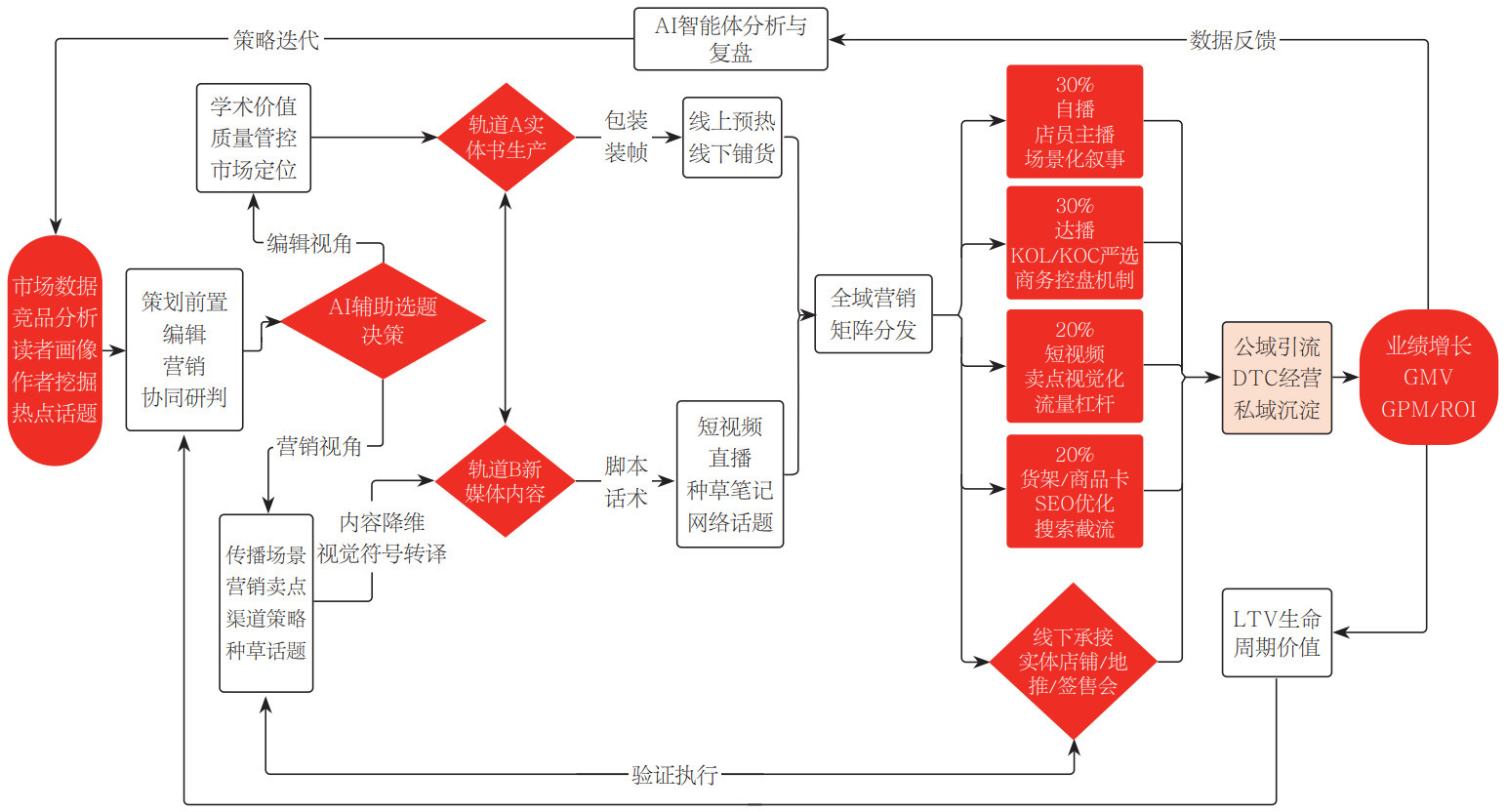
图 1  “营销前置”策略模型
表 1  视频类型与策略定位
表 2  视频内容设计与时长规划
表 3  浙江新华“千人主播”核心项目量化业绩
1 张君成. 抖音发布报告: 2024年买书用户数量同比增1.3倍[N]. 中国新闻出版广电报, 2025-01-21(3).
2 王建磊, 张延. 作为实践主张的流量逻辑: 数字经济的阐释视角[J]. 当代传播, 2024 (6): 26- 31.
3 隗静秋, 陈晶. 从商业带货到情感链接: 心理契约视域下出版直播营销研究[J]. 中国出版, 2022 (24): 7- 14.
4 石尚, 张聪. 出版社短视频营销的现状、问题与对策: 基于抖音、快手、微信视频号等短视频平台的实证研究[J]. 青年记者, 2021 (24): 110- 112.
5 陈俊, 江玉. 互动仪式链视域下出版社少儿图书直播营销探析[J]. 编辑学刊, 2022 (4): 13- 19.
6 Warner K S R , W?ger M . Building dynamic capabilities for digital transformation: An ongoing process of strategic renewal[J]. Long Range Planning, 2019, 52 (3): 326- 349.
doi: 10.1016/j.lrp.2018.12.001
7 朱逸, 朱瑞庭. 叙事魔力: 何以触发网络直播购物的冲动购买行为: 基于SOR与ELM理论模型的结合[J]. 兰州学刊, 2024 (12): 64- 76.
8 Wongkitrungrueng A , Assarut N . The role of live streaming in building consumer trust and engagement with social commerce sellers[J]. Journal of Business Research, 2020, 117, 543- 556.
doi: 10.1016/j.jbusres.2018.08.032
9 Jerasa S , Boffone T . BookTok 101:TikTok, digital literacies, and out-of-school reading practices[J]. Journal of Adolescent & Adult Literacy, 2021, 65 (3): 219- 226.
10 Revilla M , Rodriguez-Prados F . Algorithmic curation and the reshaping of cultural consumption: How recommendation systems influence book discovery[J]. International Journal of Cultural Studies, 2024, 27 (2): 215- 234.
11 王艺, 曹越. AIGC技术赋能下图书选题智能策划系统的技术逻辑与体系构建[J]. 出版发行研究, 2024 (2): 31- 37.
[1] 葛欣. 数字化转型背景下教育出版社C端市场发展路径研究[J]. 科技与出版, 2026, 45(5): 49-56.
[2] 谢清风,许一多. 中国出版深度数字化转型:2025年实践探索和趋势展望[J]. 科技与出版, 2026, 45(3): 6-13.
[3] 王鹏飞,高智晖. 人工智能驱动与情绪价值引领:2025年出版营销与运营[J]. 科技与出版, 2026, 45(3): 28-37.
[4] 余钧,戚德祥. 推动出版产业数据要素价值化的支持政策研究[J]. 科技与出版, 2026, 45(3): 123-131.
[5] 谢冰滨. PMC指数模型视角下政策赋能出版人才队伍建设的机制研究[J]. 科技与出版, 2026, 45(2): 66-81.
[6] 宋俊锋,刘万. 可解构的“畅销经验”:AIGC赋能出版营销的价值趋向与实践落点[J]. 科技与出版, 2026, 45(1): 70-84.
[7] 王剑飞,林松. 媒介升维与空间重构:可交互空中成像技术对出版业的范式革新研究[J]. 科技与出版, 2025, 44(8): 28-37.
[8] 孙帅. 寻求共鸣:学术期刊数字化转型中[J]. 科技与出版, 2025, 44(6): 131-140.
[9] 吕永峰,陈惊涛,王创业. 流量泡沫还是营销变革?——图书直播电商的模式困境与路径优化[J]. 科技与出版, 2025, 44(5): 119-130.
[10] 陈矩弘,封采龄. 生成式人工智能赋能出版营销的技术逻辑与实践进路[J]. 科技与出版, 2025, 44(4): 76-84.
[11] 王鹏飞,褚晓雨. 新局面下的多方求索:2024年的出版营销与运营[J]. 科技与出版, 2025, 44(3): 27-34.
[12] 高虹. 新质生产力推动学术期刊高质量发展的理论逻辑与实践路径*[J]. 科技与出版, 2024, 43(7): 70-78.
[13] 杨阳,宋昱霖. 出版企业数据资产的概念、分类与建设*[J]. 科技与出版, 2024, 43(7): 92-102.
[14] 宋吉述,杨阳. 2023—2024年出版业融合发展现状及趋势研判[J]. 科技与出版, 2024, 43(6): 26-37.
[15] 刘欣,蒋雪颖,袁也. 数智时代的国家认同与主题出版融合发展路径探析*[J]. 科技与出版, 2024, 43(2): 71-76.