Please wait a minute...
科技与出版  2026, Vol. 45 Issue (6): 136-149    
学术探索
数智时代实体书店空间体验优化与场景营销探新
沈悦1,赵新毅2,*,孙露铭1
1. 上海师范大学,200234,上海
2. 华中师范大学,430079,武汉
Spatial Experience Optimization and Innovative Scenario Marketing for Physical Bookstores in the Digital-Intelligent Era
SHEN Yue1,ZHAO Xinyi2,*,SUN Luming1
1. Shanghai Normal University, 200234, Shanghai, China
2. Central China Normal University, 430079, Wuhan, China
全文: HTML    PDF(1902 KB)  
输出: BibTeX | EndNote (RIS)      
摘要: 

当前,人工智能等新技术的勃兴为实体书店数智化转型注入新动能、带来新契机。实体书店在数智化转型进程中,面临空间设计缺乏科技赋能、技术应用与读者需求脱节、数据挖掘流于浅层等现实困境。本文基于上海代表性实体书店数智化转型的案例分析,回应数智技术能否促成购书转化、吸引读者到店,以及数智技术与实体书店类型、图书类型如何适配等问题。研究发现,实体书店可通过数智赋能空间构造升级、线上线下场景深度融合、营销活动创新、社群化知识服务体系构建等多元路径,提升空间体验与经营效益,实现数智化转型与高质量发展。

关键词 实体书店人工智能空间体验场景营销智能出版    
Abstract

This article investigates how physical bookstores can optimize spatial experience and marketing amid artificial intelligence, big data, the Internet of Things, and immersive media. It starts from a practical tension: although digital reading platforms, online bookstores, and reading apps have weakened the traditional sales function of bookstores, emerging intelligent technologies may provide new momentum for their spatial, service, and marketing transformation. The central questions are whether digital-intelligent technologies can drive in-store purchase conversion and how technologies should be matched to different bookstore types, book categories, and reader segments. The digital transformation of physical bookstores should not be understood as a simple accumulation of devices or a pursuit of technological spectacle. Rather, it is a systematic reorganization of value logic, operational structure, and spatial form, shaped by the coupling of a “new retail platform” and a “public cultural space.” Through theoretical discussion and multiple case analysis, the article identifies several current difficulties: weak integration between technology and spatial design, a mismatch between technical applications and readers’ real needs, superficial data mining, privacy risks, rising operational costs, and the erosion of bookstores’ humanistic and social attributes. Empirically, the article examines representative bookstores in Shanghai, including Duoyun Bookstore, Sisyphe Bookstore, and Tsutaya Books, combining questionnaires, interviews, and participant observation. The findings show that digital-intelligent technologies do not generate value uniformly. Their effectiveness depends on bookstore type, location, target readers, content positioning, service model, and communication mechanism. Cultural-landmark bookstores can transform social-media visibility into visits, activity reservations, and cultural consumption; standardized chain bookstores can improve efficiency through membership systems, inventory management, CRM, and precise event promotion; lifestyle-oriented bookstores can strengthen community identification through curated databases, aesthetic narratives, and cross-industry data analysis. Reader groups such as students, parent-child families, young white-collar readers, professional scholars, older adults, tourists, and community readers require differentiated technical touchpoints.The core value of digital-intelligent technologies lies in reducing the cost of book discovery and purchase decisions, enhancing embodied store experience, strengthening community attachment, and optimizing inventory allocation. However, these benefits can be transformed into stable purchasing behavior and business performance only when technology aligns with bookstore positioning, reader needs, book categories, and operational capacity. Therefore, bookstores should avoid blind investment in costly immersive devices or opaque algorithms, especially when such tools are disconnected from content and service conversion.Accordingly, the article proposes four strategies: upgrading spatial quality through generative AI, AR/VR, intelligent guidance, and data-driven scenario design; deepening online-offline integration through apps, mini-programs, real-time inventory, social reading, and precise recommendation; innovating marketing activities through gamified book searching, event-data-driven campaigns, O2O interaction, and technology-based co-branding; and building community-oriented knowledge services through LBS bookstore maps, knowledge graphs, UGC annotation systems, and localized reading networks.Ultimately, the future bookstore should balance technological instrumentality with humanistic value, becoming not merely a retail terminal, but a socially embedded knowledge hub and cultural engine.

Key wordsphysical bookstores    artificial intelligence    spatial experience    scenario marketing    intelligent publishing
出版日期: 2026-07-14
基金资助:国家社会科学基金一般项目“习近平文化思想国际传播话语体系建构研究”(25BKS003)
通讯作者: 赵新毅   
Corresponding author: Xinyi ZHAO   

引用本文:

沈悦,赵新毅,孙露铭. 数智时代实体书店空间体验优化与场景营销探新[J]. 科技与出版, 2026, 45(6): 136-149.
SHEN Yue,ZHAO Xinyi,SUN Luming. Spatial Experience Optimization and Innovative Scenario Marketing for Physical Bookstores in the Digital-Intelligent Era. Science-Technology & Publication, 2026, 45(6): 136-149.

链接本文:

http://kjycb.tsinghuajournals.com/CN/      或      http://kjycb.tsinghuajournals.com/CN/Y2026/V45/I6/136

表 1  实体书店的转型脉络与业态特征
表 2  上海代表性实体书店实证样本与数智化特征
表 3  读者群体、需求结构与适配技术
表 4  多元类型实体书店的数智化技术适配边界
表 5  图书类型、适配技术与实体书店应用场景
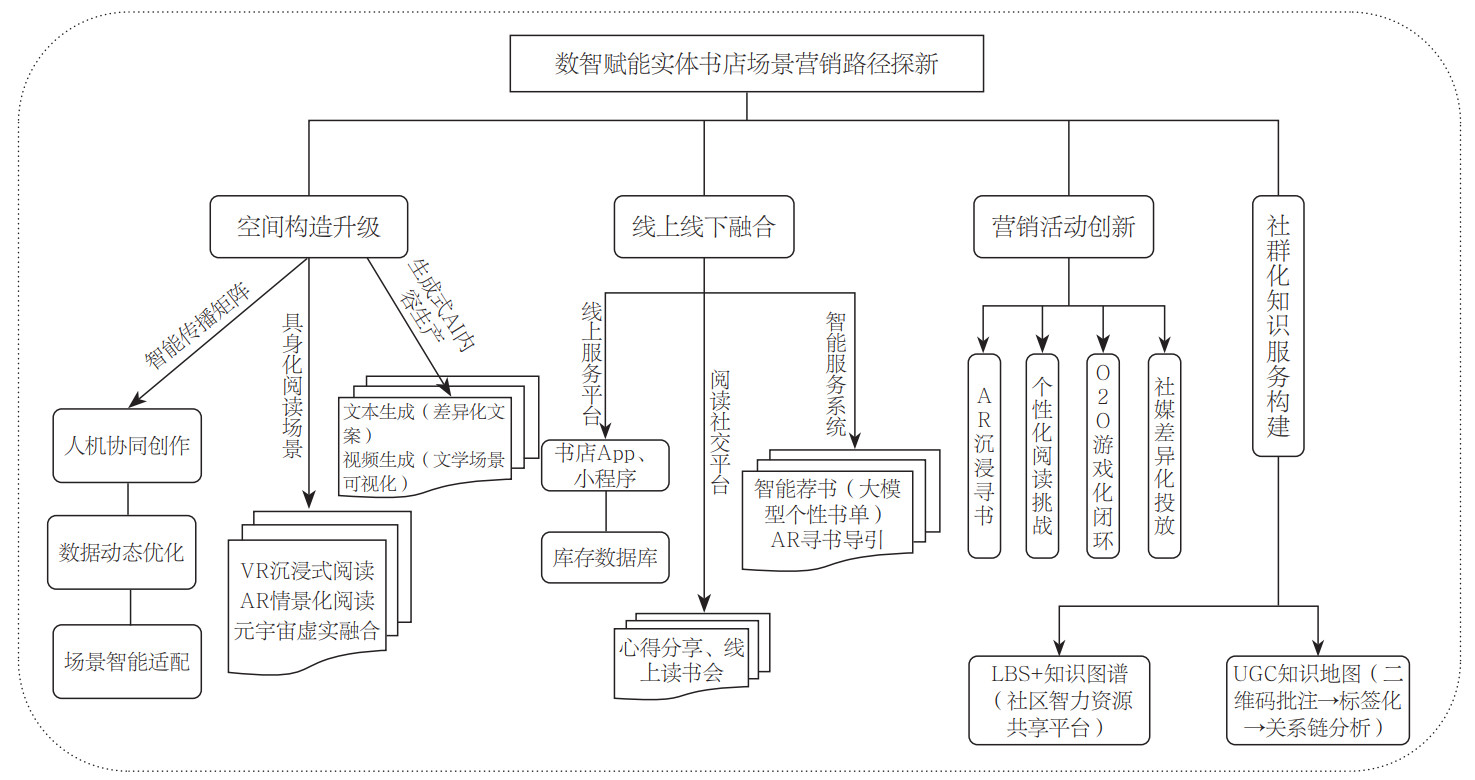
图 1  数智赋能实体书店场景营销路径探新总体框架
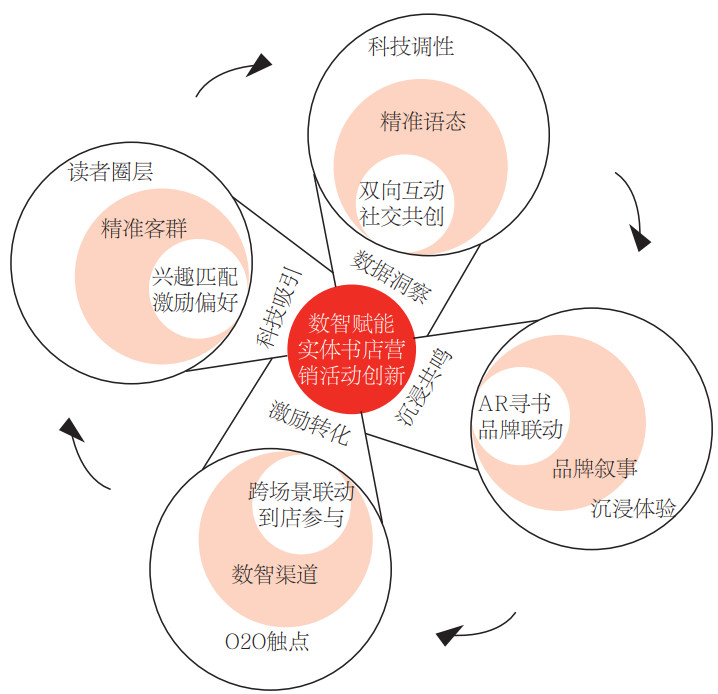
图 2  数智赋能实体书店营销活动创新模型
1 张铮, 陈雪薇. “云端”之上:实体书店的现实困境、存在价值与发展方向[J]. 出版发行研究, 2020 (8): 19- 24.
2 张萱. 场景融合·社群激活·“实验场”:城市传播视域下实体书店作为知识生产空间的价值研究[J]. 东岳论丛, 2021 (4): 131- 138.
3 储节旺, 陈梦蕾. 人工智能驱动图书馆变革[J]. 大学图书馆学报, 2019, 37 (4): 5- 13.
4 杨学坤, 吴树勤. 新零售业态下我国实体书店经营与发展策略[J]. 出版科学, 2019 (4): 90- 94.
5 徐静, 万安伦. 出版深度融合条件下中国特色出版学构建的逻辑依凭与现实路径[J]. 出版发行研究, 2023 (12): 5- 10.
6 吴若航, 茆意宏. 新质生产力赋能图书馆的理论逻辑、框架与未来进路[J]. 图书情报工作, 2026, 70 (6): 55- 65.
7 罗然, 王晰巍, 李姝璇. 图书馆场景下知识服务智能问答机器人人智交互效果评价[J]. 图书情报工作, 2026, 70 (4): 100- 115.
8 刘艳. 读书短视频的两端与图书分离人群的视频化阅读新图景[J]. 图书馆建设, 2024 (6): 148-157,172.
9 司新丽. 北京新型公共阅读空间:特点、价值与发展对策[J]. 图书情报工作, 2021, 65 (11): 64- 70.
10 关于支持实体书店发展的指导意见[EB/OL].(2026-01-08)[2026-02-26]. https://www.nppa.gov.cn/xxfb/zcfg/gfxwj/201605/t20160527_4491.html.
11 周坤. 立法护航+文旅共生:2026实体书店大会勾勒文化消费新生态[EB/OL].(2026-01-19)[2026-02-26]. http://ah.people.com.cn/n2/2026/0108/c227131-41467031.html.
12 罗建周. “书店+”:实体书店融合升级路径探析[J]. 编辑之友, 2023 (7): 29- 34.
13 沈悦, 张祎璇. 复合“再造”:实体书店空间延展与场景拓新[J]. 中国出版, 2025 (20): 62- 67.
14 王翎子, 张志强. “情境”视角下图书短视频发展业态探析:以“抖音”App头部账号为例[J]. 科技与出版, 2020 (8): 50- 57.
15 刘念, 闫玉刚. 实体书店的智能化发展策略及优化路径:以新华书店为例[J]. 科技与出版, 2019 (12): 49- 53.
16 Adnan M N M,Chowdury M R,Taz I,et al. Content based news recommendation system based on fuzzy logic[C]// 2014 International Conference on Informatics,Electronics & Vision(ICIEV). May 23-24,2014,Dhaka,Bangladesh. IEEE,2014:1-6.
17 彭兰. 智能传播技术驱动的“认知连接”[J]. 山西大学学报(哲学社会科学版), 2025, 48 (1): 71- 78.
18 彭兰. 传播活动中作为转义者的智能技术及其作用机制[J]. 宁夏社会科学, 2024 (2): 181- 190.
19 马丁·海德格尔. 海德格尔选集(下卷)[M]. 孙周兴,译. 上海:上海三联书店,1996:937-938.
20 万建辉. 中南路外文书店全新升级“归来”[N]. 长江日报,2019-12-19(19).
21 赵明范, 刘宁. “脱嵌”—“再嵌入”:元宇宙阅读的价值意蕴与风险困境[J]. 南阳理工学院学报, 2024, 16 (1): 58- 62.
22 张宁, 刘浩冰. VR阅读赋能读者理解的原理、优势与困境[J]. 科技与出版, 2023 (7): 93- 100.
doi: 10.16510/j.cnki.kjycb.20230728.003
23 陈宏伟. 5G与人工智能技术赋能下VR图书的内容设计研究[J]. 出版广角, 2020 (12): 42- 44.
24 薛璇, 朴美善. 虚拟阅读创新形态分析:基于AR技术的书籍阅读方式研究[J]. 出版广角, 2019 (2): 47- 49.
25 武利红, 侯惠宁, 张丝雨. 我国公共图书馆增强现实(AR)阅读推广研究:基于32个省级公共图书馆的样本分析[J]. 图书情报工作, 2023, 67 (7): 79- 91.
26 戴维. 社会化媒体时代图书广告传播的变革与对策研究[J]. 出版科学, 2018, 26 (1): 71- 75.
27 王治, 江文婷. 游戏化营销策略对消费者补偿性消费行为的影响[J]. 商业经济研究, 2024 (14): 47- 51.
28 重返未来1999×钟书阁·上海徐汇店联动主题店[EB/OL].(2025-03-08)[2026-01-04]. https://weibo.com/3008377507/5142024969782425.
29 毛丽君. 长三角又添文旅新地标!关键词“未来”“科幻”,还能体验三体宇宙![EB/OL].(2025-03-26)[2026-02-26]. https://www.jfdaily.com.cn/wx/detail.do?id=881986.
30 陈悦, 刘则渊. 悄然兴起的科学知识图谱[J]. 科学学研究, 2005, 23 (2): 149- 154.
31 张昱辰. 塑造城市全民阅读生态中的数字界面:试论数字书店地图融合创新路径[J]. 中国出版, 2025 (20): 52- 56.
[1] 刘普,蔡英辉. 学术期刊在科研诚信建设中的职责定位与实践路径——基于近年来曝光的涉刊学术不端典型案例的分析[J]. 科技与出版, 2026, 45(6): 5-15.
[2] 申尧. AI时代影像档案出版的真实性机制与成果链[J]. 科技与出版, 2026, 45(6): 36-42.
[3] 张窈,吴媛媛. 算法逻辑下的场景重构:教育出版人工智能应用的三重层级与实现框架[J]. 科技与出版, 2026, 45(6): 68-75.
[4] 张弘杨,吴瑜,肖进,彭熙,别思瑶,唐定国. 人工智能辅助期刊审稿责任认定规则构建研究[J]. 科技与出版, 2026, 45(6): 106-114.
[5] 肖晓羽,姜钰,李佳. 人工智能视域下中小学数字教材的实践省思与进路展望[J]. 科技与出版, 2026, 45(5): 28-36.
[6] 张新新,杜欢欢,席媛媛. 具身智能视域的出版智能体:概念、构成与价值——基于《智能体规范应用与创新发展实施意见》的研究视角[J]. 科技与出版, 2026, 45(5): 37-48.
[7] 范晔. 出版内容语料库建设的逻辑前提、现状检视与实践路径[J]. 科技与出版, 2026, 45(5): 93-102.
[8] 孙冠豪. 生成式人工智能赋能学术期刊出版的挑战与应对策略[J]. 科技与出版, 2026, 45(4): 59-68.
[9] 刘玥,黄楚新,李一凡. 人工智能赋能数智出版的平台化实践[J]. 科技与出版, 2026, 45(4): 77-85.
[10] 冯立君,鲍柳康. AI赋能科普图书内容“二次创作”及多模态转化的路径探析[J]. 科技与出版, 2026, 45(4): 94-103.
[11] 徐丽芳,田峥峥,张蒂,曹天天,王一雪. 公正导向下的开放与治理重构:2025海外科技期刊出版观察[J]. 科技与出版, 2026, 45(3): 38-55.
[12] 王鹏飞,高智晖. 人工智能驱动与情绪价值引领:2025年出版营销与运营[J]. 科技与出版, 2026, 45(3): 28-37.
[13] 周蔚华,梁乾. 人工智能赋能出版的政策导向、理论研究与产业实践——2025年出版业人工智能应用报告[J]. 科技与出版, 2026, 45(3): 82-92.
[14] 叶娟. 教育数字化背景下高校出版社融合出版模式研究[J]. 科技与出版, 2026, 45(3): 146-151.
[15] 钱聪,杨晓新,杨海平. 出版业竞争力重塑:GenAI赋能下的出版业情境化转型路径研究[J]. 科技与出版, 2026, 45(2): 59-65.