Please wait a minute...
科技与出版  2026, Vol. 45 Issue (7): 30-38    
特别策划·从“规模扩张”到“效能提升”:推动中国科技期刊国际传播新进阶
AI赋能中文科技期刊参与破解“两头在外”困局的应然愿景、实然困境与使然策略
万倩芸1,曾群2,杨玙2,*
1. 湖北中医药大学期刊社,430065,武汉
2. 华中师范大学学报编辑部,430079,武汉
AI-Empowered Chinese-Language STM Journals in Resolving the “Two Ends Outside” Situation: Normative Vision, Practical Dilemmas, and Enabling Strategies
WAN Qianyun1,ZENG Qun2,YANG Yu2,*
1. Journal Publishing House, Hubei University of Chinese Medicine, 430065, Wuhan, China
2. Editorial Department, Journal of Central China Normal University, 430079, Wuhan, China
全文: HTML    PDF(1836 KB)  
输出: BibTeX | EndNote (RIS)      
摘要: 

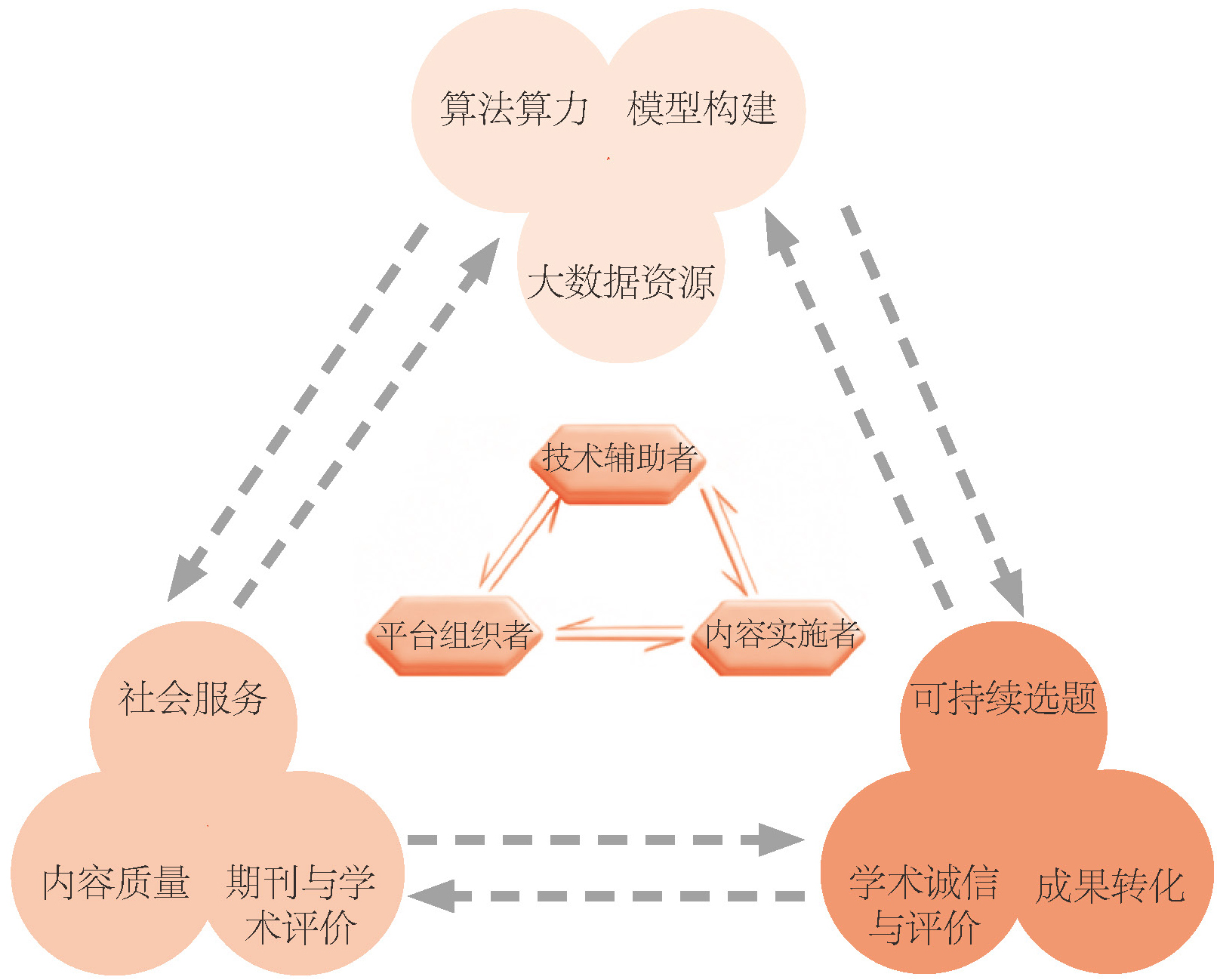
高水平学术平台建设是破解我国基础研究“两头在外”困局的重要手段之一。当前一流科技期刊建设背景下,我国英文科技期刊的迅猛发展为破解“两头在外”困局和促进高水平成果“回流”作出了贡献,但其体量有限,难以为基础研究提供全方位支撑。而人工智能(AI)技术的合理应用能够有效促进中文科技期刊与基础研究协同发展,并反哺技术的更新与迭代,助力中文科技期刊提质增效,有望为其参与破解“两头在外”困局注入新的动能。本文基于“技术辅助者—平台组织者—内容实施者”良性循环模型描绘AI赋能中文科技期刊与基础研究协同发展生态的应然愿景,并从技术、主体和系统层面剖析AI赋能中文科技期刊参与破解“两头在外”困局的实然困境,进而提出六个方面的使然策略:构建适配中文场景的科研数据库,夯实数据基础;分类筛选和评估适配中文科技期刊的AI工具,促进技术应用;明确AI技术应用边界与伦理审查机制,保障数据可信;探索AI赋能本土特色选题策划与双语传播机制,提升学术话语权;兼顾复合培养与专业细分,构建多元人才体系;充分发挥科技期刊社会服务功能,助力高端科学仪器建设。

关键词 AI中文科技期刊"两头在外"困局基础研究协同发展    
Abstract

The construction of high-level academic platforms is one of the key measures to resolve the “Two Ends Outside” situation in China’s basic research. Against the current background of developing world-class STM journals, the rapid development of China’s English-language STM journals has contributed to resolving the “Two Ends Outside” situation and promoting the reflow of high-level research achievements. However, their limited overall scale makes it difficult to provide comprehensive support for basic research. The rational application of artificial intelligence (AI) technology can effectively promote the coordinated development of Chinese-language STM journals and basic research, which in turn feeds back into the updating and iteration of the technology itself. It can also improve the quality and efficiency of Chinese-language STM journals, and is expected to inject new momentum for them to participate in resolving the “Two Ends Outside” situation. Based on the virtuous cycle model of “technology facilitator – platform organizer – content implementer”, this paper depicts the normative vision of the coordinated development ecosystem of AI-empowered Chinese-language STM journals and basic research. It analyzes the practical dilemmas of AI-empowered Chinese-language STM journals participating in resolving the “Two Ends Outside” situation from the technical, stakeholder, and systemic dimensions, and proposes enabling strategies from six aspects: building scientific research databases adapted to Chinese-language scenarios to consolidate the data foundation; conducting classified screening and evaluation of AI tools suitable for Chinese-language STM journals to promote technology application; clarifying the application boundaries of AI technology and establishing an ethical review mechanism to ensure data credibility; exploring AI-empowered topic planning with local characteristics and bilingual communication mechanisms to enhance academic discourse power; balancing interdisciplinary comprehensive training and professional specialization to build a diversified talent system; giving full play to the social service functions of scientific and technical journals to support the development of high-level scientific instruments.

Key wordsAI    Chinese-language STM journals    "Two Ends Outside"situation    basic research    collaborative development
出版日期: 2026-09-07
基金资助:2025年度中国科技期刊卓越行动计划高水平办刊人才培育项目—人才荟项目;2025年中国高校科技期刊研究会“师范·民族”期刊专项基金(CUJS-SFMZ-2025-C17);中国高校科技期刊研究会出版融合工作委员会2025年出版融合创新基金课题(CUJS2025-CBRH-012)
通讯作者: 杨玙   
Corresponding author: Yu YANG   

引用本文:

万倩芸,曾群,杨玙. AI赋能中文科技期刊参与破解“两头在外”困局的应然愿景、实然困境与使然策略[J]. 科技与出版, 2026, 45(7): 30-38.
WAN Qianyun,ZENG Qun,YANG Yu. AI-Empowered Chinese-Language STM Journals in Resolving the “Two Ends Outside” Situation: Normative Vision, Practical Dilemmas, and Enabling Strategies. Science-Technology & Publication, 2026, 45(7): 30-38.

链接本文:

http://kjycb.tsinghuajournals.com/CN/      或      http://kjycb.tsinghuajournals.com/CN/Y2026/V45/I7/30

图 1  AI赋能中文科技期刊与基础研究的关系图示
1 荣俊美, 陈强. 基础研究"两头在外"如何破局?[J]. 中国科技论坛, 2021 (11): 21- 30.
2 孙滔. 中国科学院院士席南华: 顶刊崇拜正在阻碍中国科研创新[N]. 中国科学报, 2025-09-25(1).
3 刘益东. 科研体系大转型:从国际论文挂帅到追求原始创新与科技自立自强:以基于国际顶刊论文数量的大学排名体系信誉崩塌为契机[J]. 关东学刊, 2024 (1): 46- 57.
4 元纯. "两头在外"的含义不容篡改![J]. 编辑学报, 2025, 37 (3): 354.
5 张建武. "两头在外"的基础研究之痛[J]. 科学新闻, 2010 (17): 57.
6 张建武. "两头在外"的基础研究之痛何时休[J]. 科学新闻, 2010 (21): 59.
7 张慕华. 回归自主办刊, 助力破解"两头在外":新时代科技期刊高质量发展路径探索[J]. 北京印刷学院学报, 2025, 33 (1): 19- 26.
8 夏丽云. 我国科技期刊参与破解"两头在外"问题义不容辞[J]. 编辑学报, 2025, 37 (2): 126- 130.
9 龚江宏, 李杨, 刘宇, 等. 从"两头在外"到"双回流":《先进陶瓷》(英文)的实践探索[J]. 编辑学报, 2025, 37 (1): 6- 11.
10 田瑞强, 岳晓旭, 杨代庆. 科技期刊参与破解"两头在外"问题的路径分析[J]. 编辑学报, 2026, 38 (1): 30- 34.
11 鲁烨. 科技期刊参与破解"两头在外"问题的角色定位与实践路径[J]. 出版广角, 2026 (1): 83- 89.
12 曾建勋. 大力推进政府资助成果在国内科技期刊发表[J]. 农业图书情报学报, 2025, 37 (8): 104- 105.
13 中国科协学会服务中心. 中国科技期刊发展蓝皮书(2025)[M]. 北京: 科学出版社, 2025.
14 夏浪, 陈敏, 赵蕾, 等. 中文医学期刊精准引导优质科研成果国内发表的探索与实践:以《中华消化外科杂志》为例[J]. 编辑学报, 2024, 36 (5): 577- 581.
15 徐艳, 蒋永忠, 邝文国, 等. 中文科技期刊吸引高水平英文论文回流的策略[J]. 编辑学报, 2023, 35 (S2): 77- 80.
16 马峥. AI数据令旗:科技学术期刊运行模式创新探索[J]. 编辑学报, 2025, 37 (4): 367- 373.
17 矫娆, 高茜, 黄福娟. 学术期刊数字化转型初探[J]. 记者摇篮, 2025 (6): 30- 32.
18 柳静怡. 农林高质量科技期刊论文网络传播效果评价研究[D]. 南京: 南京林业大学, 2023.
19 洪淳薇. 林学高被引学者中英文科技论文社会影响力对比研究[D]. 南京: 南京林业大学, 2025.
20 秦小燕, 王珏, 任娇菡, 等. 人工智能对科技期刊传播的影响机制与对策建议[J]. 中国科技期刊研究, 2025, 36 (4): 428- 438.
21 尤凯, 苏静艳, 洪瑞, 等. AI赋能高校科技期刊:新质生产力视角下的机遇和挑战[J]. 哈尔滨学院学报, 2025, 46 (1): 140- 144.
22 汪梓怡. 中国中医药学术期刊新媒体矩阵研究[D]. 郑州: 河南大学, 2024.
23 郝娇. "刊-会"协同助力高校综合性学报交叉学科出版:以《浙江大学学报(理学版)》为例[J]. 编辑学报, 2025, 37 (3): 305- 309.
24 焦丽珍. AIGC时代期刊编辑的数字素养:内涵审视、发展困境及实践路向[J]. 教育传媒研究, 2024 (3): 84- 89.
25 张莹, 吕平香. 我国培育世界一流科技期刊的探索及启示:以iMeta为例[J]. 传播与版权, 2024 (17): 16- 18.
26 邹小荣, 邹菁. 困境破解:高校中文科技期刊"稿荒"与"发文难"[J]. 湖北科技学院学报, 2020, 40 (6): 95- 97.
27 赵新科. 高校科技期刊在提升研究生培养质量中的作用[J]. 伊犁师范大学学报(自然科学版), 2022, 16 (3): 72- 76.
28 贾泽军. 基于AI邮件精准推送的科技期刊影响力提升实践与思考: 以《中国临床医学》为例[G]//刘志强, 张昕. 学报编辑论丛. 上海: 上海大学出版社, 2024: 633-637.
29 刘荣, 陈晓峰, 沈锡宾, 等. 科技期刊传播链中人工智能工具应用现状及传播特征演变[J]. 中国科技期刊研究, 2025, 36 (7): 844- 850.
30 闫东洁. 中国科学技术信息研究所举办第二届玉渊潭科研诚信会议[EB/OL].(2025-12-07)[2026-02-01]. https://tj.chinadaily.com.cn/a/202512/07/WS69357e71a310942cc499560a.html.
31 《人工智能应用伦理安全指引1.0》发布[EB/OL].(2026-05-22)[2026-05-22]. https://www.cac.gov.cn/2026-05/22/c_1781191242686496.htm.
32 Hong J , Tian Y , Liang T , et al. Imaging surface structure and premelting of ice Ih with atomic resolution[J]. Nature, 2024, 630 (8016): 375- 380.
doi: 10.1038/s41586-024-07427-8
33 何畅, 夏天. 由“精”到“尖”多项国产高端科学仪器“硬核成果”亮相[EB/OL].(2025-11-18)[2026-02-01]. https://content-static.cctvnews.cctv.com/snow-book/index.html?item_id=2971074199600354447.
34 Pradier C , Céspedes L , Larivière V . How multilingual is scholarly communication? Mapping the global distribution of languages in publications and citations[J]. Journal of the Association for Information Science and Technology, 2026, 77 (5): 699- 713.
doi: 10.1002/asi.70055
[1] 张辉洁,张彤,冉明会,胡小洋. 全球出版语种生态格局下中文科技期刊国际学术影响力发展特征及提升路径[J]. 科技与出版, 2026, 45(7): 18-29.
[2] 袁萱. AIGC重塑网络文学IP:从线性写作到循环生成工作流研究[J]. 科技与出版, 2026, 45(5): 121-132.
[3] 王婧,张芳英,吴领叶,刘志强,张铁明,张昕. 收官“十四五”:从“卓越计划”到“卓越生态”——2025年我国中文科技期刊发展盘点[J]. 科技与出版, 2026, 45(3): 68-81.
[4] 叶娟. 教育数字化背景下高校出版社融合出版模式研究[J]. 科技与出版, 2026, 45(3): 146-151.
[5] 王大可. AI辅助阅读对深度阅读能力的影响机制研究——基于认知路径重构视角的分析[J]. 科技与出版, 2026, 45(3): 152-160.
[6] 卢明嘉,陆贵曦,郝运. AI时代国际中文教育出版知识产权价值链构建:特性分析、逻辑解构与瓶颈突破[J]. 科技与出版, 2026, 45(1): 43-52.
[7] 丁靖佳,宋宁远. 生成式出版:内涵、外延与框架[J]. 科技与出版, 2026, 45(1): 112-120.
[8] 本刊编辑部. 从工具到伙伴:AI如何赋能期刊未来发展[J]. 科技与出版, 2025, 44(9): 47-51.
[9] 刘普,孙婉婷. 社科学术期刊的AI使用政策图谱与治理进阶——基于50家社科学术期刊生成式人工智能使用政策文本的分析[J]. 科技与出版, 2025, 44(9): 52-62.
[10] 郭璐琪,骆瑾,王昕. 中文科技期刊视频摘要传播效果及提升策略——以卓越计划二期项目中文单刊为例[J]. 科技与出版, 2025, 44(9): 79-86.
[11] 本刊编辑部. AI驱动下的学术创作范式重构——基于七位跨学科专家观点类编与深度述要[J]. 科技与出版, 2025, 44(8): 5-15.
[12] 吕晓峰,孟祥晴,詹洪春. 人工智能时代出版业知识服务的伦理挑战、价值重构与实践进路[J]. 科技与出版, 2025, 44(8): 47-55.
[13] 董慧娟,余非. AIGC可版权的必要非充分要件:“有限控制论”的证成与适用展开*[J]. 科技与出版, 2025, 44(8): 113-127.
[14] 尉鹏阳. 行业期刊与智库协同发展的路径研究[J]. 科技与出版, 2025, 44(8): 128-135.
[15] 张辉洁,刘世华,赵敬,冉明会,胡小洋. 全球SCIE期刊、高水平科技论文和年APC总量分布格局及其相互关系研究[J]. 科技与出版, 2025, 44(7): 81-93.