Please wait a minute...
科技与出版  2026, Vol. 45 Issue (7): 39-48    
特别策划·从“规模扩张”到“效能提升”:推动中国科技期刊国际传播新进阶
国际合作论文影响力视角下出版模式统筹策略:面向开放获取内循环的出版治理
陈昕伊1,2
1. 《电化学能源评论(英文)》编辑部,上海大学期刊社,200444,上海
2. 上海大学期刊发展研究中心,200444,上海
Coordination Strategies for Publishing Models from the Perspective of International Collaborative Paper Impact: Publishing Governance for the Internal Circulation of Open Access
CHEN Xinyi1,2
1. Editorial Office of Electrochemical Energy Reviews, Periodicals Agency of Shanghai University, 200444, Shanghai, China
2. Center for Journal Publishing Research, Shanghai University, 200444, Shanghai, China
全文: HTML    PDF(2297 KB)  
输出: BibTeX | EndNote (RIS)      
摘要: 

经费政策可调控金色开放获取论文处理费(OA APC)支出,但难以统筹管理各类出版模式;然而,在论文影响力维度可开展出版模式系统性比较分析。本文以2015—2024年Web of Science(WoS)数据库收录的中国论文为分析对象,采用Spearman秩相关、非参数检验等方法,探讨出版模式演变对国际合作论文的影响机制。结果表明,由于近年来国际出版结构调整,抬高了非OA录用门槛,我国国际合作优质资源向非OA模式集中,金色OA模式仅对我国次优国际合作资源发挥渠道兜底作用。最后,从出版模式统筹管理角度提出分阶段论文回流策略:打造国内免费钻石OA平台,吸引国内合作非OA论文回流以强化我国OA知识创新内循环效能;强化国际平台推广效能的监管,在学术影响力维度构建国际出版商的良性竞争机制;通过学术影响力补偿机制对冲论文回流风险。

关键词 开放获取金色OA国际科研合作学术话语权国际出版合作    
Abstract

Funding policies can regulate the expenditure of article processing charges (APC) for gold open access (gold OA) papers, but cannot coordinate the management of different publishing models. Publishing models can, however, be compared systematically along the dimension of paper impact. Based on the data of Chinese papers included in the Web of Science (WoS) database from 2015 to 2024, this paper adopts Spearman rank correlation and non-parametric Kruskal-Wallis test methods to explore the influence mechanism of publishing model evolution on international collaborative papers. Chinese SCI papers are categorized into four groups based on the two-dimensional framework of “collaboration type × publishing model”, namely international collaboration with gold OA, international collaboration with non-OA, domestic collaboration with gold OA, and domestic collaboration with non-OA. A three-year rolling-average smoothing procedure is applied to improve the robustness of the correlation analysis. The empirical results reveal significant differentiated correlation characteristics between collaboration types and the academic influence of Chinese SCI papers. To ease the tension between these factors and paper impact, it is essential to strengthen international collaboration and prioritize the publication of high-potential highly-cited papers in Q1 journals; improving the content quality of domestically collaborative papers can systematically optimize core academic indicators, while citation improvement strategies for non-collaborative papers from single domestic institutions require strict effectiveness verification. Further analysis shows that structural adjustments in international publishing in recent years have raised the acceptance threshold for non-OA papers, leading to the concentration of China’s high-quality international collaborative resources in the non-OA publishing model, while the gold OA publishing model only serves as a fallback channel for suboptimal international collaborative resources in China. Such adjustments have also driven the expansion of non-collaborative, non-OA papers in China, and have particularly intensified the outflow of domestically collaborative non-OA papers — which deliver higher academic influence than domestic gold OA papers — and restrained the growth of internationally collaborative non-OA papers with high category normalized citation impact (CNCI). Such structural changes have triggered the one-way closed outflow of high-level academic papers through non-OA channels. This not only endangers national high-level scientific and technological information security, but also weakens the internal circulation efficiency of China’s OA knowledge innovation, further exposing the structural dilemma of “high output with insufficient high-quality achievement” of Chinese SCI papers. Therefore’s indigenous gold OA publishing system urgently needs to be deeply embedded in the global open science ecosystem so as to enhance the systemic capacity of China’s high-level opening-up. Finally, phased paper backflow strategies are proposed from the perspective of overall management of publishing models: constructing a domestic free diamond OA platform to attract the backflow of domestic collaborative non-OA papers and strengthen the internal circulation efficiency of China’s OA knowledge innovation; strengthening public oversight of the promotional performance of international platforms so as to build a sound competition mechanism among international publishers in terms of academic impact; and hedging backflow risks through an academic influence compensation mechanism.

Key wordsopen access    gold OA    international scientific research collaboration    academic discourse power    international publishing collaboration
出版日期: 2026-09-07
基金资助:2025年度中国科技期刊卓越行动计划高水平办刊人才培育项目—人才荟项目

引用本文:

陈昕伊. 国际合作论文影响力视角下出版模式统筹策略:面向开放获取内循环的出版治理[J]. 科技与出版, 2026, 45(7): 39-48.
CHEN Xinyi. Coordination Strategies for Publishing Models from the Perspective of International Collaborative Paper Impact: Publishing Governance for the Internal Circulation of Open Access. Science-Technology & Publication, 2026, 45(7): 39-48.

链接本文:

http://kjycb.tsinghuajournals.com/CN/      或      http://kjycb.tsinghuajournals.com/CN/Y2026/V45/I7/39

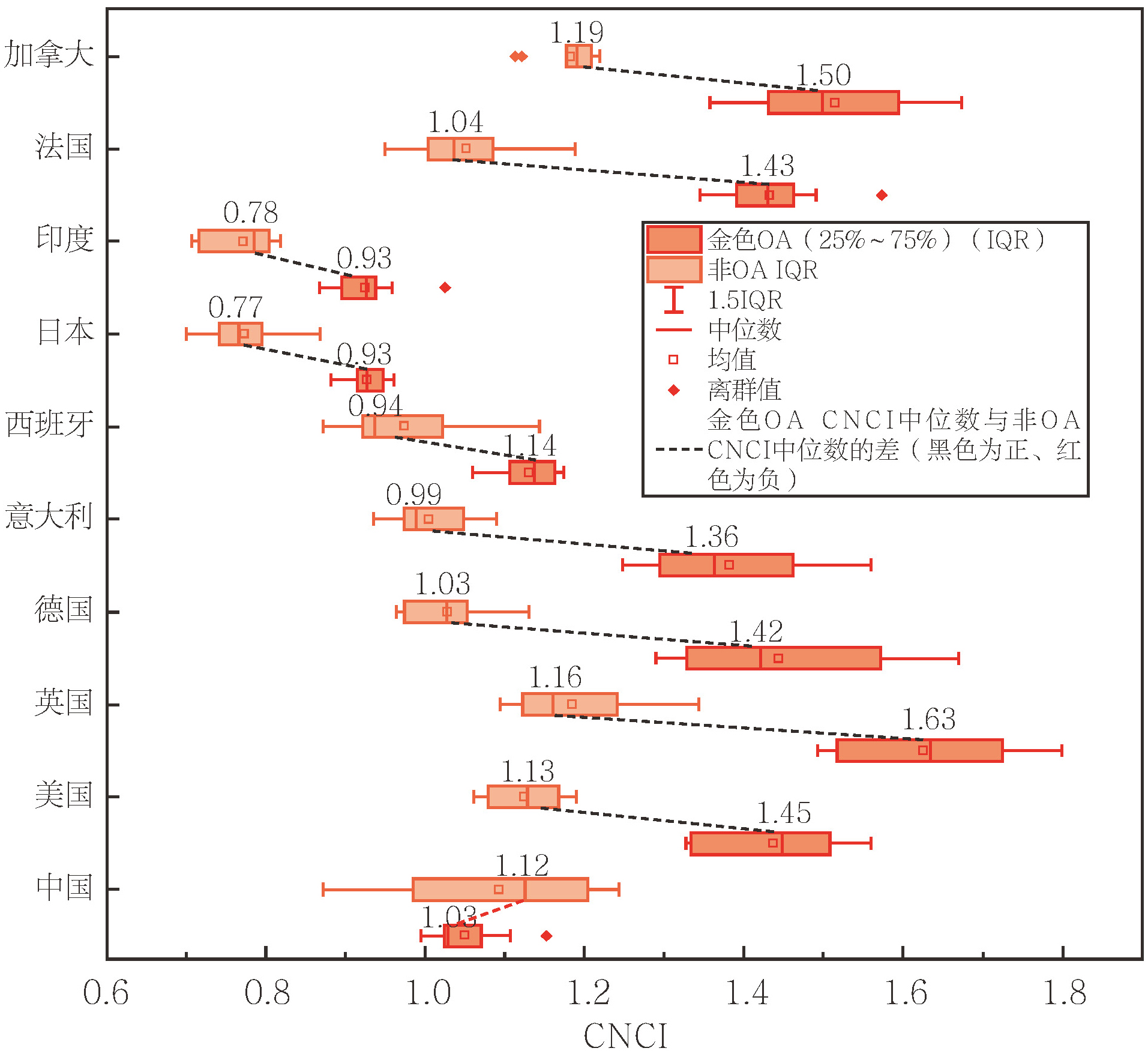
图 1  金色OA论文发文规模位列前10的国家/地区的金色OA论文CNCI与非OA论文CNCI的箱线图对比;标记了中位数值
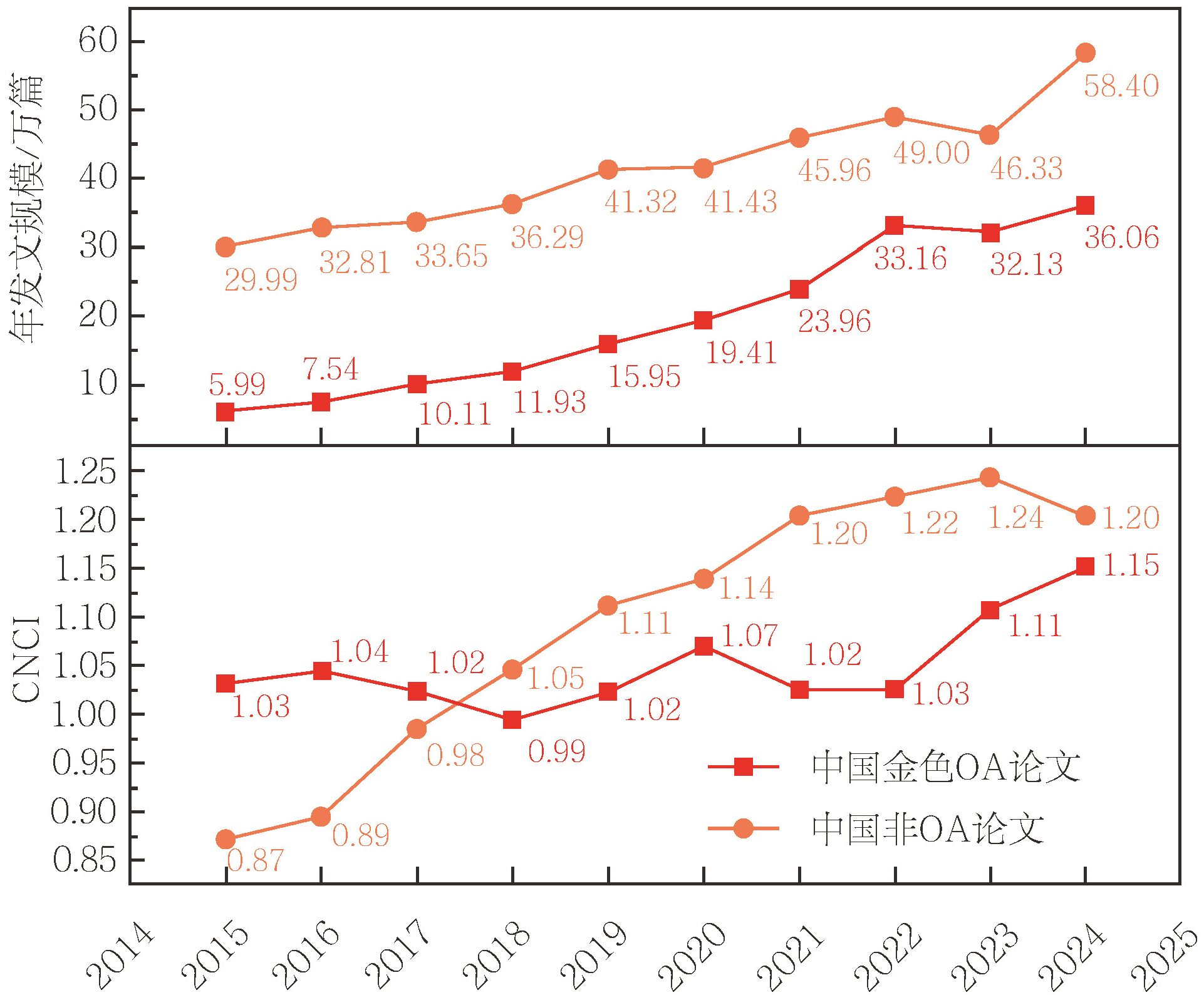
图 2  中国金色OA论文与非OA论文的年发文规模及CNCI走势
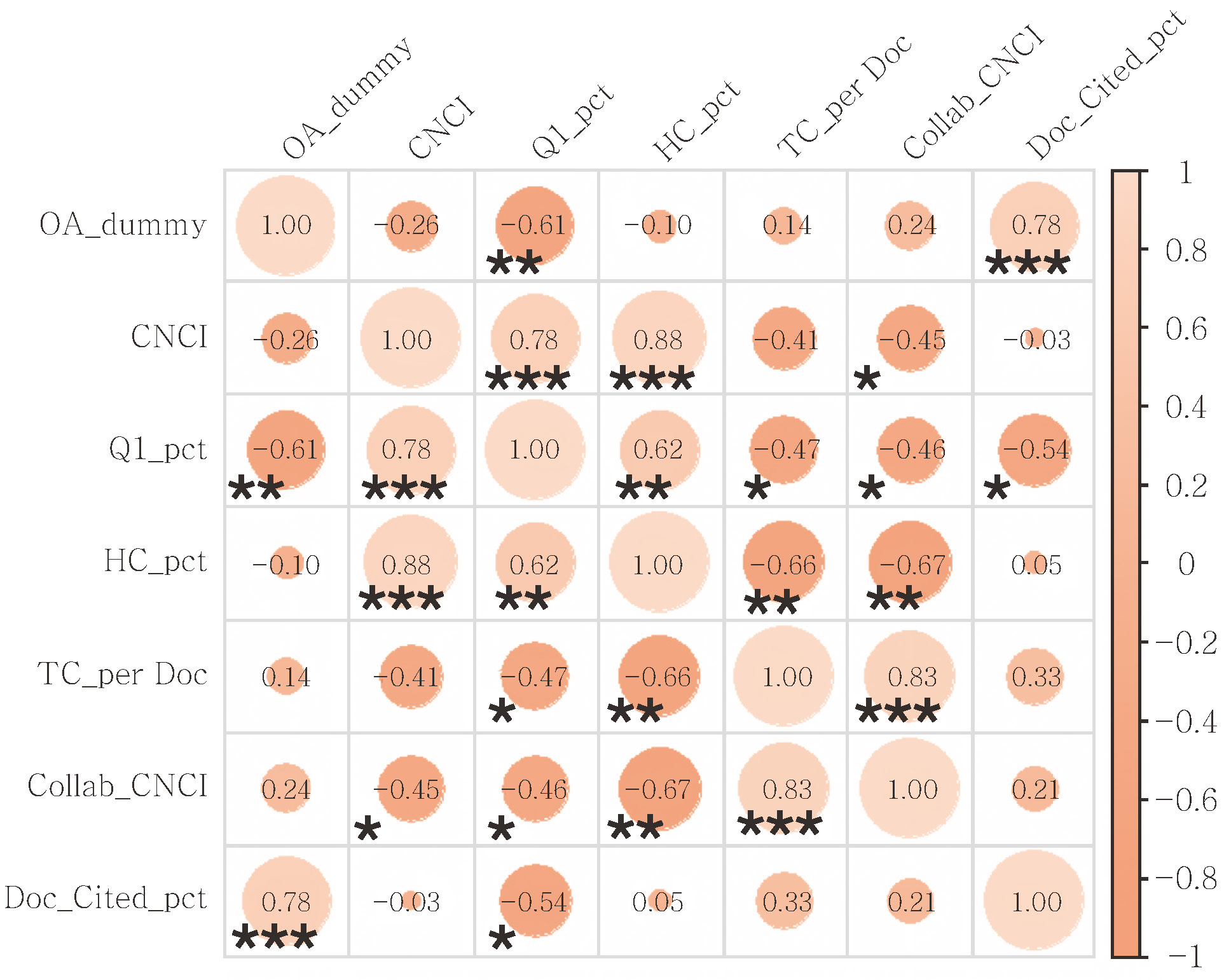
图 3  2015—2024年中国SCI论文CNCI相关因素的Spearman相关系数矩阵。圆圈面积和颜色表示相关系数绝对值大小
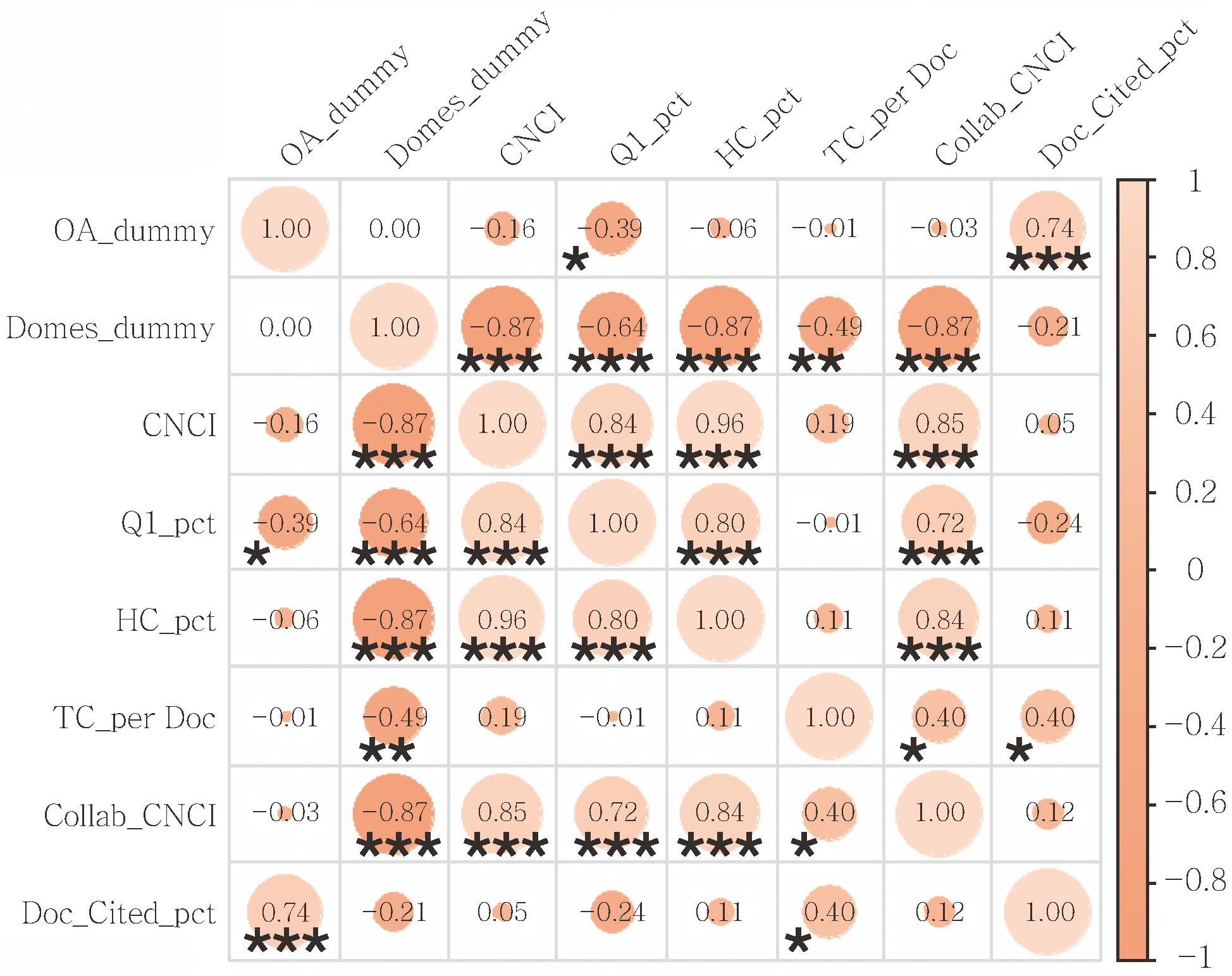
图 4  2015—2024年中国国内合作/国际合作SCI论文CNCI相关因素的Spearman相关系数矩阵。圆圈面积和颜色表示相关系数绝对值大小
图 5  箱线散点图:中国国内合作/国际合作SCI论文的(a)CNCI与(b)Collab-CNCI;中国SCI期刊国内合作/国际合作论文的(c)CNCI与(d)Collab-CNCI;标记了中位数值。散点1—10对应2015—2024年的年份序列
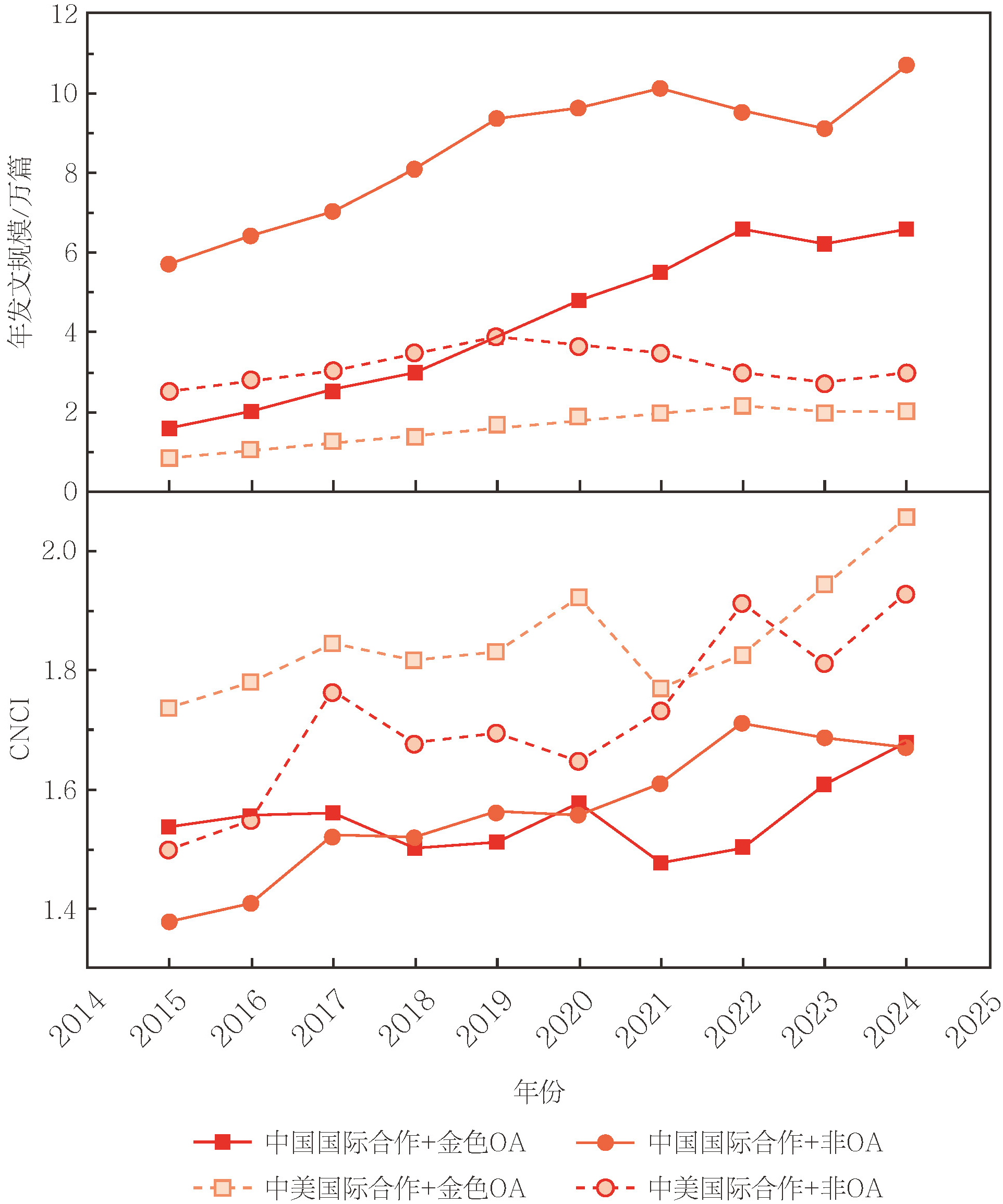
图 6  中国国际合作论文及中美合作论文在金色OA与非OA渠道的发文规模及CNCI趋势
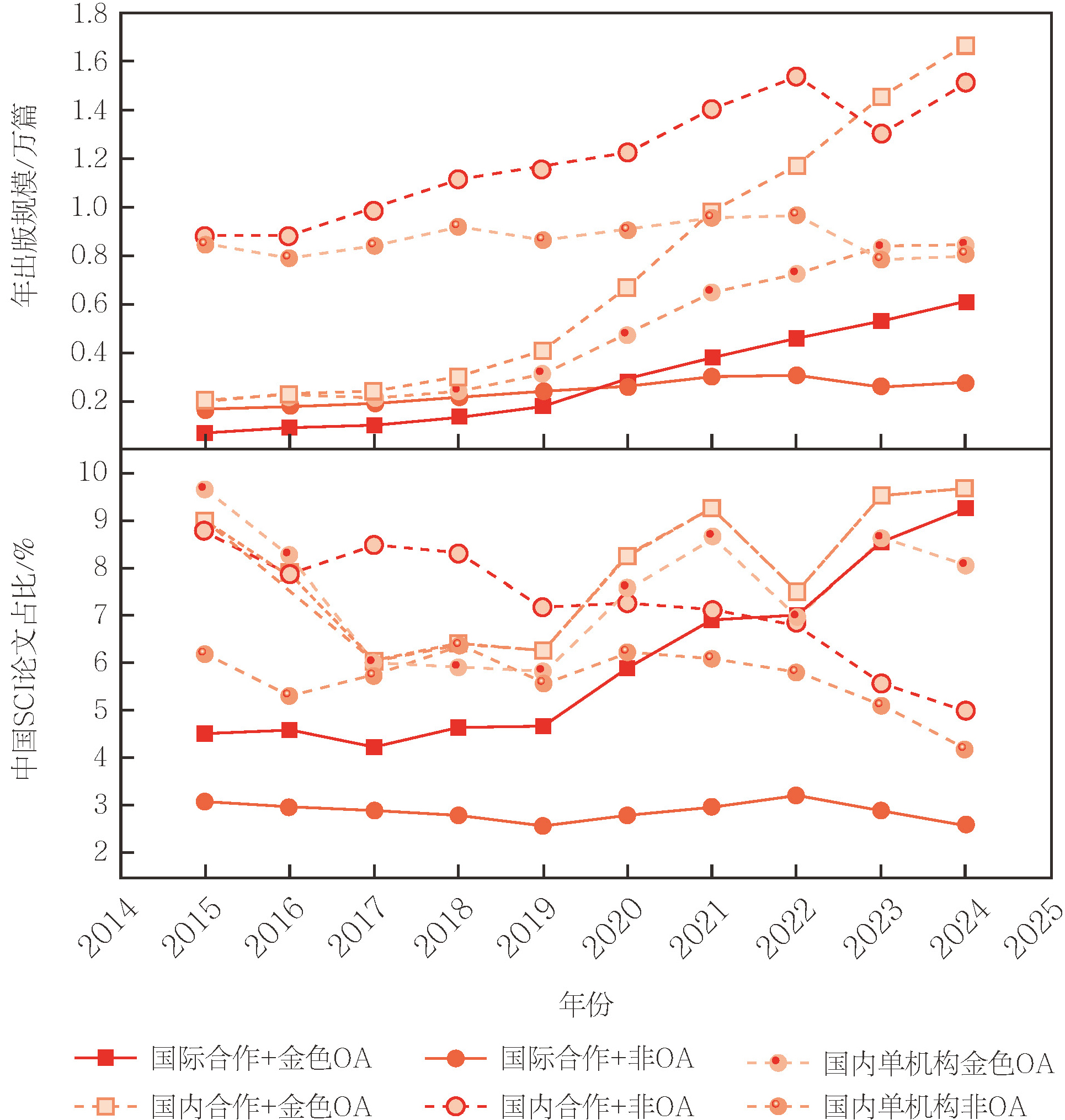
图 7  中国SCI期刊各出版场景的发文规模及对中国SCI论文占比趋势
表 1  2015—2024年,中国国际合作金色OA论文与非OA论文的CNCI与Collab-CNCI的Spearman相关系数
1 European Commission . Study on Scientific Publishing in Europe:Development, Diversity, and Transparency of Costs[M]. Luxembourg: Publications Office of the European Union, 2024.
2 刘萍萍. 混合期刊中开放获取论文的引用优势研究:以生物医学工程方向期刊为例[J]. 中国科技期刊研究, 2023, 34 (3): 383- 391.
3 刘佳雨, 虞为, 陈俊鹏. 基于OA及免费全文链接的期刊影响力指数优势[J]. 中国科技期刊研究, 2020, 31 (3): 356- 364.
4 周玥, 金文苑, 李春丽. 不同类型开放获取论文的引用优势分析:以食品类英文期刊为例[J]. 科技传播, 2024, 16 (16): 84- 88.
5 Bj?rk B C , Welling P , Laakso M , et al. Open access to the scientific journal literature:Situation 2009[J]. PLoS One, 2010, 5 (6): e11273.
doi: 10.1371/journal.pone.0011273
6 Davis P M , Lewenstein B V , Simon D H , et al. Open access publishing, article downloads, and citations:A randomised controlled trial[J]. BMJ, 2008, 337, a568.
doi: 10.1136/bmj.a568
7 Eysenbach G . Citation advantage of open access articles[J]. PLoS Biology, 2006, 4 (5): e157.
doi: 10.1371/journal.pbio.0040157
8 Piwowar H , Priem J , Larivière V , et al. The state of OA:A large-scale analysis of the prevalence and impact of Open Access articles[J]. PeerJ, 2018, 6, e4375.
doi: 10.7717/peerj.4375
9 Dorta-González P , Dorta-González M I . The influence of funding on the open access citation advantage[J]. Journal of Scientometric Research, 2023, 12 (1): 68- 78.
doi: 10.5530/jscires.12.1.010
10 Plume A . Open-access publishing:Citation advantage is unproven[J]. Nature, 2024, 626 (7999): 480.
11 Langham-Putrow A , Bakker C , Riegelman A . Is the open access citation advantage real? A systematic review of the citation of open access and subscription-based articles[J]. PLoS One, 2021, 16 (6): e0253129.
doi: 10.1371/journal.pone.0253129
12 中国科学技术协会, 国际科学、技术与医学商协会. 中国开放获取出版发展报告2022[EB/OL].(2022-12-14)[2025-09-20]. https://www.cast.org.cn/cms_files/filemanager/583933374/attach/20235/17c3bb51f66b45e5a204402d6cd73026.pdf.
13 李广利, 白雪, 张美琦. 中国金色OA论文现状分析:基于Web of Science数据[J]. 农业图书情报学报, 2020, 32 (1): 40- 46.
14 陈铭. 国际科技期刊论文开放获取现状比较研究[J]. 数字图书馆论坛, 2022, 18 (7): 33- 42.
15 Nguyen T V , Ho-Le T P , Le U V . International collaboration in scientific research in Vietnam:An analysis of patterns and impact[J]. Scientometrics, 2017, 110 (2): 1035- 1051.
doi: 10.1007/s11192-016-2201-1
16 杨宪暇, 刘新靓, 何佳欣, 等. 全球卫生领域国际合作论文与学术影响力的关系研究:以中国全球健康大学联盟高校为例[J]. 中国卫生政策研究, 2025, 18 (2): 76- 83.
17 彭正霞. 基于InCites的高校国际合作论文分析:以西部某高校为例[J]. 高等教育评论, 2019 (1): 146- 158.
18 夏蓓丽. 国外开放存取发展中的政府介入行为分析与借鉴[J]. 图书情报知识, 2015, 32 (5): 110- 120.
19 徐丽芳, 邹青, 周伊, 等. 在博弈中迈向开放科学: 2022年海外科技期刊出版与数据出版盘点[J]. 科技与出版, 2023 (3): 36- 49.
20 National Institutes of Health. 2024 NIH Public Access Policy[EB/OL].(2024-12-17)[2025-06-11]. https://grants.nih.gov/grants/guide/notice-files/NOT-OD-25-047.html.
21 Zhang L , Wei Y , Huang Y , et al. Should open access lead to closed research? The trends towards paying to perform research[J]. Scientometrics, 2022, 127 (12): 7653- 7679.
doi: 10.1007/s11192-022-04407-5
22 Ronda-Pupo G A . Global ties in science:A scientometric approach to international collaboration dependence[J]. Scientometrics, 2025, 130 (7): 3903- 3928.
doi: 10.1007/s11192-025-05363-6
23 Adams J . The fourth age of research[J]. Nature, 2013, 497 (7451): 557- 560.
doi: 10.1038/497557a
24 Clarivate. InCites[DB/OL].(2026-02-28)[2026-03-27]. https://incites.clarivate.com/.
25 Clarivate Web of Science Help. Open Access[EB/OL].[2024-09-24]. https://webofscience.help.clarivate.com/en-us/Content/open-access.html.
26 Clarivate InCites Help Center. Collaboration Analysis[EB/OL].[2025-09-24]. https://incites.zendesk.com/hc/en-gb/articles/32405722942481-Collaboration-Analysis.
27 Tukey J W . Exploratory Data Analysis[M]. New York: Pearson, 1977.
28 Springer Nature. 开放获取完全手册[EB/OL].[2026-01-26]. https://app.jingsocial.com/mF/cms/pdfPreview/8t6Mw3uLeKYTZ8rsAZoD7m/none/8t6Mw3uLeKYTZ8rsAZoD7m/JPDmJNfWeMCvW3XyM8jkuZ.
29 Springer Nature. Open Access Fees and Funding[EB/OL].[2026-01-26]. https://www.nature.com/ncomms/open-access.
30 Springer Nature. 在施普林格·自然发表OA文章能为你带来什么?[EB/OL].(2022-08-30)[2026-01-28]. https://mp.weixin.qq.com/s/AAK15rGTS2gh-4mbqMgbGQ.
31 Wagner C S , Jonkers K . Open countries have strong science[J]. Nature, 2017, 550 (7674): 32- 33.
doi: 10.1038/550032a
32 翟琰琦, 杨立英, 孙粒, 等. 基于WoS论文的科学基金学科发展态势分析(2013-2022年)[J]. 中国科学基金, 2025, 39 (4): 600- 614.
33 陈昕伊. 我国国际合作论文规模与结构的变化趋势[J]. 编辑学报, 2025 (2): 146- 151.
[1] 戴王娟,陈汐敏. 国际传播需求下中文医学期刊官网规范性建设研究——基于国内外综合性医学期刊的调查[J]. 科技与出版, 2026, 45(7): 95-109.
[2] 杨杨,李海英. 从地方性知识到全球话语:我国中医药国际学术传播的路径与方法探析——以《中医药文化(英文版)》办刊实践为例[J]. 科技与出版, 2026, 45(7): 120-130.
[3] 贺思,陈红兵,王景周,贺嫁姿. 高APC限制:政策动因剖析与协同治理路径探索[J]. 科技与出版, 2026, 45(4): 43-51.
[4] 郁林羲,郑羽彤. 全球钻石开放获取可持续发展路径比较与启示[J]. 科技与出版, 2026, 45(1): 93-102.
[5] 徐丽芳,罗婷,田峥峥,张蒂. 技术驱动的开放与可信出版:2024年海外科技期刊出版动态研究[J]. 科技与出版, 2025, 44(3): 35-54.
[6] 崔丽媛,朱亚鑫,曲波. 政策工具视角下法国钻石开放获取政策文本分析及其启示[J]. 科技与出版, 2025, 44(12): 75-84.
[7] 顾立平,陆彩女. 国际主要学术出版集团出版生态变迁及启示[J]. 科技与出版, 2025, 44(11): 37-49.
[8] 孟平,陈佳男. 作者与出版方共生视角下的开放获取期刊版权管理研究[J]. 科技与出版, 2025, 44(1): 140-148.
[9] 卫夏雯,祝叶华,刘晶晶,王丽娜,徐丽娇,傅雪,王微. 开放科学背景下科技期刊出版与传播模式探析*[J]. 科技与出版, 2024, 43(9): 78-84.
[10] 杨淑娇,辛瑞瑞,洪汀,唐浏英,刘谦,孙宇. 开放获取背景下我国科技期刊公益平台版权运营路径探析*[J]. 科技与出版, 2024, 43(8): 21-26.
[11] 徐丽芳,周伊,罗婷,田峥峥. 理念革新与技术驱动:2023年海外科技期刊出版的挑战与新思路*[J]. 科技与出版, 2024, 43(3): 33-45.
[12] 任胜利,丁佐奇,宁笔,陈哲. 2023年我国英文科技期刊发展回顾[J]. 科技与出版, 2024, 43(3): 46-54.
[13] 刘萍萍,尹欢. 开放获取对提升我国SCI科技期刊影响力的作用研究*[J]. 科技与出版, 2023, 42(9): 106-113.
[14] 蔡忠伟. 国家政策驱动下的日本开放获取实践进展[J]. 科技与出版, 2023, 42(9): 97-106.
[15] 徐丽芳, 邹青, 周伊, 罗婷, 田峥峥. 在博弈中迈向开放科学:2022年海外科技期刊出版与数据出版盘点*[J]. 科技与出版, 2023, 42(3): 36-49.