Please wait a minute...
科技与出版  2026, Vol. 45 Issue (6): 97-105    
编辑实务
被“格式化”的身份:我国英文期刊汉字署名现状与优化路径
陈辰1,余党会2,马瀚青3,4,魏莎莎2,*
1. 东南大学期刊中心, 210009, 南京
2. 海军军医大学教研保障中心出版社《海军军医大学学报》编辑部, 200433, 上海
3. 中国科学院西北生态环境资源研究院, 730000, 兰州
4. 甘肃省知识计算与决策智能重点实验室, 730000, 兰州
'Formatted' Identities: Current Status and Optimization of Chinese-Character Author Names in China's English-Language Journals
CHEN Chen1,YU Danghui2,MA Hanqing3,4,WEI Shasha2,*
1. Journal Center, Southeast University, 210009, Nanjing, China
2. Editorial Office, Journal of Naval Medical University, Naval Medical University, 200433, Shanghai, China
3. Northwest Institute of Eco-Environment and Resources, Chinese Academy of Sciences, 730000, Lanzhou, China
4. Key Laboratory of Knowledge Computing and Intelligent Decision-Making, 730000, Lanzhou, China
全文: HTML    PDF(2013 KB)  
输出: BibTeX | EndNote (RIS)      
摘要: 

在国际学术出版体系中,中国学者的姓名长期被拼音“格式化”,导致严重的身份识别混淆与文化标识弱化问题。为了解这一问题,本研究以56种“中国科技期刊卓越行动计划”英文领军期刊为样本,从政策、出版、传播3个维度对汉字署名现状进行了实证研究。研究发现,我国卓越英文领军期刊已有32.1%出台了支持性政策,但实际落地率不足4%,且汉字元数据在国际主流引文数据库中仍无法被直接检索。因此,本研究建议,期刊编辑部应主动完善汉字署名服务流程,出版机构应强化底层技术支撑以打破跨平台传输壁垒,行业层面应给予评价与政策引导。通过多方协同,打通汉字署名从政策制定到精准可检索的全链条,从而提升中国学者的国际辨识度与中华文化彰显力。

关键词 汉字署名英文期刊作者标识学术传播文化自信    
Abstract

The phenomenon of "identity formatting", where Chinese scholars' names in Chinese characters are romanized into Pinyin, has led to dual predicaments of confusion in identity recognition and the weakening of cultural identifiers. This study selected 56 leading English-language journals included in the Excellence Action Plan as research objects and constructed a three-dimensional analytical framework of "policy-publishing-dissemination". Through methods such as official website information collection, journal article review, and multi-platform retrieval verification, this study systematically explored the current development status and practical characteristics of "author names in Chinese characters" in China's English-language scientific and technological journals, and proposed targeted optimization paths. The findings revealed that only 18 out of the 56 sample journals, accounting for 32.1%, have issued supportive policies related to "author names in Chinese characters". The policy descriptions are highly dependent on the templates provided by publishing institutions, with low levels of independent customization by the journals themselves. Among the journals where policies have been adopted, although the proportion of articles by Chinese authors in the 18 policy-supportive journals is generally high, indicating a strong potential demand for "author names in Chinese characters", only 2 journals actually presented such signatures, resulting in a policy implementation rate of less than 4%. In the dimension of dissemination effectiveness, while most current publisher platforms support Chinese character retrieval, major international citation databases such as Web of Science, Scopus, and PubMed still cannot directly retrieve metadata with "author names in Chinese characters". Overall, the application of "author names in Chinese characters" in China's leading English-language journals is currently in a stage characterized by "policy support, low implementation in publishing, and existing barriers in dissemination", accompanied by such problems as unbalanced policy implementation and practical application, insufficient refinement of the author identity identification system, and prominent cross-platform technical constraints. In response to these issues, this study proposes optimization paths from three perspectives: journal editorial offices need to raise their service awareness, integrate "author names in Chinese characters" into the entire publishing process; publishing institutions should strengthen underlying technical support, standardize the encapsulation of metadata for "author names in Chinese characters" in accordance with the international JATS data standard; and industry competent authorities need to play a guiding role, incorporate the implementation of "author names in Chinese characters" into the evaluation indicators for journal service capabilities. This study points out that breaking the predicament of Pinyin "formatting" for Chinese scholars' names is not merely a technical issue, but a broader challenge tied to academic concepts and cultural confidence. The promotion of Chinese-character author names will effectively enhance the international recognizability of Chinese scholars' academic identities, strengthen their cultural identifiers, and restore a true, complete and culturally resonant academic portrait for Chinese scholars. At the same time, it will help China's English-language scientific and technological journals improve their author service capabilities and international influence, and demonstrate Chinese cultural confidence on the international academic publishing stage.

Key wordsChinese character author names    English-language journals    author identification    scholarly communication    cultural confidence
出版日期: 2026-07-14
基金资助:中国科技期刊卓越行动计划高水平办刊人才培育项目“科技期刊办刊人才青编荟活动”(E52392XZPZ);江苏省科技期刊学会·TrendMD期刊学术传播基金项目“从‘传播’到‘对话’:科技期刊科学普及的公众参与模式研究”(JSKJQK-TM-2025-024)
通讯作者: 魏莎莎   
Corresponding author: Shasha WEI   

引用本文:

陈辰,余党会,马瀚青,魏莎莎. 被“格式化”的身份:我国英文期刊汉字署名现状与优化路径[J]. 科技与出版, 2026, 45(6): 97-105.
CHEN Chen,YU Danghui,MA Hanqing,WEI Shasha. 'Formatted' Identities: Current Status and Optimization of Chinese-Character Author Names in China's English-Language Journals. Science-Technology & Publication, 2026, 45(6): 97-105.

链接本文:

http://kjycb.tsinghuajournals.com/CN/      或      http://kjycb.tsinghuajournals.com/CN/Y2026/V45/I6/97

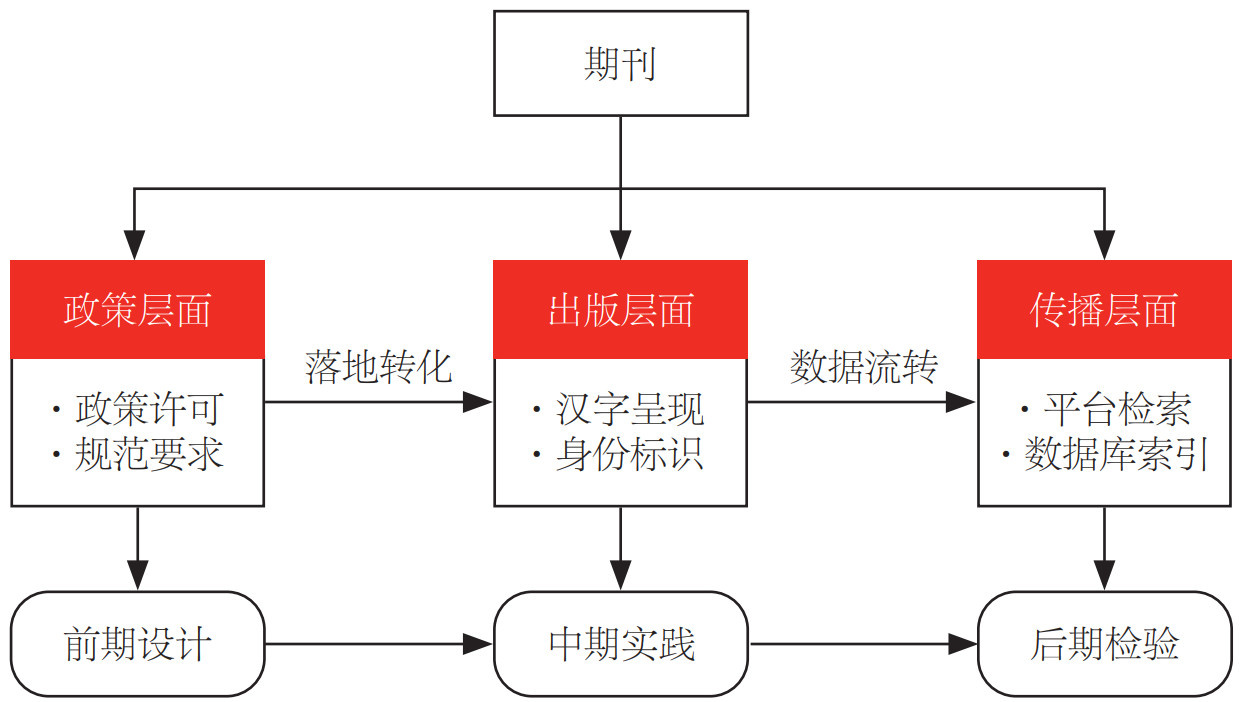
图 1  “政策—出版—传播”三维分析框架
表 1  研究对象基本情况
表 2  “非拉丁字母署名”政策文本模式分类
表 3  18本期刊抽样刊期中中国作者发文、汉字署名情况及ORCID标识信息统计
图 2  汉字署名呈现示例(来自《基因组蛋白质组与生物信息学报(英文)》)
1 胡倩, 申钰棋. 江苏科大"首席科学家"郭伟的假面人生[EB/OL]. (2025-11-25)[2026-02-02]. https://baijiahao.baidu.com/s?id=1849722653183269401&wfr=spider&for=pc.
2 黄卓航. 跨文化传播视域下的汉字传播: 以中文署名为例[J]. 今古文创, 2022 (42): 126- 128.
3 郑琳, 黄国彬. 科研人员唯一标识符的理论研究现状剖析[J]. 图书馆建设, 2015 (11): 25- 30.
4 胡大伟, 蒋涛. 优先出版网络首发与XML云排版的应用实践: 以科技期刊《病毒学报》为例[J]. 采写编, 2024 (11): 106- 108.
5 康宏宇, 李姣, 侯震, 等. 基于JATS标准的医学期刊电子资源格式处理与转化[J]. 中国科技期刊研究, 2018, 29 (8): 822- 827.
6 Li C , Shenvi R A . Total synthesis of 25 picrotoxanes by virtual library selection[J]. Nature, 2025, 638 (8052): 980- 986.
doi: 10.1038/s41586-024-08538-y
7 马勇, 芮海田, 王磊, 等. 全方位传播助力科技期刊学术影响力提升[J]. 科技与出版, 2023 (9): 56- 61.
8 杨涵, 庄红权. 基于新质生产力视阈的数字出版科技创新体系完善: 问题与路径[J]. 科技与出版, 2024 (12): 69- 75.
9 任胜利, 丁佐奇, 宁笔, 等. 2023年我国英文科技期刊发展回顾[J]. 科技与出版, 2024 (3): 46- 54.
10 王雅娇, 路佳, 柯晓静. 学术画像在科技期刊中的应用研究[J]. 中国编辑, 2021 (4): 45- 49.
[1] 郁林羲,周雷. 基于ResearchGate的学术社交平台传播机制及其生态影响研究[J]. 科技与出版, 2026, 45(6): 150-160.
[2] 刘娟,李建军. 文明互鉴背景下学术期刊讲好“一带一路”故事的多维分析——基于话语建构的审思[J]. 科技与出版, 2025, 44(7): 36-44.
[3] 易耀森. 人工智能生成内容应用出版伦理政策现状分析与完善建议——以我国160种医学期刊为例[J]. 科技与出版, 2025, 44(10): 82-93.
[4] 刘杨,齐豫. 美美何以与共:中原文化典籍域外出版实践进路探索[J]. 科技与出版, 2025, 44(10): 142-150.
[5] 游迎亚,李爱群,宋菲菲. 学术传播秩序变革下体育学术期刊的形象危机与重塑路径[J]. 科技与出版, 2025, 44(10): 132-141.
[6] 张人天. 马克思主义理论期刊助推文化自信自强的逻辑理路*[J]. 科技与出版, 2023, 42(9): 114-120.
[7] 高希中. 新时代中国历史学的主要特征及实践成就*[J]. 科技与出版, 2023, 42(11): 48-60.
[8] 宋启凡,段鹏丽. 英文学术期刊提升国际影响力和传播力的路径探索*[J]. 科技与出版, 2022, 41(4): 71-78.
[9] 李海英. 根植本土,向世界讲好中国故事*[J]. 科技与出版, 2021, 40(3): 134-139.
[10] 史创新. 文化自信视域下编辑人才核心素养提升研究[J]. 科技与出版, 2021, 40(11): 123-126.
[11] 章诚. 学术期刊微信公众平台运营现状及提升策略*[J]. 科技与出版, 2020, 39(8): 73-78.
[12] 张萌. 阅读的世界,世界的阅读[J]. 科技与出版, 2020, 39(7): 39-42.
[13] 谢清风. 文化自信理论下出版“走出去”的高质量推进[J]. 科技与出版, 2020, 39(5): 13-19.
[14] 沈丹,张福颖. 创新思想供给1[J]. 科技与出版, 2020, 39(5): 108-115.
[15] 丛挺,赵婷婷. 基于微信公众号的学术期刊移动化传播研究*[J]. 科技与出版, 2019, 38(7): 80-85.