Please wait a minute...
科技与出版  2026, Vol. 45 Issue (10): 23-34    
产业观察
赓续与赋能:党的文献编辑出版实践逻辑、内在机理及其当代价值的实证研究
黎珂含1,韩顺法1,张昕2,*
1. 南京师范大学新闻与传播学院,210097,南京
2. 中国高校科技期刊研究会,100083
Continuity and Empowerment: The Practical Logic, Mechanisms, and Contemporary Value of Editing and Publishing CPC Documents
LI Kehan1,HAN Shunfa1,ZHANG Xin2,*
1. School of Journalism and Communication, Nanjing Normal University, 210097, Nanjing, China
2. Society of China University Journals, 100083, Beijing, China
全文: HTML    PDF(2077 KB)  
输出: BibTeX | EndNote (RIS)      
摘要: 

中国共产党文献编纂实践积累了丰富的编辑方法论经验,也是观察中国特色马克思主义出版观实践形态的重要样本。本文以2026年1月为检索截止时间,从132篇文献中提取1777条有效业务案例,借鉴Meta分析的系统整合逻辑,围绕文献征集与选稿、史实核实与考订、文稿整理与编辑、注释与副文本建构、审稿与版本管理五个核心环节进行结构化归并与跨案例比较。研究发现,这一实践形成的不只是稳定的业务方法,还有政治把关、工匠精神、知识生产与组织制度四者相互作用的机理:政治要求经专业程序转化为具体判断,证据核验既保障文本准确又推动认识深化,这些判断与经验再经制度化沉淀为组织能力。其当代价值不在于复制特定历史条件下的具体规则,而在于使这一实践机制在新的技术与业务环境中获得新的实现形式。

关键词 : 党的文献,  编辑出版,  方法论迁移,  马克思主义出版观    
Abstract:

The Communist Party of China (CPC) has compiled, edited, and published CPC documents for more than a century, accumulating rich methodological experience and providing an empirical basis for examining how the Marxist view of publishing with Chinese characteristics is put into practice. Existing scholarship has focused mainly on theoretical principles or individual compilation projects, leaving limited cross-case explanation of how macro-level principles are translated into concrete editorial judgments, professional norms, and organizational mechanisms. The study draws on the systematic integration logic associated with meta-analysis to organize retrieval, evidence extraction, cross-study comparison, and interpretive synthesis, without calculating or pooling effect sizes. Using January 2026 as the search cutoff, 132 publications were included after screening. Each was read closely, and every independently identifiable editing and publishing practice was extracted as a structured record of source, stage, case description, and distilled principle. After data checking and removal of exact duplicates, 1,777 valid cases remained. Of these, 1,391 (78.28%) fell into five core stages: document collection and selection, verification and critical examination of historical facts, text preparation and editing, annotation and paratext construction, and manuscript review and edition management. The remaining 386 cases, concerning organizational management, dissemination, and social benefits, were retained as other related practices rather than forced into the five-stage framework. The distilled principles were iteratively merged into 119 methodological codes; key or disputed facts were cross-checked against multiple sources; and a Sankey diagram linked source publication period, editorial stage, and high-frequency codes. Review and edition management (504 cases, 28.36%) and text preparation and editing (407 cases, 22.90%) were the most densely documented stages. Eighteen high-frequency codes covered 59.20% of cases, while 101 low-frequency codes formed a long tail associated with specific document types and tasks. “Seeking truth from facts” was the most frequent code (179). "Political gatekeeping" appeared explicitly only 40 times, but the analysis suggests a broader role because related requirements also appeared through guiding ideology, author approval, and organizational safeguards. Across the cases, a stable practical logic emerged: archival and oral evidence were cross-validated; selection balanced political and historical criteria; facts required multi-source corroboration; editorial intervention was differentiated by document type and constrained by fidelity to original intent; annotations supplied historical context while avoiding unsupported judgments; and multilevel review extended into cautious revision across editions. At a deeper level, political gatekeeping, craftsmanship, knowledge production, and institutional arrangements interacted rather than operating separately. Political requirements were translated into concrete judgments through professional procedures; a craft ethos of precision, truth-seeking, and credibility supported textual accuracy, while sustained evidentiary scrutiny helped deepen understanding and could generate new knowledge; and institutional arrangements converted tested judgments and experience into shared organizational capacity through norms, procedures, and training. The contemporary value of this experience lies not in reproducing historically specific rules, but in allowing these mechanisms to take new forms in digital and intelligent publishing, where editors must retain responsibility for judgment, verify the sources underlying machine-generated content, integrate editing with research, and clarify the boundaries of human–machine responsibility.

Key words: CPC documents    editing and publishing    methodological transfer    Marxist view of publishing with Chinese characteristics
出版日期: 2026-11-17
通讯作者: 张昕   
Corresponding author: Xin ZHANG   

引用本文:

黎珂含,韩顺法,张昕. 赓续与赋能:党的文献编辑出版实践逻辑、内在机理及其当代价值的实证研究[J]. 科技与出版, 2026, 45(10): 23-34.
LI Kehan,HAN Shunfa,ZHANG Xin. Continuity and Empowerment: The Practical Logic, Mechanisms, and Contemporary Value of Editing and Publishing CPC Documents. Science-Technology & Publication, 2026, 45(10): 23-34.

链接本文:

http://kjycb.tsinghuajournals.com/CN/      或      http://kjycb.tsinghuajournals.com/CN/Y2026/V45/I10/23

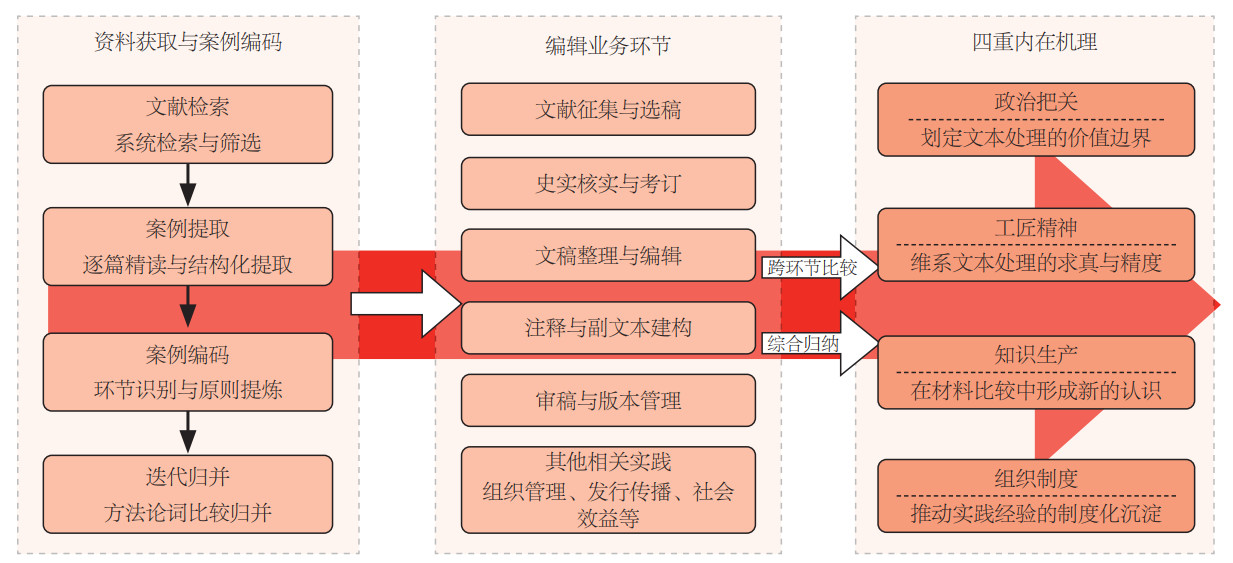
图 1  研究流程与分析框架
表 1  文献案例提取示例
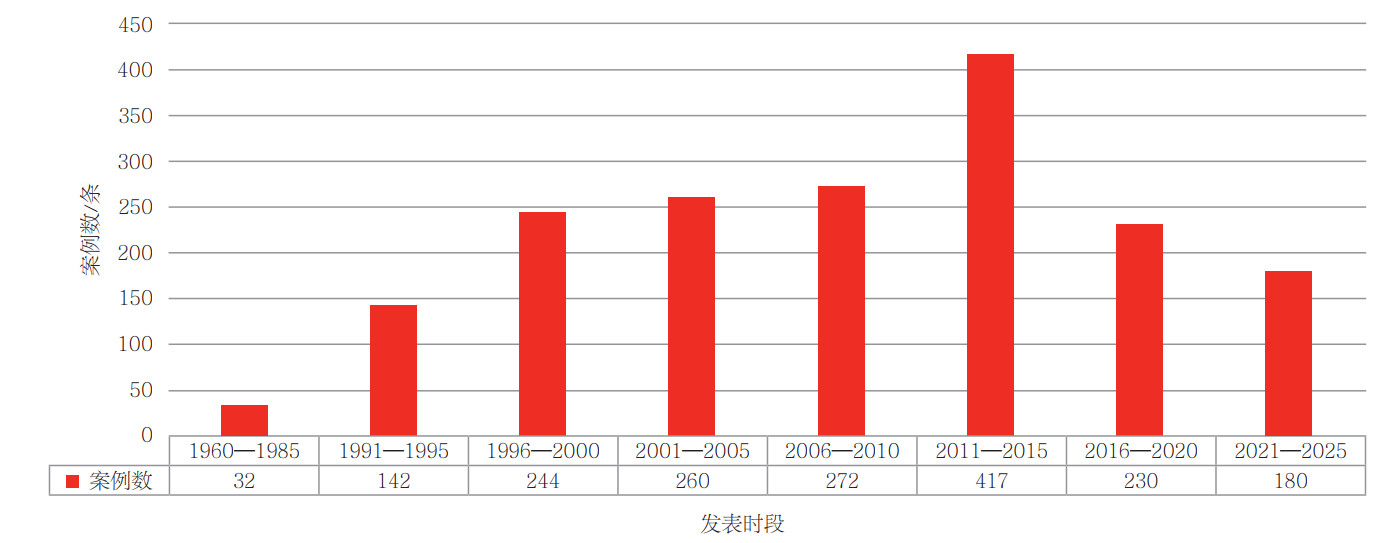
图 2  来源文献发表时段对应案例分布(N=1777)
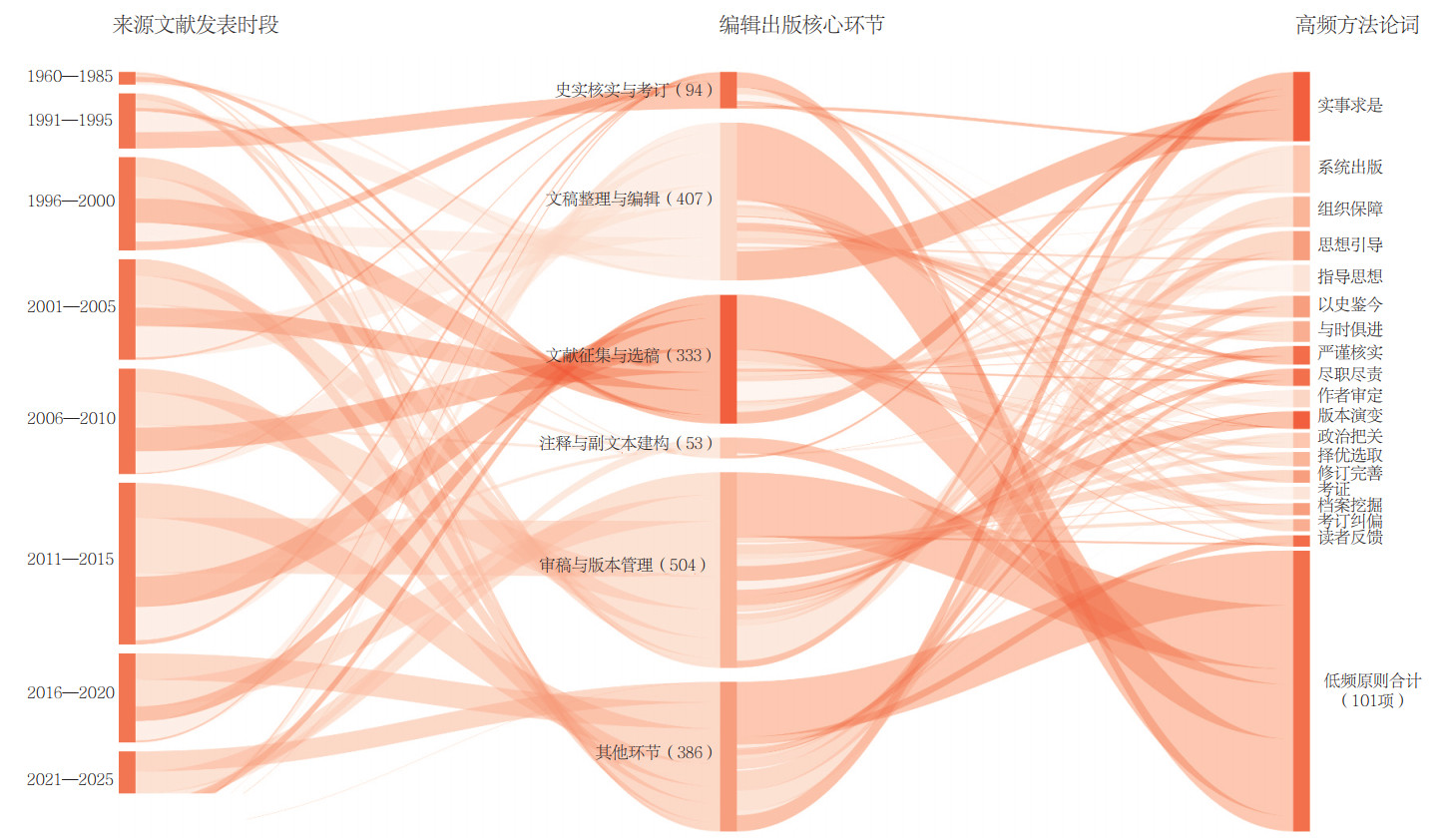
图 3  “来源文献发表时段—编辑环节—高频方法论词”桑基图(N=1777)
注:图中“2021—2025”时段的180条案例实际均来自2021—2024年发表的纳入文献。
表  党的文献编辑出版核心环节与方法论词对应表
1 冯蕙. 《毛泽东文集》编辑记事[J]. 党的文献, 2002 (1): 76- 85.
2 王炎龙. 马克思主义出版观的演进发展研究[J]. 编辑之友, 2021 (6): 26- 33.
3 王广义, 王可研. 马克思主义出版观中国化时代化的生成机理、丰富内涵及实践进路[J]. 科技与出版, 2023 (6): 9- 21.
doi: 10.16510/j.cnki.kjycb.20230620.001
4 杨石华. 吸纳与嵌入: 马克思主义出版观与主题出版的协同发展[J]. 科技与出版, 2024 (1): 39- 45.
doi: 10.16510/j.cnki.kjycb.20240010.005
5 高晓虹, 涂凌波, 李泓江. 面向中国式现代化的出版学自主知识体系建构[J]. 出版发行研究, 2024 (5): 5- 9.
6 海兵. 编“党书”的学问: 访党的文献编辑研究专家杨胜群研究员[J]. 思想政治工作研究, 2024 (5): 42- 45.
7 唐洲雁, 曹前发, 单劲松. 关于《毛泽东选集》四卷文稿的考辨[J]. 党的文献, 2013 (5): 108- 115.
8 魏芬. 改革开放以来党的文献编辑研究的创新发展[C]//新中国60年研究文集(3). 中央文献研究室办公厅, 2009: 693-704.
9 于慧哲. 《建国以来刘少奇文稿》出版座谈会综述[J]. 党的文献, 2005 (4): 102- 104.
10 熊坤静. 《毛泽东选集》编辑出版始末[J]. 党史文苑, 2013 (19): 37- 42.
11 王玉强. 《论共产党员的修养》校勘和研究[J]. 党的文献, 2016 (1): 64- 69.
12 张曙. 邓小平的晚年岁月[J]. 党史博采, 2024 (12): 4- 9.
13 张懋学, 万安伦. 马克思主义出版观研究的历史进程、热点主题与逻辑进路[J]. 中国编辑, 2025 (11): 34- 40.
14 张养志. 出版博士要学习和研究马克思主义出版观的方法论[J]. 河南大学学报(社会科学版), 2025, 65 (4): 125-130, 156.
15 张霜, 宋波. Meta分析应用中应注意的几个关键问题[J]. 生物多样性, 2026, 34 (1): 36- 46.
16 Borenstein M , Hedges L V , Higgins J P T , et al. Introduction to Meta-Analysis[M]. New York: John Wiley & Sons, 2021.
17 齐涵悦, 杨颜僖, 林泽斐. 融合图尔敏模型与大语言模型的社会科学循证知识库构建方法[J]. 数字图书馆论坛, 2025, 21 (10): 1- 11.
18 《陈云年谱》的特点和撰写方法概述[J]. 党的文献, 2000(4): 81-86.
19 中共组织史资料中央编纂领导小组. 卷帙浩繁鉴往知来: 中共组织史资料编纂出版述实[J]. 中共党史研究, 2001 (2): 42- 46.
20 冯蕙. 《毛泽东年谱》(中卷)若干问题的辨析与补记(之一)[J]. 党的文献, 1995 (1): 93- 96.
21 李锐. 一项具有重要意义的浩大工程: 写在《中国共产党组织史资料》(中央卷)出版之前[J]. 中共党史研究, 1996 (5): 78- 84.
22 冯蕙. 参加毛泽东著作编辑工作的一些体会[J]. 党的文献, 2000 (3): 67- 70.
23 潘荣庭. 文稿整理的一些原则[J]. 党的文献, 2000 (2): 91- 93.
24 王永华. 《邓小平文选》是如何编辑出版的?[J]. 党史纵览, 2011 (10): 42- 44.
25 王梦奎. 陈云指导文选编辑工作二三事[J]. 中共党史研究, 2015 (6): 24- 29.
26 张曙. 邓小平亲自指导编辑《邓小平文选》第三卷[J]. 党史博采(纪实), 2014 (19): 10- 13.
27 逄先知. 永远怀念胡乔木同志[J]. 党的文献, 1994 (3): 9-12, 58.
28 关于《中国共产党历史资料》丛书编纂和出版工作的几项规定[J]. 福建党史通讯, 1985(6): 2-3.
29 王仿子. 出版委员会与《毛泽东选集》[J]. 党的文献, 1996 (3): 65-67, 49.
30 张养志. 毛泽东开启了马克思主义出版观的中国化[J]. 科技与出版, 2023 (2): 125- 144.
doi: 10.16510/j.cnki.kjycb.2023.02.007
31 张神根. 《中国共产党的九十年》的编写出版及重大意义[J]. 北京党史, 2017 (1): 49- 52.
32 张建华. 《毛泽东选集》出版往事[J]. 党史博览, 2012 (7): 4- 8.
33 陈标. 《中央宣传部宣传要点—苏德战争形势和反对亲日派反苏反共阴谋》成文时间考[J]. 党的文献, 1995 (3): 92.
34 卢洁. 一部反映毛泽东思想科学体系和基本内容的大型理论工具书: 《毛泽东著作专题摘编》编辑情况介绍[J]. 党的文献, 2004 (4): 90- 95.
35 胡毅. 党史上第一部公开出版的中央文件集: 《中国共产党五年来之政治主张》[J]. 百年潮, 2023 (9): 56- 61.
36 于友先. 乔木同志对新中国出版事业的贡献[J]. 当代中国史研究, 2000 (1): 14- 15.
[1] 王嘉昀,朱文清,姚俊峰. 出版深度融合发展研究的方法论体系构建研究[J]. 科技与出版, 2026, 45(8): 120-130.
[2] 李玖倩,李爱群. 数智赋能科技期刊编辑出版变革的应用场景与技术反思[J]. 科技与出版, 2025, 44(8): 38-46.
[3] 李杨,郭岳寒,林芝,龚华靖. 基于专业价值认同视角的编辑出版学专业人才培养路径探析[J]. 科技与出版, 2025, 44(2): 70-79.
[4] 徐小明,董燕萍. 2019—2023年编辑出版类期刊论文基金资助情况调查[J]. 科技与出版, 2025, 44(2): 125-136.
[5] 张新新,陈少志. 加快建设数字出版三大体系,切实推动数字出版理论创新——数字出版“十四五”学术热点分析与“十五五”重要议题展望[J]. 科技与出版, 2025, 44(1): 61-76.
[6] 李雅筝,刘洪权. AIGC技术赋能高校编辑出版人才培养:转型机遇、能力重构与实践策略*[J]. 科技与出版, 2024, 43(2): 52-57.
[7] 张养志,王娟熔,马莺子. 理论自信是当代出版人情怀培育的关键*[J]. 科技与出版, 2024, 43(12): 94-103.
[8] 郑保卫,郑权. 学习借鉴马克思主义新闻观研究经验促进马克思主义出版观研究理论创新*[J]. 科技与出版, 2024, 43(1): 6-17.
[9] 许洁,周娴. 马克思主义出版观视域下的出版学自主知识体系建设[J]. 科技与出版, 2024, 43(1): 28-38.
[10] 杨石华. 吸纳与嵌入:马克思主义出版观与主题出版的协同发展*[J]. 科技与出版, 2024, 43(1): 39-45.
[11] 张养志. 中国化时代化马克思主义出版观形成的理论逻辑与实践逻辑[J]. 科技与出版, 2024, 43(1): 46-58.
[12] 王广义, 王可研. 马克思主义出版观中国化时代化的生成机理、丰富内涵及实践进路*[J]. 科技与出版, 2023, 42(6): 9-21.
[13] 钟学丽,苏鹏. 列宁的马克思主义出版观及其当代启示[J]. 科技与出版, 2023, 42(5): 137-144.
[14] 张养志. 开展马克思主义出版观教育是新时代文化强国建设的本质要求[J]. 科技与出版, 2023, 42(4): 107-117.
[15] 任胜利, 杨洁, 宁笔, 陈哲, 马峥. 2022年我国英文科技期刊发展回顾[J]. 科技与出版, 2023, 42(3): 50-57.