Please wait a minute...
科技与出版  2025, Vol. 44 Issue (1): 89-100    
融媒之光
超越“融合之困”:数智技术赋能儿童出版的现实困境、生发逻辑及其矫治之道
邱乾,张森
中国政法大学光明新闻传播学院,100088,北京
Beyond the "Dilemma of Integration": Digital Dilemma, Generative Logic and Corrective Measures of Digital Intelligence Technologies Empowering Children's Publishing
QIU Qian,ZHANG Sen
Guangming School of Journalism and Communication, China University of Political Science and Law, 100088, Beijing, China
全文: HTML    PDF(1681 KB)  
输出: BibTeX | EndNote (RIS)      
摘要: 

数智技术的迭代升级愈渐成为儿童出版变革的重要引擎,其展现出的生产“可供性”使儿童“数智”出版呼之欲出。但不能否认的是,数智技术嵌入儿童出版实践后仍然存在着部分不能贴合实践需要的情况,具体表现为数字工具泛滥、本土性匮乏、交互性设计缺失、分级标准不一,以及儿童隐私数据泄露等。锚定解决儿童出版数字化转型过程中遭遇的困境,需要对出版组织采纳和扩散新技术的内在机理予以关注。本文从“技术—组织”双向互动的角度出发,认为数智技术过度嵌入导致出版目标偏离、传统组织结构阻碍技术优势发挥、技术化约性与阅读情境复杂性间的张力、技术快速更迭与制度调整惰性间的张力是数字“困境”生成的深层原因。对此,需要有效协同数智技术与儿童出版组织之间的关系,勘正出版组织价值目标、优化组织架构、加强组织制度适配性,趋向技术嵌入与组织调试双向融合、共同演进的共轭状态。

关键词 儿童出版数字出版数智技术技术组织互构    
Abstract

With the rapid evolution of a new round of scientific and technological revolution and industrial transformation, digital technologies represented by big data, cloud computing and artificial intelligence have developed rapidly and begun to be widely used in the publishing industry, showing strong publishing affordance. As one of key sectors within the entire publishing industry, children's publishing has actively participated in the construction of digital publishing systems and digital publishing service capabilities, continuously strengthened the digital thinking of publishing entities, and expanded more efficient technical tools, thus laying a solid foundation for building a Chinese style modernization of children's publishing. However, it is undeniable that once embedded into children's publishing practices, digital intelligence technologies partially fail to meet practical needs, and the problems include repetitive digital construction, low utilization rate of various platforms, and poor content quality. Moverover, children's digital books lack localization and rely heavily on Western cultural resources, further exacerbating issues of homogeneity and superficiality of content production. Children's digital books also lack integration, struggling to establish smooth connection between print media and other forms of media, and lack design to mobilize children's multiple sensory systems. Additionally, for children's digital books, there are inconsistencies in classification standards and imbalances in classification resources, as well as concerns regarding the potential infringement of children's privacy, etc. The root cause of the aforementioned challenges is that digital technology does not work in a vacuum, but is deeply embedded in a specific social context, and influenced and constrained by endogenous factors such as the goals, structure and system of publishing organizations. From the theoretical perspective of "technology-organization" dual interaction, this paper argues that the excessive embedding of digital technology leads to the deviation from publishing goals, the traditional organization structures hinder the effective leverage of technological advantages, the tension between technological reducibility and the complexity of reading situations, and the tension between rapid technological evolution and institutional inertia are the deep reasons for the generation of digital dilemmas. The challenges encountered by children's publishing cannot be reduced to simple technical problems, but should be understood in terms of how technology, organizations and organizational actors can well interact. To address these challenges, it is necessary to effectively coordinate the relationship between digital technology and children's publishing organizations, and gradually optimize them from the aspects of organizational goals, structures, subjects and systems. Specifically, publishing organizations should first realign the value goals of children's digital publishing, guiding technology to a more human-centered dimension. On this basis, clarify the types of action subjects, clarify the relationship between subjects, and build a "publishing community". Moreover, absorb comprehensive talents with diverse backgrounds and compound skills, such as professionals with knowledge in multiple fields such as editing and technology. Additionally, we will strengthen top-level system construction, improve management systems and operational processes that are compatible with industry rules, ensure the regular and standardized development of children's digital publishing business, and promote the healthy and orderly development of the entire industry.

Key wordschildren's publishing    digital publishing    digital intelligence technology    technology—organization interaction
出版日期: 2025-03-12
基金资助:中国政法大学新兴学科培育与建设计划政治传播学(22ZFXXXK02)

引用本文:

邱乾,张森. 超越“融合之困”:数智技术赋能儿童出版的现实困境、生发逻辑及其矫治之道[J]. 科技与出版, 2025, 44(1): 89-100.
QIU Qian,ZHANG Sen. Beyond the "Dilemma of Integration": Digital Dilemma, Generative Logic and Corrective Measures of Digital Intelligence Technologies Empowering Children's Publishing. Science-Technology & Publication, 2025, 44(1): 89-100.

链接本文:

http://kjycb.tsinghuajournals.com/CN/      或      http://kjycb.tsinghuajournals.com/CN/Y2025/V44/I1/89

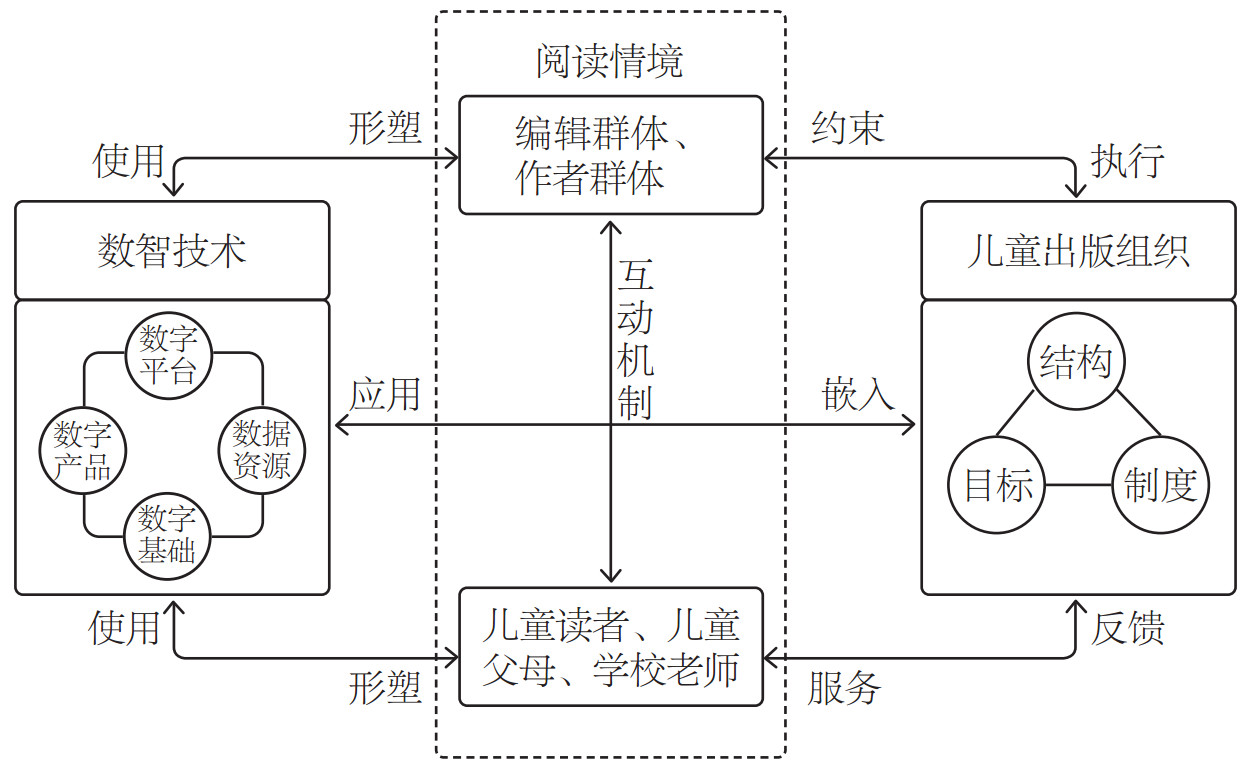
图 1  数智技术与出版组织互动分析框架
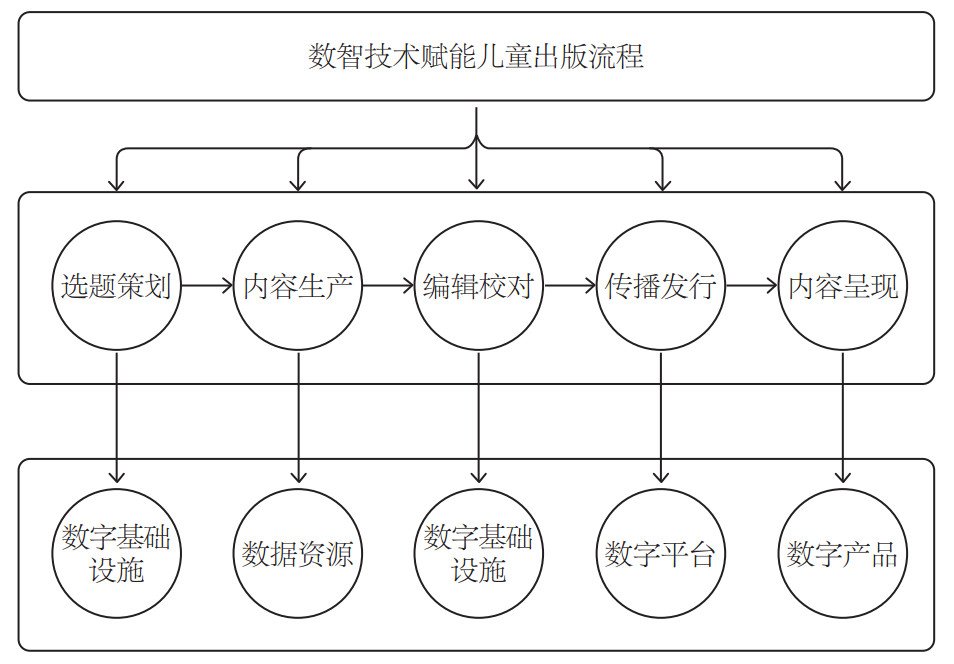
图 2  数智技术赋能儿童出版流程图
表 1  KaDa阅读App不同年龄阶段阅读榜单
1 关于推动出版深度融合发展的实施意见[EB/OL].(2022-04-24)[2024-10-05]. https://www.nppa.gov.cn/xxfb/tzgs/202204/t20220424_666332.html.
2 牛文斌, 郑铁男. 儿童经典读物的出版融合实践:以长尾巴月读社阅读盒子为例[J]. 出版广角, 2023 (16): 55- 59.
3 阮征. 5G时代童书出版的应对策略:基于儿童阅读的新变化[J]. 出版广角, 2020 (9): 9- 11.
4 李小华, 周嘉琪. 技术可供性视角下儿童科普图书多媒介文本建构及其功能[J]. 中国出版, 2022 (16): 45- 50.
5 万安伦, 徐沁心, 郝园. 传播游戏理论视域下红色经典童书出版[J]. 中国出版, 2023 (7): 42- 46.
6 池仁勇, 阮鸿鹏, 王昀. 数字出版产业持续创新能力及提升路径[J]. 中国出版, 2019 (12): 28- 31.
7 王波伟. 拥抱“儿童性”:基于人本取向中国原创绘本的价值共创机制及路径[J]. 编辑之友, 2023 (6): 27- 33.
8 邱泽奇. 技术与组织的互构:以信息技术在制造企业的应用为例[J]. 社会学研究, 2005 (2): 32- 54.
9 理查德·斯科特,杰拉尔德·戴维斯. 组织理论:理性、自然与开放系统的视角[M]. 高俊山,译. 北京:中国人民大学出版社,2011:37.
10 潘忠党, 刘于思. 以何为“新”?“新媒体”话语中的权力陷阱与研究者的理论自省:潘忠党教授访谈录[J]. 新闻与传播评论, 2017 (1): 2- 19.
11 尼尔·波斯曼. 技术垄断:文化向技术投降[M]. 何道宽,译. 北京:北京大学出版社,2007:33.
12 尤尔根·哈贝马斯. 理论与实践[M]. 郭官义,李黎,译. 北京:社会科学文献出版社,2010:273.
[1] 张新新,陈少志. 加快建设数字出版三大体系,切实推动数字出版理论创新——数字出版“十四五”学术热点分析与“十五五”重要议题展望[J]. 科技与出版, 2025, 44(1): 61-76.
[2] 马文欢,王梓薇,黄超兰. AIGC影响数字出版产业链韧性机制模型研究*[J]. 科技与出版, 2024, 43(9): 54-62.
[3] 傅爱雯,王跃,邵波. 数字出版融合生态:体系构建与业务组织[J]. 科技与出版, 2024, 43(9): 63-70.
[4] 宋吉述,杨阳. 2023—2024年出版业融合发展现状及趋势研判[J]. 科技与出版, 2024, 43(6): 26-37.
[5] 戚天姣,吴怡频. 英美知名出版企业数字化发展策略*[J]. 科技与出版, 2024, 43(5): 76-83.
[6] 张立,王扬,李梦竹,孙晓翠. 对近年来数字出版评优产品的追踪测评及分析(Ⅵ)[J]. 科技与出版, 2024, 43(4): 48-63.
[7] 揭其涛,王奕诺. 玫瑰荆棘:生成式AI赋能数字出版内容生产的逻辑、机遇与隐忧[J]. 科技与出版, 2024, 43(4): 64-70.
[8] 李子星,张新新,李佰珏. 数字出版十大学术热点分析*[J]. 科技与出版, 2024, 43(4): 99-111.
[9] 王飚,毛文思. 2023年中国数字出版发展态势盘点及2024年发展展望[J]. 科技与出版, 2024, 43(3): 14-25.
[10] 徐丽芳,周伊,罗婷,田峥峥. 理念革新与技术驱动:2023年海外科技期刊出版的挑战与新思路*[J]. 科技与出版, 2024, 43(3): 33-45.
[11] 任胜利,丁佐奇,宁笔,陈哲. 2023年我国英文科技期刊发展回顾[J]. 科技与出版, 2024, 43(3): 46-54.
[12] 杨涵,庄红权. 基于新质生产力视阈的数字出版科技创新体系完善:问题与路径*[J]. 科技与出版, 2024, 43(12): 69-75.
[13] 张立,王扬,李梦竹,张其濛,李丹青,孙晓翠. 对近年来数字出版评优产品的追踪测评及分析(Ⅶ)[J]. 科技与出版, 2024, 43(10): 36-50.
[14] 张新新,周晨. 数字出版智库治理:本体功能、现状梳理与路径优化*[J]. 科技与出版, 2023, 42(8): 20-32.
[15] 范雨竹,周安平. 数字传播时代有声读物出版的现状、问题与发展*[J]. 科技与出版, 2023, 42(8): 42-48.